
Building the 99 Days of Peace Through Unity Living Curriculum
Choose Peace. Live Peace. End War.
A Participatory Pathway of Physical, Emotional, Mental, and Spiritual Transformation
Beloved Friends,
Today, I want to invite us into a very practical and sacred task. The **99 Days of Peace Through Unity Ceremony-Choice Peace. Live Peace. End War **is a Ceremony, a Prayer, not only a message.
It is destined to become a living curriculum of transformation that will guide our** Planetary Ceremony until we End War.**
This curriculum is not something that one person, one office, one organization, or one tradition can create alone. It must be built through a participatory process that draws on the wisdom, experience, prayer, service, and lived knowledge of many people.
Each person carries a flame. Each community carries a teaching. Each Nation carries a memory. Each spiritual tradition carries a sacred gift. When these are brought together with humility, they become a shared fire.
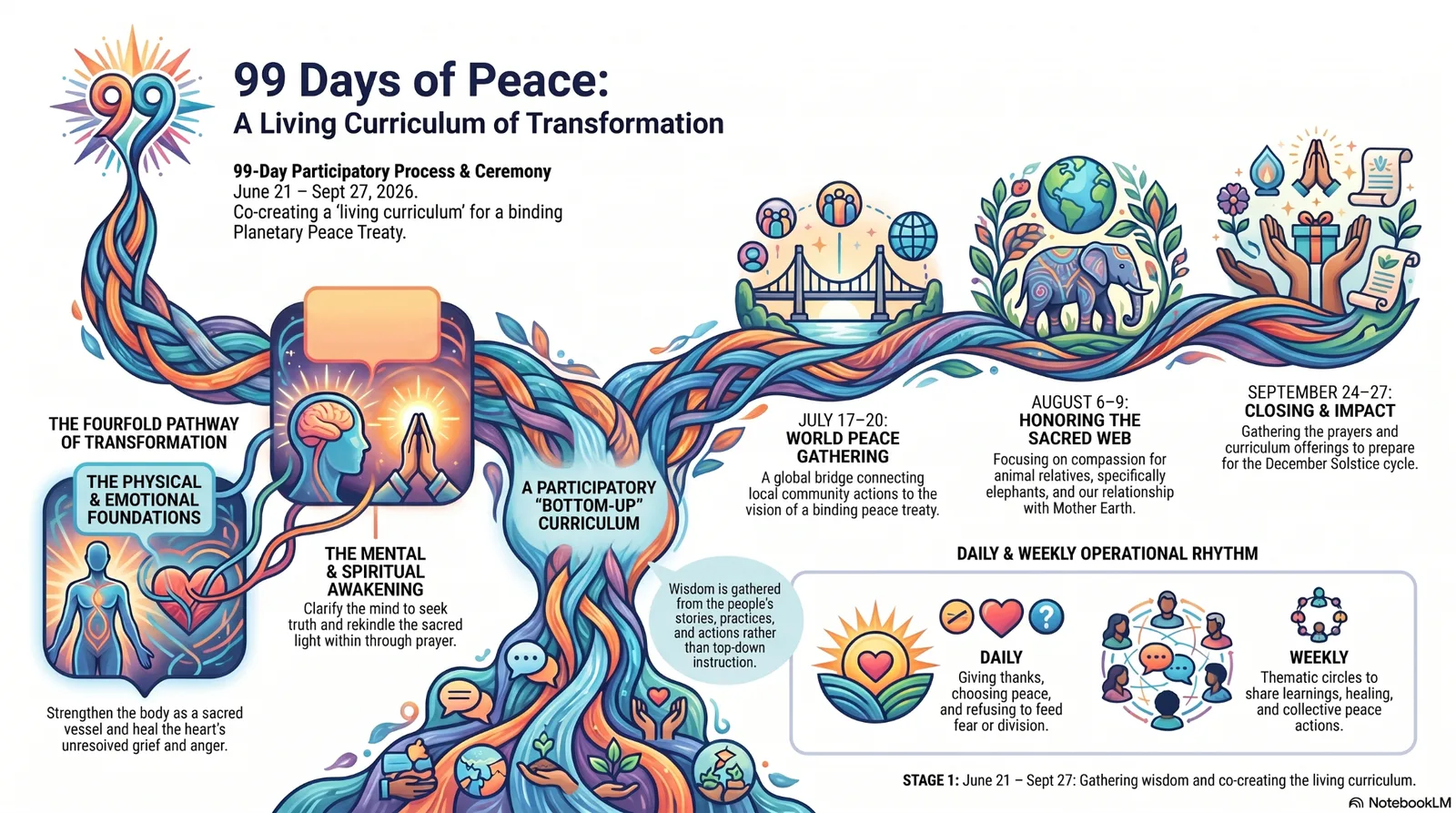
From the Solstice launch on June 21, 2026, until our first completion on September 27, 2026, we are walking through a fourfold pathway: the physical, the emotional, the mental, and the spiritual.
This is a natural order of human development. When we come into this world, we first arrive through the physical body. Then the emotional life begins to unfold. Then the mind becomes clearer, sharper, and more capable of understanding. Then, through a healed body, a softened heart, and a clarified mind, we are better able to enter the deeper spiritual dimensions of life.
This is the structure of the curriculum. First, we strengthen the physical body. Then, we heal the emotional heart. Then, we clarify the mental life. Then, we awaken and deepen the spiritual reality.
This is not a rigid formula. It is a living pathway. The physical, emotional, mental, and spiritual are always connected, always influencing one another, always moving together. But for the purpose of building a curriculum that people can understand, practice, and help develop, this fourfold pathway gives us a clear and beautiful structure.
The Purpose of the First 99 Days
The purpose of these first 99 days is to begin building the curriculum itself through shared participation. We are not simply asking people to receive a curriculum. We are asking people to help create it.
During these 99 days, we will gather teachings, practices, stories, prayers, songs, exercises, questions, ceremonies, service actions, youth activities, family practices, community dialogues, and collective commitments. These will come from elders, youth, women, men, Two-Spirit relatives, spiritual circles, educators, artists, healers, peacebuilders, families, communities, Nations, organizations, and all people of goodwill who are called to serve peace.
This is a Four Worlds participatory input process. We listen first. We gather the wisdom of the people. We look for the deeper patterns. We honor the unique gifts of each voice while discerning the shared vision rising among us.
By September 27, 2026, we want to be able to say: this is what the people prayed for; this is what the people gave thanks for; this is what the people are ready to heal; this is what the people are ready to release; this is what the people are choosing; this is what the people are willing to do; and this is the living curriculum now beginning to emerge from our shared collective impact.
Part One: The Physical Curriculum — Strengthening the Sacred Vessel
The first part of the curriculum is physical because we enter this world through the body. The body is the first lodge of the human spirit. It carries our breath, our movement, our senses, our service, our work, our songs, our prayers, and our relationships.
If the body is weak, exhausted, neglected, hungry, poisoned, or disconnected from Mother Earth, it becomes much harder to carry peace. So the first movement of the curriculum asks us to strengthen the sacred vessel of the body.
This part of the curriculum asks: How do we care for our bodies as sacred gifts? How do we restore our relationship with water, food, breath, movement, rest, and healing? How do we protect the physical life of our families, our communities, our animal relatives, and Mother Earth? How do we stop feeding the systems that weaken life and begin strengthening the systems that protect life?
The physical curriculum may include simple daily practices such as drinking water with gratitude, walking in prayer, caring for the land, planting food, feeding those in need, resting more consciously, reducing harm to Mother Earth, caring for animal relatives, and strengthening the body through movement, discipline, and balance.
This part of the curriculum should be simple enough that anyone can begin immediately. A child can offer thanks for water. A family can share a meal with gratitude. A community can clean a riverbank. A school can plant a garden. A spiritual circle can pray for the healing of Mother Earth. An organization can feed the hungry or support those without shelter.
We are asking people to help us build this part of the curriculum by contributing physical practices, wellness teachings, food and water teachings, land-based activities, body-strengthening exercises, Mother Earth protection actions, and practical ways to care for the physical life of humanity and all our relatives.
Please insert your input here.
Part Two: The Emotional Curriculum — Healing the Heart
The second part of the curriculum is emotional. Once the body is grounded, we must turn toward the heart. The heart carries grief, fear, anger, loneliness, tenderness, love, courage, compassion, memory, and longing. Many of the wars outside us are connected to unresolved wars within the human heart.
Humanity cannot build peace while carrying unhealed hatred. We cannot walk together while feeding resentment, blame, cruelty, and separation. We cannot end the war between Nations if we continue to pass the war from heart to heart, family to family, community to community, and generation to generation.
The emotional curriculum asks: What grief is humanity carrying? What fear must be healed? What anger must be transformed? What relationships need forgiveness? What wounds between people, Nations, families, and communities must be acknowledged and healed? How do we restore compassion, tenderness, courage, and love?
This part of the curriculum may include listening circles, forgiveness practices, grief ceremonies, family healing exercises, compassion challenges, reconciliation dialogues, practices for speaking respectfully, and ways to stop passing pain forward.
It may also include teachings about the stages of grief, the healing of trauma, the power of tears, the courage to forgive, the discipline of compassion, and the sacred responsibility to protect children from inherited hatred.
We are asking people to help us build this part of the curriculum by contributing emotional healing practices, Talking Circle questions, grief and forgiveness exercises, family restoration practices, teachings on compassion, and ways to help people move from hurt toward healing.
The emotional curriculum must be gentle, honest, and courageous. It must not force people to speak before they are ready. It must create safe and respectful spaces where people can listen deeply, speak truthfully, and begin to heal.
Please insert your input here.
Part Three: The Mental Curriculum — Clarifying the Mind
The third part of the curriculum is mental. When the body is strengthened and the heart is healing, the mind can become clearer. A clear mind can see patterns. A clear mind can seek truth. A clear mind can recognize propaganda, racism, hatred, despair, and division without being captured by them.
The world is filled with confusion. Many people are being trained to fear one another, blame one another, and see one another as enemies. The mental curriculum must help us cleanse our thinking, sharpen our understanding, and educate ourselves and our children for peace.
This part of the curriculum asks: What are we feeding our minds each day? How do we recognize thoughts that divide, dehumanize, or create fear? How do we learn the history of war without becoming trapped in hatred? How do we teach peace, justice, truth, unity, and collective responsibility? How do we use media, technology, education, and communication to heal rather than divide?
The mental curriculum may include peace education, truth-telling, media literacy, history lessons, teachings on racism and unity, study circles, community dialogues, youth learning activities, and practices for clear communication.
It should help people ask deeper questions: Is this thought feeding peace or feeding war? Is this message helping me see the humanity of others? Is this information true, useful, respectful, and healing? What assumptions must I examine? What do I need to learn before I speak?
We are asking people to help us build this part of the curriculum by contributing educational resources, discussion guides, youth lessons, study materials, media practices, storytelling formats, conflict transformation tools, and teachings that help humanity think more clearly and act more wisely.
The mental curriculum is where vision becomes organized. It is where scattered concern becomes shared understanding. It is where people begin to see the systems that must change and the responsibilities they can carry.
Please insert your input here.
Part Four: The Spiritual Curriculum — Awakening the Sacred Fire
The fourth part of the curriculum is spiritual. When the body is strengthened, the heart heals, and the mind becomes clear, we are better prepared to enter the deeper spiritual dimensions of life.
The spiritual curriculum is not about converting anyone. It is not about one path replacing another path. It is about helping every person become more faithful, more humble, more loving, more truthful, more courageous, and more deeply connected to the sacred source of life.
This part of the curriculum asks: How do we rekindle the sacred light within? How do we deepen prayer, meditation, ceremony, gratitude, humility, and service? How do we remember the Creator, the Great Mystery, Mother Earth, the ancestors, future generations, and all our relatives? How do we become the prayer we are offering? How do we carry spiritual power into practical action for peace?
The spiritual curriculum may include daily prayers, sacred fire teachings, songs, ceremonies, meditations, gratitude practices, fasting or discipline where appropriate and safe, service as prayer, interfaith gatherings, Indigenous ceremonies, blessings for the waters, prayers for those suffering in war, and collective moments of synchronized spiritual action.
This spiritual part must be rooted in respect. No one is asked to surrender their own sacred path. No one is asked to be converted. No one is asked to say that one tradition is greater than another. We are here to learn from one another so that each of us may become better human beings and more faithful servants of the path we have been given.
We are asking people to help us build this part of the curriculum by contributing prayers, blessings, songs, teachings, ceremonies, spiritual disciplines, stories of transformation, and sacred practices that help people live peace from the inside out.
Please insert your input here.
How We Can Help Build the Curriculum
We are asking each person to consider where they feel called to contribute. Some may help with the physical curriculum. Some may help with the emotional curriculum. Some may help with the mental curriculum. Some may help with the spiritual curriculum. Some may help with all four.
People can contribute in many ways: a teaching, a story, a ceremony, a song, a prayer, a question, a daily practice, a youth activity, a family exercise, a community action, a peace education resource, a Mother Earth protection action, a social media message, a short video, a translation, a graphic design, a circle process, a way to gather impact, or a way to help people report what they are doing.
No offering is too small if it is sincere. A single question can open a heart. A single practice can help a family. A single prayer can strengthen a community. A single act of service can become a seed of peace.
The Participatory Input Process
The process is simple. First, we invite people to reflect. Second, we invite people to contribute. Third, we gather the contributions. Fourth, we listen for the common patterns. Fifth, we organize the wisdom into the four curriculum areas. Sixth, we share it back with the people. Seventh, we continue refining it through practice.
This is not a top-down curriculum. It is a living curriculum. It grows through participation, use, reflection, and shared learning. The people are not only participants. The people are co-creators.
From September 27 to the December Solstice
On September 27, 2026, we completed the first stage of the 99 Days of Peace Through Unity. But that completion is not an ending. It is a doorway.
From September 27, we enter the second stage of the ceremony, a bridge leading to Enlightening Our Way Together, December 18–22, 2026.
During this Stage of our Ceremony, we will gather what has been learned, organize what has been contributed, and prepare to bring the living curriculum into a more complete form.
Enlightening our Way Together will be a time to bring forward the shared teachings, collective prayer, impact patterns, commitments, stories, actions, and the next stage of the movement.
It will help us ask: What has been born during these first 99 days? What must now be strengthened? What must now be shared more widely? What must now be protected? What must now be carried into the next cycle?
The 90-Day Arc and the Continuing Solstice Cycle
From the December Solstice, we enter another sacred arc. From December 21 to March 21 is a 90-day movement into the next seasonal doorway. Along the way, important moments of remembrance, justice, water, Earth, and peace can help us gather greater momentum.
In January, we remember the living legacy of Martin Luther King Jr. and the continuing call for nonviolence, justice, courage, and beloved community.
In March, we come to the Spring Equinox and the renewal of life. Around this time, we also lift the sacredness of water and the responsibility to protect the waters of Mother Earth.
In April, we honor Mother Earth more visibly and deepen our responsibility to protect the land, waters, animals, forests, children, and generations yet to come.
Then we continue toward the next Solstice on June 21, 2027, and from there the cycle continues.
Each Solstice becomes a doorway. Each cycle strengthens the movement. Each stage gathers more people, more communities, more Nations, more spiritual circles, more youth, more elders, more partners, and more shared action.
This ceremony will continue through the Solstices, year after year, right through 2030, and beyond if necessary, until its purpose is fulfilled.
Until the Binding Peace Treaty Is Signed
The purpose of this ceremony is not only symbolic. The purpose is to inspire humanity to move toward the signing of the Binding Planetary Peace Treaty to End war.
This is a great task. Some may say it is too large. Some may say the patient is too wounded. Some may say the sickness of war is too deep. But a true healer does not abandon the patient because the illness is severe.
A doctor does not stop treating a patient because the healing is difficult. A grandmother does not stop praying because the night is long. A firekeeper does not walk away because the embers are low. A peacebuilder does not surrender because the world is wounded.
The deeper the sickness, the greater the need for healing. The greater the danger, the greater the need for courage. The longer the war has continued, the stronger our commitment must become to end it.
So we continue. We continue until peace is not only spoken, but practiced. We continue until peace is not only prayed for, but organized. We continue until peace is not only hoped for, but embodied. We continue until the children can inherit a world no longer governed by the inevitability of war.
The Invitation
The Continental is asking each of you to help us build this living curriculum.
What should be included for the physical body?
What should be included for the emotional heart?
What should be included in the mental life of humanity?
What should be included for the spiritual awakening of the people?
Where do you feel called to contribute? What teaching do you carry? What practice has helped you heal? What action has strengthened your family or community? What prayer do you want to offer? What wisdom should be shared with the children? What commitment are you ready to make?
Let us gather the wisdom already among us. Let us make this curriculum simple enough for a child, deep enough for an elder, practical enough for a family, strong enough for a community, and powerful enough for the world.
This is how the ceremony becomes a curriculum. This is how curriculum becomes action. This is how action becomes a shared impact. This is how shared impact becomes a movement. This is how a movement becomes a new pattern for the human family.
Each person brings one flame. Together, those flames become a sacred fire. That fire becomes vision. That vision becomes action. That action becomes a collective impact.
We Choose Peace. We Live in Peace. We End War. The Sacred Lineage Behind This Living Curriculum
This living curriculum does not arise from nowhere. It comes from a long sacred journey of prophecy, ceremony, Indigenous sovereignty, spiritual responsibility, and service to Mother Earth and the human family.
The spiritual foundation of this movement reaches back to the ancient prophecy of the Eagle and the Condor, a prophecy of the reunion of the Indigenous Peoples of the North and the South. This prophecy was fulfilled in a powerful spiritual way in the spring of 1971 at Lake Titicaca in Bolivia, where the sacred energies of North and South were joined in prayer, ceremony, and renewed purpose.
The first fires of this movement were planted earlier, during the Yakima Council Fires of 1969 and 1970 in White Swan, Washington. Although these gatherings were small in number, they held vast spiritual significance for future generations. They were among the first sparks of a much larger continental awakening that would continue to unfold over the decades.
The First Continental Indigenous Council was officially held in October 1978 at White Swan, bringing together around 200 representatives from 28 Nations across the United States, Canada, and Alaska. At that gathering, Phil Lane Jr. was elected Chairperson, a sacred responsibility he has carried for 48 years.
From there, the circle continued to grow. In 1980, the second gathering was held in Wilmette, Illinois, drawing more than 400 Indigenous peoples. The third gathering took place in 1982 at the Blood First Nation in Canada, and the fourth was held in 1986 in Fairbanks, Alaska. These gatherings helped expand the circle of relationship, prayer, consultation, and shared Indigenous responsibility across the continent.
A major part of this era was the emergence of the Trail of Light journeys. Indigenous teams traveled across North America and down into South America, including Ecuador, Peru, Bolivia, and Chile, sharing ceremonies, teachings, songs, and spiritual encouragement. These journeys helped fulfill the ancient prophecy of the reunion of the Peoples of the North and South, carrying the light of unity from community to community.
In 1990, the movement entered a painful but necessary transition when funding and administrative support from Bahá’í institutions were suddenly withdrawn. This caused deep hardship and suffering, but over time it has come to be understood as a vital step in the movement’s spiritual maturation. It required the Continental Indigenous Council to become fully independent, fully Indigenous-led, and fully sovereign in its own sacred purpose.
Even through this difficult period, the fire was never extinguished. The movement’s inner life continued through the work of the Four Worlds International Institute, which carried forward the principles of community healing, youth empowerment, cultural revitalization, leadership development, and spiritual transformation. For more than four decades, this work helped keep the sacred vision alive.
On June 16, 2026, the Continental Indigenous Council was prayerfully reignited with renewed vision as a non-political, Indigenous-led sacred movement. This reignition marks a new beginning, rooted in the same original fire, but now prepared to serve a much wider global purpose.
The renewed Continental Indigenous Council carries nine sacred responsibilities. These include revitalizing the NABI Institute in the Navajo Nation as a spiritual center; uniting other non-political Indigenous movements; sharing the Four Worlds integrative framework for human transformation; actualizing the Sacred Union of the Condor, Hummingbird, Quetzal, and Eagle; building a 4th Way Digital Network to spread unity safely and quickly; empowering and uplifting womankind as true representatives of Mother Earth; supporting the global movement to Choose Peace, Live Peace, End War; mentoring and empowering the youth, the Seventh Generation; and uniting all faith traditions to help heal Mother Earth through a strict covenant against proselytization, religious pressure, or spiritual coercion.
At the heart of this movement is the Red Road of oneness. This way teaches that true unity does not erase our identities. True unity protects the sacred gifts, cultures, languages, Nations, ceremonies, and spiritual responsibilities that each person carries.
The Continental Indigenous Council affirms that every person is a sovereign, ancient, imperishable, and everlasting spiritual being. Each person carries dignity. Each Nation carries a sacred trust. Each tradition carries a gift. Each generation carries a responsibility to those who came before and those yet to come.
This is why the 99 Days of Peace Through Unity Living Curriculum is not simply a program. It is the next expression of a sacred journey that has been unfolding for generations.
It gathers the fire of prophecy, the discipline of healing, the wisdom of Indigenous consultation, the strength of spiritual sovereignty, and the practical call to serve peace in the world.
The curriculum now becomes one way to carry this sacred lineage forward. It helps people strengthen the body, heal the heart, clarify the mind, awaken the spirit, and act together for peace. It helps transform remembrance into responsibility, prayer into practice, and ceremony into shared collective impact.
This is the story behind the work. This is the fire we are carrying. This is the sacred stream flowing into the 99 Days of Peace Through Unity, the December Solstice gathering, the continuing Solstice cycles through 2030, and the global movement to Choose Peace, Live Peace, and End War.
The Living Infrastructure Now in Development
Alongside the fourfold curriculum of the physical body, emotional heart, mental life, and spiritual awakening, there is also a practical infrastructure now being developed to help carry the 99 Days of Peace Through Unity across communities, Nations, spiritual circles, families, schools, organizations, and global networks.
This infrastructure is still in development. It is not yet complete, and that is part of the purpose of this first 99-day stage. We are building the pathway as we walk it, and we are asking those who feel called to help shape the tools, systems, communications, and shared practices that can make this ceremony visible, accessible, and useful to many people.
One of the first pieces being developed is a 99-Day Curriculum Calendar. This calendar would help organize the journey day by day and week by week, so that people can participate in simple, practical, and meaningful ways.
Each day includes a daily theme, one reflection question, one small practice, one peace action, and one way to share or report impact. This does not need to be complicated. People should be able to participate for five minutes, thirty minutes, or as part of a full family, school, community, or spiritual circle gathering.
A simple daily rhythm being suggested is this: today I give thanks for something sacred; today I choose peace in one real way; today I refuse to feed fear, hatred, or division; today I protect something living; and today I offer one action for the sake of the children and the generations yet to come. This daily rhythm can be adapted for families, youth groups, elders, schools, ceremonies, online circles, and organizations.
Another part of the infrastructure now in development is the Ceremony System. This includes the Solstice launch, weekly circles, synchronized moments of prayer, special gatherings, songs, blessings, sacred fire observances where appropriate, and the closing ceremony on September 27. A suggested weekly circle could ask: what did we learn this week, what are we healing, what action are we taking, and what prayer are we carrying forward? These weekly circles can help keep the ceremony alive, relational, and grounded.
The Curriculum System is also still being developed. This will include daily prompts, short teachings, simple practices, youth activities, family exercises, Talking Circle guides, peace action challenges, art, music, storytelling, ceremony, and prayer invitations. This curriculum should feel like a ceremony, not schoolwork. It should help people live in peace in their bodies, relationships, thoughts, spiritual practices, homes, communities, and service to Mother Earth.
The Communications System is another essential part of the work. We are moving toward a one-world approach through the internet, with possible pathways via One World, WhatsApp, Facebook, email, video, social media, media partners, and other broadcast outlets. What is needed is a clear and steady flow of messages that people can easily receive and share. This could include a short daily message, a weekly teaching, a three-minute video reflection, a simple social media image, a WhatsApp message that can be forwarded easily, and occasional media releases for wider public visibility. The message must remain consistent everywhere: Choose Peace. Live Peace. End War.
The Participation and Impact System is also being developed. The reflection form already provides the beginning of this system by gathering gratitude, dedication, healing themes, peace visions, personal commitments, gifts, skills, resources, and prayers. As responses are gathered, they can help create a Global Gratitude Map, a Dedication Circle, a Shared Vision of Peace, a Healing and Release Pattern, a 99-Day Action Pathway, and a Collective Peace Prayer. This is how individual reflection becomes shared collective impact.
A Team-of-Teams System will also be needed because a single person or office cannot carry out this work. It needs a circle of circles.
Possible teams now being suggested include a Ceremony Team, Curriculum Team, Communications Team, Technology Team, Youth and Schools Team, Elder and Spiritual Guidance Team, Translation Team, Partnership Team, and Impact Weaving Team.
Each team would carry one part of the work while remaining connected to the larger sacred purpose.
A weekly rhythm is also being suggested to help people stay connected throughout the 99 days.
Each week could have one theme and one action pathway, beginning with gratitude for life, honoring Mother Earth, healing the body of humanity, releasing fear and anger, healing family and community, ending racism and separation, clearing the mind, peace education and truth-telling, protecting the sacred web of life, becoming the prayer, global unity and shared commitment, and finally spiritual completion and collective impact.
The key insight is that the first ceremony asked people what they are grateful for, who they are praying for, what they are ready to release, what world they are choosing, and what action they are ready to take.
The 99-day curriculum must now help them live their answers. The form gathers the prayer. The curriculum activates the prayer. The communications spread the prayer. The circles deepen the prayer. The actions embody the prayer. The final report reveals the people’s collective prayer.
For now, the recommendation is to keep the infrastructure simple and up and running. We begin with four basic tools: a 99-day calendar, a daily WhatsApp or Facebook message, a weekly global circle, and a simple reporting or reflection form.
That is enough to begin. The curriculum does not have to be perfect before it is shared. It can grow through use, feedback, prayer, consultation, and shared learning.
This section remains open for development. We are asking people to help strengthen it. Those with skills in curriculum development, communications, technology, translation, youth work, ceremony, education, media, organizing, design, evaluation, storytelling, and community engagement are invited to step forward.
What is not yet complete is not a weakness. It is the doorway for participation.
The deepest purpose of this infrastructure is to help humanity practice peace as a daily discipline, not only speak of peace as a distant hope. Choosing Peace becomes the daily decision. Live Peace becomes the daily practice. End War becomes the collective commitment.
Four Major Ceremonial Anchors Within the First 99 Days
Alongside the ongoing daily, weekly, and monthly activities of the 99 Days of Peace Through Unity, four major ceremonial anchors now stand before us. These gatherings do not replace the daily work. They help focus it, deepen it, and give the people clear moments to come together, share what is being learned, strengthen collective action, and build shared impact.
Throughout the 99 days, people will continue to participate through prayer, ceremony, reflection, Talking Circles, service, youth activities, Mother Earth protection, communications, media, creative offerings, and community action. These daily and weekly practices are the living heartbeat of the ceremony. The four major anchors help gather that heartbeat into larger moments of unity, visibility, remembrance, celebration, healing, creativity, and shared purpose.
These four anchors are not isolated events. They are part of one unfolding ceremonial movement. The first anchor carries forward the World Peace Gathering and the sacred commitment to a binding Planetary Peace Treaty. The second anchor brings the peace ceremony directly into our relationship with the animal people, the elephants, Mother Earth, food, compassion, and the sacred web of life. The third anchor calls forth the creative imagination of humanity through songs, music, poetry, art, video, prayer, and digital tools in service to peace. The fourth anchor closes the first 99-day stage by gathering the prayers, actions, teachings, commitments, impact patterns, and curriculum offerings into a stronger foundation for the next stage.
Together, these four anchors help us move from prayer into practice, from practice into shared impact, and from shared impact into a continuing movement that carries us toward Illuminating Our Way Together from December 18–22, 2026, then forward through the Solstice cycles of 2027, 2028, 2029, and 2030, until the purpose of the ceremony is fulfilled.
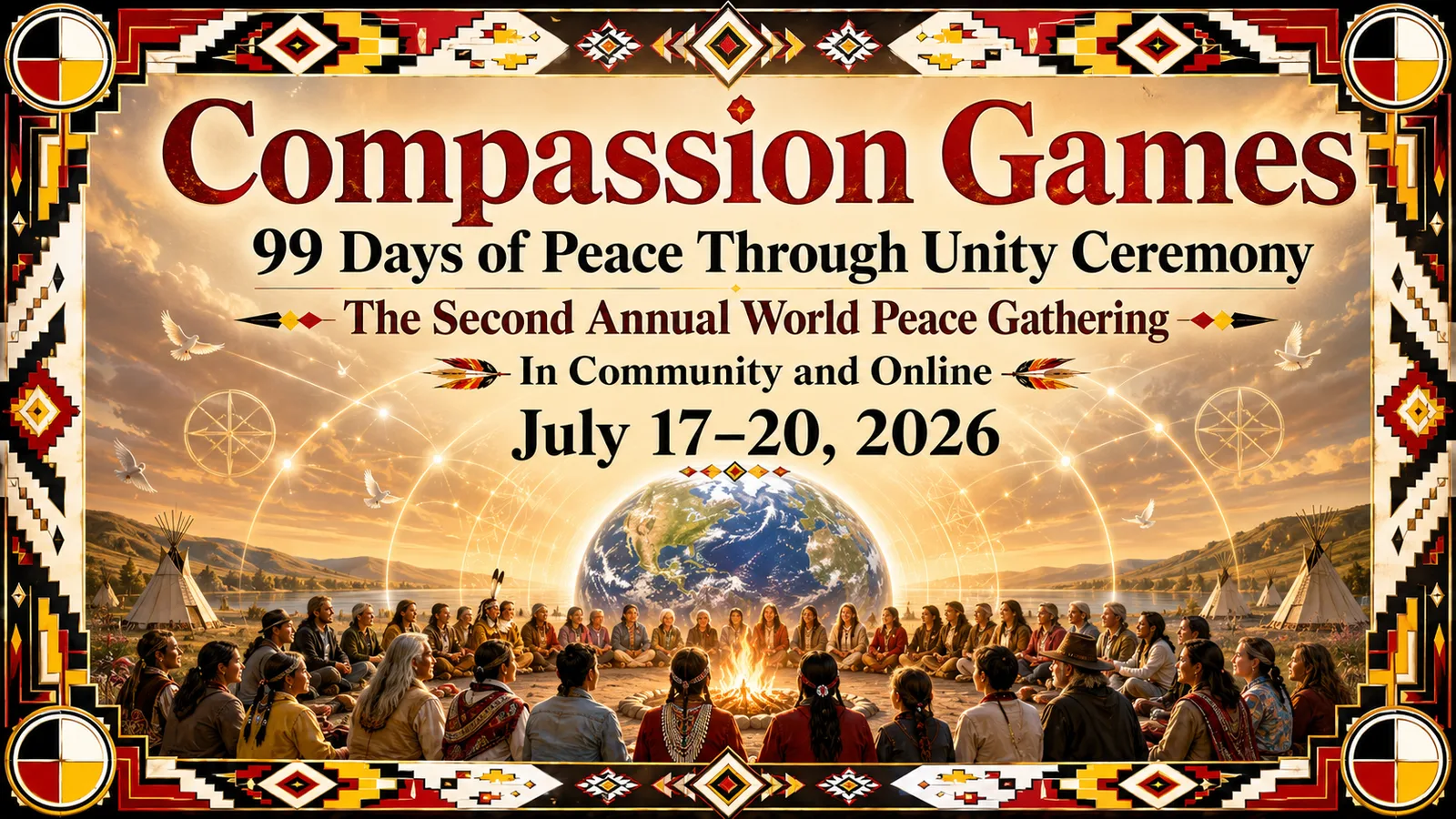
The Second Annual World Peace Gathering — In Community and Online, July 17–20, 2026
The first major ceremonial anchor is the Second Annual World Peace Gathering, from July 17–20, 2026. This gathering will be held in community and online, with people participating around the world through local gatherings, spiritual circles, family circles, Indigenous communities, interfaith circles, peace networks, online ceremonies, and shared global moments of prayer, reflection, music, dialogue, and action.
This gathering carries forward the sacred fire of the first World Peace Gathering, held at a castle in County Cork, Ireland, from July 10–20, 2025. That first gathering opened on July 10 and closed on July 20, following the Solstice ceremony of June 21, 2025. It carried the sacred intention of the Planetary Peace Treaty, the end of war, and the beginning of a new pattern of spiritual, community, and planetary responsibility.
The Second Annual World Peace Gathering will honor that first gathering and bring its spirit into a much wider circle. It will not only be centered in Ireland. It will be celebrated in the community and online around the world, so that people in many places can take part without needing to travel. A family can gather in prayer. A school can hold a peace circle. An Indigenous community can offer a ceremony. A spiritual group can dedicate prayers. Artists and musicians can share songs. Elders can speak. Youth can offer their vision. Communities can gather in parks, homes, community centers, sacred places, and online circles to renew the call to Choose Peace, Live Peace, and End War.
The purpose of this gathering is to articulate the spiritual and practical significance of a binding peace treaty. Peace cannot remain only a beautiful idea. Peace must become an agreement, a relationship, a discipline, a practice, a ceremony, a shared responsibility, and a new pattern of action among peoples, Nations, communities, families, spiritual traditions, and all members of our one human family.
This gathering helps us remember that ending war is not only the responsibility of governments. It is also the responsibility of the people. The people must prepare the ground. The people must pray to open the way. The people must stop feeding hatred. The people must begin living the treaty in their own hearts, homes, relationships, communities, schools, organizations, and Nations. A living culture of peace must support a binding peace treaty.
The Second Annual World Peace Gathering is therefore not only an event. It is a global invitation. It invites every person, family, community, Nation, organization, and spiritual circle to ask: What does peace require of us now? What must we stop feeding if we truly want peace? What must we begin protecting more deeply? What relationships must be healed? What truth must be spoken? What forgiveness must be practiced? What courage must be found? What commitment are we willing to make for the sake of the children and the generations yet to come?
This gathering is deeply connected to the 99 Days of Peace Through Unity. It occurs during the first 99-day stage, as the living curriculum is developed through participation, prayer, consultation, reflection, and shared action. The World Peace Gathering can help gather the prayers, commitments, teachings, stories, songs, and actions that are rising through the first weeks of the ceremony and carry them into a wider global field.
It can also become one of the first major opportunities to invite people to contribute to the living curriculum. During this gathering, people can be asked what they can offer to the physical, emotional, mental, and spiritual curricula. They can offer practices to strengthen the body, heal the heart, clarify the mind, awaken the spirit, and act together for peace.
The World Peace Gathering can include local and online Talking Circles, prayers for the end of war, teachings on peace, interfaith reflections, Indigenous ceremonies where appropriate, music and art for peace, youth messages, elder wisdom, community service actions, and reflections on the Planetary Peace Treaty. It can also include simple ways for people to submit their prayers, commitments, songs, poems, stories, and actions into the shared collective impact process.
Because this gathering will be both in-person and online, it can reach a wide range of participants. Some may gather in large circles. Some may gather in small groups. Some may join by phone or video. Some may offer a song from their home. Some may light a candle or sacred fire. Some may share a message on social media. Some may organize a meal, a prayer walk, a water blessing, a youth circle, an elder circle, or a peace dialogue. Each offering matters. Each offering becomes part of the larger ceremony.
This gathering should also help people understand that the Planetary Peace Treaty is not simply a document. It is a sacred commitment to change direction. It calls humanity to move away from war, violence, hatred, greed, racism, exploitation, domination, and separation. It calls humanity to move toward compassion, justice, truth, courage, forgiveness, unity, respect, healing, and protection for Mother Earth.
**The Second Annual World Peace Gathering **can therefore become a living school of peace. It can help teach that peace begins in the body through how we live, eat, breathe, move, rest, and care for the Earth. It continues in the heart through forgiveness, grief work, compassion, and the healing of relationships. It grows in the mind through truth, education, clear understanding, and the refusal to be captured by fear or hatred. It deepens in the spirit through prayer, ceremony, humility, service, and remembrance of our sacred relationship with the Creator, Mother Earth, the ancestors, future generations, and all our relatives.
During July 17–20, communities around the world can be invited to hold their own local World Peace Gathering in whatever way is appropriate for them. They can gather for one hour, one day, or the full four days. They can use the shared prayers and reflection questions. They can offer their own songs, ceremonies, and teachings. They can send in their commitments. They can report their actions. They can share what peace means in their own community and what support they need to live it more fully.
The online dimension can help weave all these local gatherings into one global circle. Through shared messages, livestreams, short videos, online prayer circles, social media posts, music, art, and reflection forms, people can see that they are not alone. They can feel that many others are praying, acting, learning, and serving with them. This helps individual lights become a shared fire.
The Second Annual World Peace Gathering will also help prepare the way for the later ceremonial anchors: the August 6–9 gathering for the animal people and elephants, the global creative peace initiative, the September 24–27 closing of the first 99-day stage, and the December Solstice gathering of Illuminating Our Way Together from December 18–22, 2026.
In this way, the World Peace Gathering becomes a bridge. It bridges the first gathering in County Cork in 2025 with the wider global ceremony of 2026. It bridges local community action with online global participation. It bridges prayer with commitment. It bridges the Planetary Peace Treaty with daily practice. It bridges the first flame of the Solstice ceremony with the expanding sacred fire of the 99 Days of Peace Through Unity.
The invitation is simple and powerful: gather where you are, in community and online. Pray for peace. Speak for peace. Sing for peace. Create for peace. Serve for peace. Commit to peace. Help build the living curriculum. Help carry the Planetary Peace Treaty from vision into practice. Help humanity remember that war is not inevitable when the people choose another way.
To Choose Peace is to make a sacred decision. To Live Peace is to practice that decision every day. To End War is to carry that decision into collective action until the children inherit a world no longer governed by the inevitability of war.
The Second Annual World Peace Gathering is one of the great moments in this first 99-day stage when the people can gather their prayers, strengthen their commitments, and help move the whole human family one step closer to peace.Honoring the Animal People and the Sacred Web of Life — August 6–9, 2026
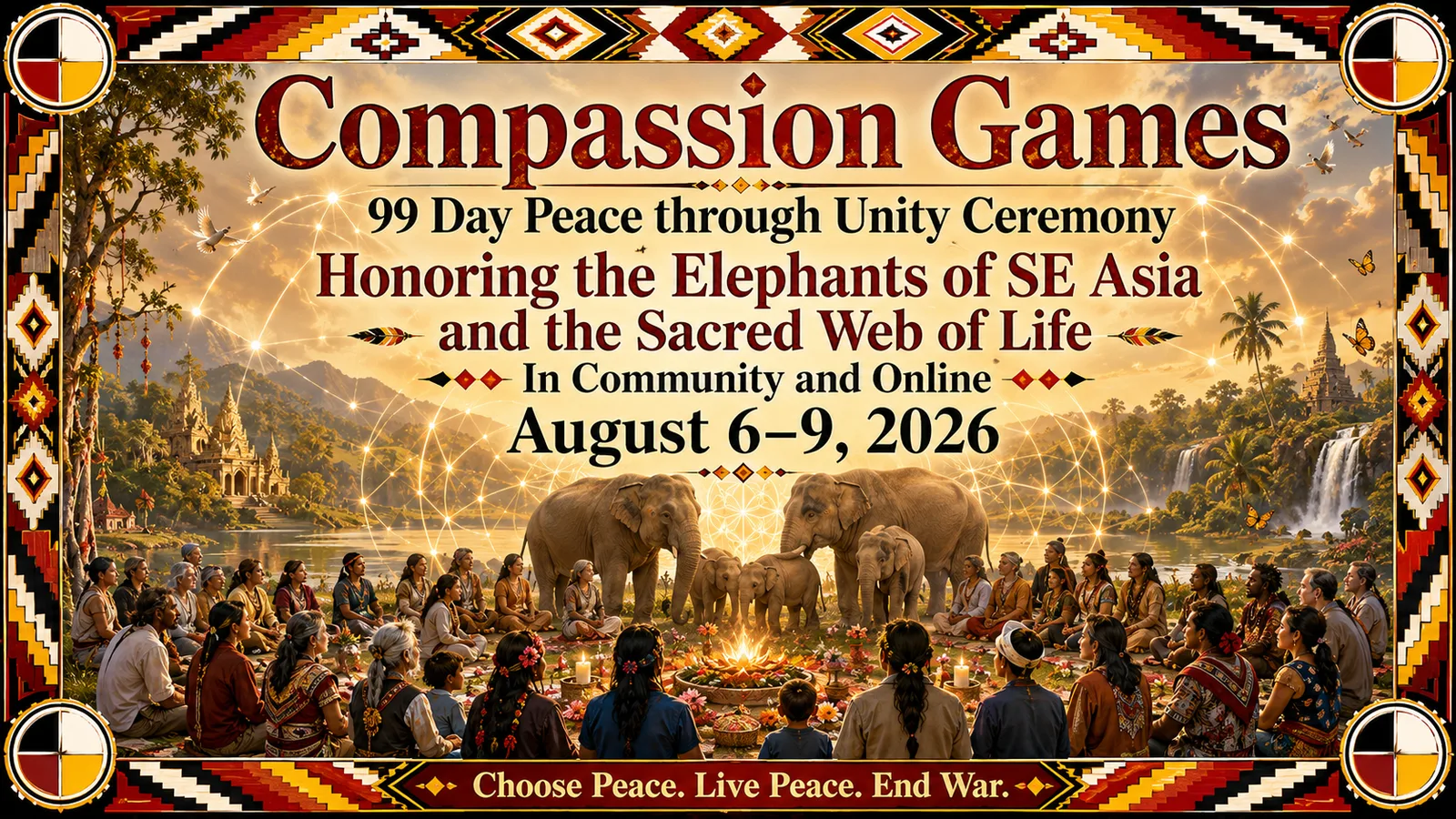
The second major anchor is the gathering from August 6–9, 2026, to honor, protect, and celebrate our animal people and all our living relatives in the sacred web of life. This is a very important gathering within the first 99 days because it brings the peace ceremony directly into our relationship with the animals, with Mother Earth, with what we eat, with how we live, and with how humanity treats the living beings who share this world with us.
This gathering is especially focused on the suffering of animal relatives in Southeast Asia, with particular attention to the elephants
and other animal people who are elderly, wounded, displaced, overworked, neglected, or in need of care, healing, protection, and sanctuary. The elephant people carry ancient wisdom, memory, family bonds, emotional depth, and sacred presence. To honor them is to remember that humanity is not alone on this Earth. We live in a relationship with many Nations of life.
This gathering will help us look deeply at how ending war also means ending the war against Mother Earth and against the animal people. War is not only bombs and weapons. War is also a way for humanity to become disconnected from the suffering of other beings. War is the way greed, neglect, exploitation, and indifference can enter into our food systems, our economies, our entertainment, our tourism, our habits, and our daily choices. To choose peace means we must also ask how peace becomes visible in our relationship with animals.
This does not mean judging or shaming people. It means opening a respectful and honest circle of reflection. What are we eating? Where does our food come from? How are animals treated before they reach our tables? How do our choices affect Mother Earth, the waters, the forests, the climate, the soils, and future generations? How can families, schools, spiritual communities, and Nations begin making more compassionate, healthy, respectful, and sustainable choices?
This gathering can become a core part of the physical curriculum because it connects the body, food, health, Mother Earth, and animal life. It asks us to strengthen our bodies in a way that also strengthens our relationship with the living world. It invites us to explore food as ceremony, water as life, breath as sacred, movement as gratitude, and daily choices as part of peace.
It is also part of the emotional curriculum because our relationship with animal people opens the heart. Many people first learn compassion through animals. Children often understand immediately that animals feel, love, remember, suffer, and seek safety. When we listen to this tenderness, our hearts become softer and more courageous. The suffering of animals can awaken grief, but it can also awaken responsibility, healing, protection, and love.
It is part of the mental curriculum because we must learn the truth about how our systems work. We need education about animal welfare, food systems, sanctuaries, forests, waters, habitats, climate, tourism, agriculture, and the practical choices that can reduce harm. A clear mind can help us move beyond denial, confusion, and habit into wiser patterns of living.
It is part of the spiritual curriculum because many Indigenous traditions and spiritual pathways have always understood animals as relatives, teachers, messengers, protectors, and fellow beings in the great circle of life. To pray for the animal people is to remember humility. To protect them is to practice reverence. To change our relationship with them is to become more fully human.
During the August 6–9 gathering, we can invite people to offer prayers, songs, stories, teachings, art, youth messages, educational sessions, sanctuary support, and practical actions for the animal people. We can especially lift projects in Southeast Asia that bring care, protection, food, medical support, rest, and sanctuary to elephants and other suffering animals.
This gathering can also invite people into a simple personal reflection: What animal has taught me compassion? What animal people am I praying for? What change can I make in my own life to reduce suffering? How can my family, community, school, organization, or spiritual circle practically protect animals? How can we make our love for animals visible through action?
This gathering can also help people examine the deeper connection between peace and food. Food is not only physical nourishment. Food carries relationships, memory, land, water, labor, culture, ceremony, economy, and moral responsibility. What we eat, how we eat, where our food comes from, and how living beings are treated within food systems are all part of the larger question of how humanity lives on Mother Earth.
This must be approached with kindness and respect. The purpose is not to shame anyone or to create division. The purpose is to open a circle of learning where people can ask how their daily choices can reduce suffering, improve health, protect Mother Earth, honor animal people, and support future generations. Each person, family, and community must find its own practical path, guided by compassion, culture, health, local conditions, and spiritual responsibility.
The August 6–9 gathering is not separate from the call to end war. It is one of the clearest ways to live it. If we cannot hear the suffering of the animals, we will struggle to hear the suffering of humanity. If we learn to protect the vulnerable among the animal people, we strengthen our capacity to protect children, elders, the displaced, the forgotten, the waters, the forests, and Mother Earth herself.
To Choose Peace is to choose compassion for all beings. To Live Peace is to make daily choices that reduce harm and increase care. To End War is to end the patterns of domination, exploitation, cruelty, and indifference wherever they appear.
This gathering will help remind the human family that the animals are not beneath us. They are beside us. They are our relatives in the sacred circle of life. When we protect them, we protect something sacred within ourselves. When we heal our relationship with them, we help heal our relationship with Mother Earth. When we honor the animal people, we take another step toward a world where peace is not only spoken, but lived.
Peace Songs, Art, Poetry, and Creative Offerings for the End of War
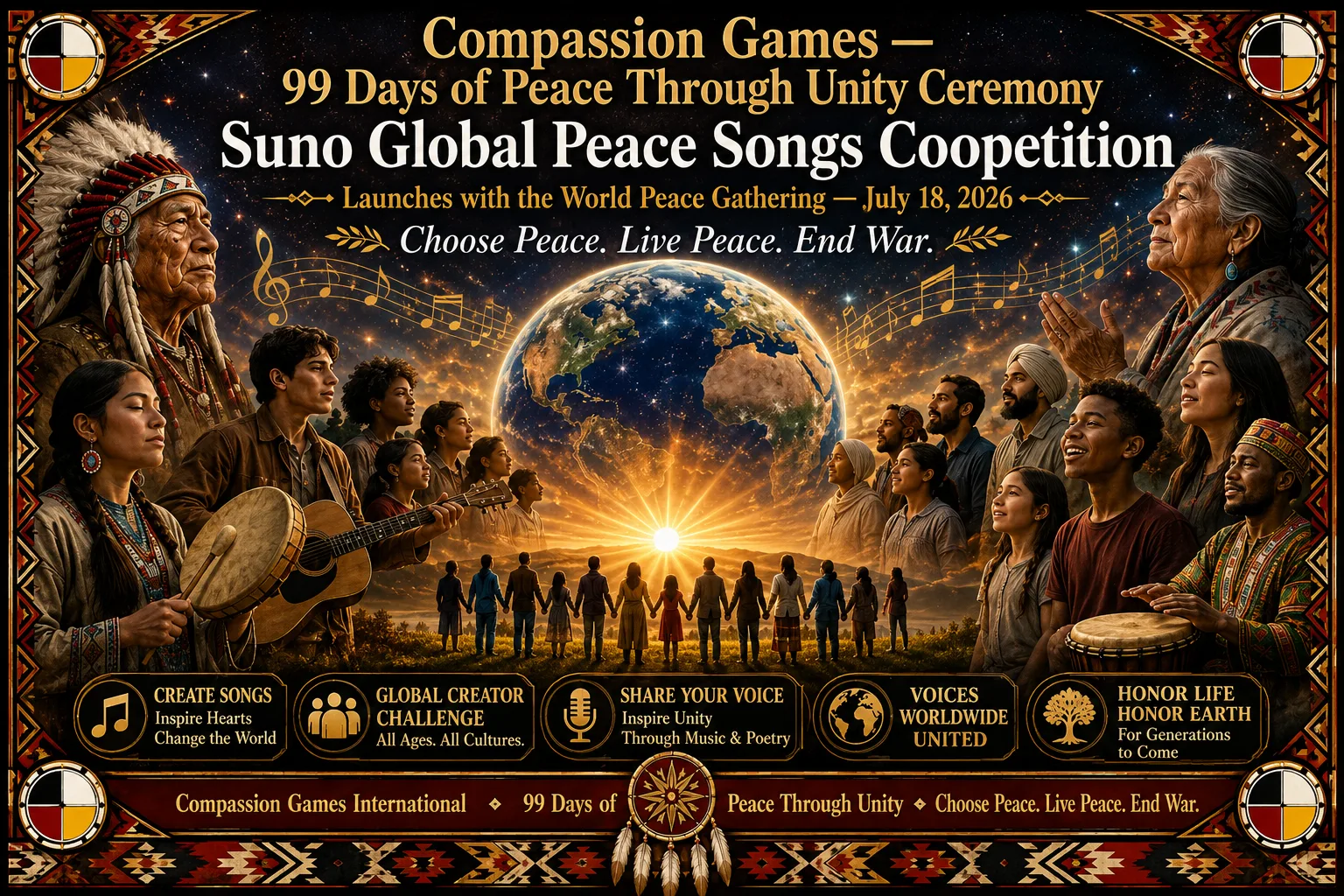
The third major anchor is a global creative peace initiative to be developed during the 99 Days of Peace Through Unity. This initiative will invite people everywhere to create and share songs, music, poetry, spoken word, visual art, short videos, prayers, stories, and other creative offerings for peace.
This initiative is still in development, but the purpose is clear. We want to invite humanity’s creative imagination to serve peace. We want to ask artists, musicians, poets, youth, elders, families, schools, spiritual circles, Indigenous communities, and online creators to help give voice, beauty, rhythm, color, and feeling to the global call: Choose Peace. Live Peace. End War.
This is especially important now because a vast and rapidly growing creative community is using new tools to make music, art, poetry, images, videos, and stories. Some are using traditional instruments and their own voices. Some are written by hand. Some are painting, dancing, filming, singing, praying, or storytelling.
Others are using new digital and AI-assisted tools such as Suno, Udio, Boomy, Mubert, AIVA, Riffusion, Soundraw, Beatoven.ai, Loudly, Musicfy, Kits.ai, ElevenLabs Music, Stable Audio, Google MusicFX, Meta AudioCraft, BandLab, Moises, Soundful, Canva, Adobe Firefly, Midjourney, Leonardo, Ideogram, Runway, Pika, Luma, ChatGPT, Gemini, Claude, and many others.
The question we want to place before this vast global creative community is simple and powerful: Who can create the most beautiful, healing, uplifting, and unifying songs, poems, images, videos, prayers, and artistic offerings for peace?
This would not be a competition of ego. It would be a celebration of service. The purpose is not to crown one person above others. The purpose is to call forth the creative gifts of the people and gather them into a living offering for the children, Mother Earth, and the generations yet to come.
The creative initiative could include categories such as Best Song for Peace, Best Youth Song for Peace, Best Indigenous Peace Song, Best Interfaith Peace Song, Best Spoken Word or Poem for Peace, Best Visual Art for Peace, Best Short Video for Peace, Best Prayer or Blessing for Peace, Best Family or School Offering, Best Community Offering, and Best Offering for Mother Earth and All Our Relatives.
It could also include special categories connected to the fourfold curriculum: creative offerings that strengthen the body, heal the heart, clarify the mind, and awaken the spirit. A song can help people move and breathe. A poem can help people grieve and forgive. A short video can teach a clear truth. A prayer can rekindle the sacred light within. Art can help people see peace before they know how to speak it.
All submissions should be rooted in peace, compassion, dignity, respect, and non-harm. They should not attack people, Nations, religions, cultures, or communities. They should not feed hatred, humiliation, revenge, or division. They should help humanity remember its sacred responsibility to choose peace, live peace, and end war.
Because many people may use digital and AI-assisted tools, the guidelines should also be clear. All creative offerings should be original, rights-respecting, and ethically made. People should not imitate living artists without permission, should not use another person’s voice, image, song, poem, prayer, ceremony, or cultural expression without consent, and should clearly acknowledge when AI-assisted tools were used. The purpose is to use technology in service to peace, not to take from others or erase the sacred responsibility of human creativity.
During the first 99 days, this initiative can be designed, organized, announced, and opened for participation. The period from now until September 27, 2026, can be used to develop the categories, guidelines, submission process, review circle, youth participation pathway, cultural respect protocols, translation support, online sharing system, and public invitation.
By the closing gathering of the first stage on September 27, 2026, we want this creative initiative to be fully ready to move forward into the next stage. The submissions, finalists, and most powerful offerings can then be carried toward Illuminating Our Way Together, from December 18–22, 2026, where selected songs, poems, prayers, art, and videos can be lifted and shared with the wider global circle.
The prize winners and honored offerings could be announced during Illuminating Our Way Together. But even more important than prizes, the creative offerings themselves can become part of the living curriculum, the communications system, the global peace prayer, the youth pathway, the social media outreach, and the ongoing Solstice cycles through 2030.
This initiative can help turn the internet into a river of peace. It can invite millions of creative people to use their gifts not to feed fear or division, but to heal, uplift, inspire, and unite. It can show that music, poetry, art, story, ceremony, and technology can become instruments of peace when guided by a sacred purpose.
In this way, the people will not only speak about peace. They will sing peace. They will paint peace. They will write peace. They will pray for peace. They will dance in peace. They will share peace. They will make peace visible, audible, beautiful, and alive.
This initiative can also become a bridge between generations. Youth are already moving quickly in digital spaces. Elders carry songs, stories, prayers, and memories. Artists carry images. Musicians carry a vibration.
Poets carry language. Families carry love. Communities carry their own forms of beauty. When these gifts are invited into one global circle of peace, the result can be far greater than any single event.
This creative peace initiative can become one of the most powerful ways to invite the wider human family into the work. Not everyone can attend a meeting. Not everyone can write a policy. Not everyone can organize a gathering. But almost everyone can offer a song, a prayer, a poem, a picture, a story, a video, a blessing, or a message of peace.
Each offering becomes a flame. Together, these creative flames can become a global fire of beauty, healing, and peace.
Suggested Development Steps for the Creative Peace Initiative
This initiative is now in development. The first step is to form a small Creative Peace Circle that can help guide the process. This circle could include musicians, poets, artists, youth, elders, cultural advisors, digital creators, communications people, technology helpers, and people with experience in ethical media and online events.
The second step is to develop simple guidelines for participation. These guidelines should explain the purpose, categories, submission dates, length limits, cultural respect standards, AI use disclosure, copyright expectations, judging process, and how selected works may be shared at the 99 Days of Peace Through Unity and the December Solstice gathering.
The third step is to create a simple online submission form where people can share their name, community, country, title of the work, category, short description, whether AI-assisted tools were used, and a link or upload of their song, poem, art, video, prayer, or creative offering.
The fourth step is to create a review process rooted in respect rather than harsh judgment. Reviewers can look for peace message, beauty, sincerity, originality, cultural respect, emotional impact, spiritual upliftment, youth participation, and practical usefulness for the global movement to end war.
The fifth step is to share selected offerings throughout the 99 days through WhatsApp, Facebook, One World, email, video gatherings, social media, community circles, and partner networks. These offerings can become daily inspiration, weekly features, and ceremonial gifts.
The sixth step is to prepare the strongest offerings for the September 27 closing of the first stage and then carry them forward into Illuminating Our Way Together from December 18–22, 2026, where the honored songs, poems, prayers, art, and creative works can help illuminate the next stage of the ceremony.
This initiative should be developed carefully, but not slowly. It needs enough structure to be trustworthy, but enough openness to allow many people to participate. It should be simple enough for a child, beautiful enough for an artist, respectful enough for an elder, and strong enough to carry a global message.
The September Closing Gathering — Completing the First Stage, September 24–27, 2026
The fourth major anchor is the great closing gathering of the first stage of the ceremony, to be held around September 24–27, 2026, with the completion on September 27. This gathering will bring people together to close the first 99-day stage of the ceremony and to understand what has been born through our collective action and shared impact.
This closing gathering is very important because the first 99 days are not only about doing activities. They are about listening for the deeper pattern rising among the people. During these 99 days, people are praying, reflecting, serving, creating, teaching, healing, protecting Mother Earth, honoring the animal people, contributing to the living curriculum, and making commitments to choose peace, live peace, and end war. The September closing gives us a sacred moment to gather all of this into one shared understanding.
At this closing gathering, we will look carefully at what the people have prayed for, what they have given thanks for, what they are ready to heal, what they are ready to release, what they are choosing, what actions they have taken, what creative offerings have been shared, what commitments they are ready to carry forward, and what support they need to continue.
This will help us gather the emerging curriculum, the shared prayers, the impact patterns, the stories, the teachings, the songs, the art, the commitments, the animal protection actions, the community service actions, the peace treaty reflections, and the practical steps into a stronger foundation for the next stage.
The September closing should help us create several shared outcomes. These may include a Global Gratitude Map, a Dedication Circle, a Shared Vision of Peace, a Healing and Release Pattern, a 99-Day Action Pathway, a Collective Peace Prayer, a first draft of the Living Curriculum, a report on the Four Major Ceremonial Anchors, and a clear invitation into the next stage of the ceremony.
This gathering should also help identify what is ready, what is still in development, and what needs more help. Some parts of the curriculum may already be strong. Some parts may need more teaching. Some parts may need youth voices. Some parts may need the elders. Some parts may need support in translation, technology, media, design, or organization. The September closing is where we honestly gather what has emerged and prepare to strengthen it.
The September closing is not an ending. It is the completion of the first step and the opening of the next doorway. From there, we move forward toward Illuminating Our Way Together, the sacred December Solstice gathering from December 18–22, 2026. By that time, we want the living curriculum to be much more fully developed, shaped by the people, tested through practice, strengthened through shared experience, and ready to carry us toward the next Solstice cycle.
From the December Solstice, we continue into the next 90-day arc toward March 21, and then onward toward June 21, 2027. Along the way, we will gather around other important moments, including the living legacy of Martin Luther King Jr., World Water Day, Mother Earth Day, and other ceremonies, observances, and gatherings that strengthen peace, justice, healing, and protection for Mother Earth.
Then another cycle begins. The ceremony continues through the Solstices, year after year, right through 2030 and beyond, if necessary, until its purpose is fulfilled. That purpose is clear: to help humanity truly Choose Peace, Live Peace, and End War, and to continue until a binding peace treaty has been signed and the children can inherit a world no longer governed by the inevitability of war.
The September closing gathering gives us a place to pause, listen, give thanks, report back, honor what has been offered, recognize what has been learned, and prepare for the next stage. It is a time to ask: What did the people show us? What did the prayers reveal? What did the actions teach us? What did the children and youth say? What did the elders remind us? What did Mother Earth ask of us? What did the animal people awaken in us? What did the artists and songmakers give us? What must now be carried forward?
These four ceremonial anchors give shape to the first 99 days. The daily practices keep the fire alive. The weekly circles keep the people connected. The major gatherings gather the learning. The shared impact reveals the pattern. And each stage prepares us for the next step on the long, sacred road to peace.
The first anchor calls the world into community and online gathering for the Planetary Peace Treaty. The second anchor calls humanity to honor the animal people, the elephants, Mother Earth, and the sacred web of life. The third anchor calls the creative gifts of the people into songs, art, poetry, prayers, stories, and digital offerings for peace. The fourth anchor brings everything together into a shared collective impact and prepares the way for Illuminating Our Way Together.
Each anchor is a doorway. Each doorway opens into deeper responsibility. Each responsibility becomes practice. Each practice becomes a shared impact. Each shared impact becomes part of the living curriculum. And the living curriculum becomes one way for people to learn together how to Choose Peace, Live Peace, and End War.
Honoring the Animal People and the Sacred Web of Life — August 6–9, 2026
The second major anchor is the gathering from August 6–9, 2026, to honor, protect, and celebrate our animal people and all our living relatives in the sacred web of life. This is a very important gathering within the first 99 days because it brings the peace ceremony directly into our relationship with the animals, with Mother Earth, with what we eat, with how we live, and with how humanity treats the living beings who share this world with us.
This gathering is especially focused on the suffering of animal relatives in Southeast Asia, with particular attention to the elephants and other animal people who are elderly, wounded, displaced, overworked, neglected, or in need of care, healing, protection, and sanctuary. The elephant people carry ancient wisdom, memory, family bonds, emotional depth, and sacred presence. To honor them is to remember that humanity is not alone on this Earth. We live in relationship with many Nations of life.
This gathering will help us look deeply at how ending war also means ending the war against Mother Earth and against the animal people. War is not only bombs and weapons. War is also the way humanity can become disconnected from the suffering of other beings. War is the way greed, neglect, exploitation, and indifference can enter into our food systems, our economies, our entertainment, our tourism, our habits, and our daily choices. To choose peace means we must also ask how peace becomes visible in our relationship with animals.
This does not mean judging or shaming people. It means opening a respectful and honest circle of reflection. What are we eating? Where does our food come from? How are animals treated before they reach our tables? How do our choices affect Mother Earth, the waters, the forests, the climate, the soils, and future generations? How can families, schools, spiritual communities, and Nations begin making more compassionate, healthy, respectful, and sustainable choices?
This gathering can become a core part of the physical curriculum because it connects the body, food, health, Mother Earth, and animal life. It asks us to strengthen our bodies in a way that also strengthens our relationship with the living world. It invites us to explore food as ceremony, water as life, breath as sacred, movement as gratitude, and daily choices as part of peace.
It is also part of the emotional curriculum because our relationship with animal people opens the heart. Many people first learn compassion through animals. Children often understand immediately that animals feel, love, remember, suffer, and seek safety. When we listen to this tenderness, the heart becomes softer and more courageous. The suffering of animals can awaken grief, but it can also awaken responsibility, healing, protection, and love.
It is part of the mental curriculum because we must learn the truth about how our systems work. We need education about animal welfare, food systems, sanctuaries, forests, waters, habitats, climate, tourism, agriculture, and the practical choices that can reduce harm. A clear mind can help us move beyond denial, confusion, and habit into wiser patterns of living.
It is part of the spiritual curriculum because many Indigenous traditions and spiritual pathways have always understood animals as relatives, teachers, messengers, protectors, and fellow beings in the great circle of life. To pray for the animal people is to remember humility. To protect them is to practice reverence. To change our relationship with them is to become more fully human.
During the August 6–9 gathering, we can invite people to offer prayers, songs, stories, teachings, art, youth messages, educational sessions, sanctuary support, and practical actions for the animal people. We can especially lift up projects in Southeast Asia that bring care, protection, food, medical support, rest, and sanctuary to elephants and other suffering animals.
This gathering can also invite people into a simple personal reflection: What animal has taught me compassion? What animal people am I praying for? What change can I make in my own life to reduce suffering? How can my family, community, school, organization, or spiritual circle protect animals in a practical way? How can we make our love for animals visible through action?
This gathering can also help people examine the deeper connection between peace and food. Food is not only physical nourishment. Food carries relationships, memory, land, water, labor, culture, ceremony, economy, and moral responsibility. What we eat, how we eat, where our food comes from, and how living beings are treated within food systems are all part of the larger question of how humanity lives on Mother Earth.
This must be approached with kindness and respect. The purpose is not to shame anyone or to create division. The purpose is to open a circle of learning where people can ask how their daily choices can reduce suffering, improve health, protect Mother Earth, honor animal people, and support future generations. Each person, family, and community must find its own practical path, guided by compassion, culture, health, local conditions, and spiritual responsibility.
The August 6–9 gathering is not separate from the call to end war. It is one of the clearest ways to live it. If we cannot hear the suffering of the animals, we will struggle to hear the suffering of humanity. If we learn to protect the vulnerable among the animal people, we strengthen our capacity to protect children, elders, the displaced, the forgotten, the waters, the forests, and Mother Earth herself.
To Choose Peace is to choose compassion for all beings. To Live Peace is to make daily choices that reduce harm and increase care. To End War is to end the patterns of domination, exploitation, cruelty, and indifference wherever they appear.
This gathering will help remind the human family that the animals are not beneath us. They are beside us. They are our relatives in the sacred circle of life. When we protect them, we protect something sacred within ourselves. When we heal our relationship with them, we help heal our relationship with Mother Earth. When we honor the animal people, we take another step toward a world where peace is not only spoken, but lived.