Healing the Hurts
Healing the Hurts is a groundbreaking Indigenous documentary directed by filmmaker Phil Lucas and produced through the Four Worlds Development Project, now the Four Worlds International Institute. Initiated in 1986 and centered upon an intensive four-day healing gathering at Alkali Lake, British Columbia, the film brought together Indigenous residential and boarding school survivors from Canada and the United States.
Phil Lane Jr., an Ihanktonwan Dakota and Chickasaw educator and co-founder of Four Worlds, designed and led the healing process, working with Indigenous community leaders, survivors, counselors, and cultural knowledge keepers.
Rather than interviewing survivors from a distance, the gathering created a protected circle in which participants could begin speaking openly about experiences that had remained hidden—sometimes for generations.
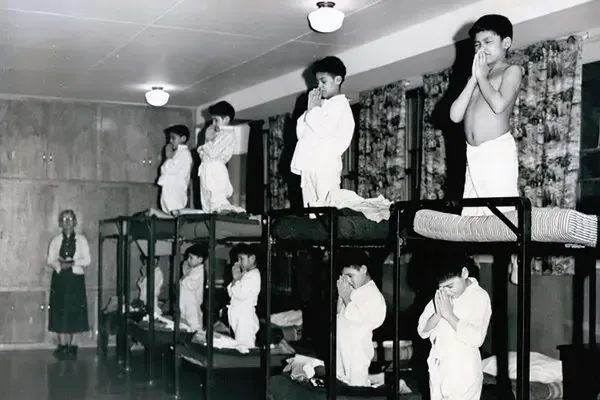
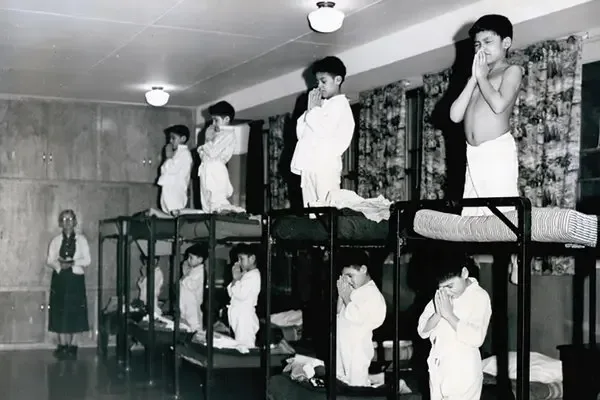
What emerged was far more than a documentary. Healing the Hurts became one of the earliest and most consequential public witnesses to the physical, emotional, spiritual, and sexual abuse inflicted upon Indigenous children in residential and boarding schools. It exposed not only what happened inside those institutions, but also how the resulting trauma continued within families, communities, leadership systems, and successive generations.
**From The Honour of All to **Healing the Hurts
The film grew out of Four Worlds’ earlier work with the Alkali Lake community.
In 1985, Phil Lucas and Four Worlds documented the extraordinary transformation of Alkali Lake in The Honour of All: The Story of Alkali Lake. Through courageous community action, culturally based recovery, and determined local leadership, Alkali Lake moved from a condition in which alcoholism affected almost the entire community to a sobriety rate exceeding 90 percent.
The success of The Honour of All demonstrated that Indigenous communities could confront even the most overwhelming social suffering when the people themselves directed the healing process. Development and recovery could not be imposed from outside. They had to arise from within the individual, the family, the community, and the culture.
But the work also revealed a deeper question: what had caused such widespread pain and dependency in the first place?
Again and again, the path led back to the residential schools.
Survivors carried memories of being taken from their parents and grandparents, punished for speaking their languages, separated from their spiritual and cultural foundations, and subjected to humiliation, violence, neglect, and abuse. Alcoholism, family violence, sexual abuse, silence, shame, and the breakdown of trust were not isolated personal failures. They were often consequences of a deliberate colonial system that had attacked Indigenous children, families, cultures, and nations.
Healing the Hurts was created to enter that deeper place.
A Film No One in Canada Would Fund
Although Canadian funding had been secured for The Honour of All, The Story of Alkali Lke, tno Canadian government agency or funding body was willing to finance a film openly confronting residential school abuse.
The subject was considered too controversial, or too dangerous. Governments and churches had not yet accepted full responsibility. Residential school abuse was rarely discussed publicly, and many survivors had never spoken openly, even within their own families, about what had happened to them.
When no support could be found in Canada, the decisive assistance came from Indigenous relatives in Alaska. The Alaska Native Health Board provided $25,000, making it possible for the gathering to be filmed and for the survivors’ voices to be preserved.
This was a remarkable act of Indigenous solidarity across colonial borders. Alaska Native people helped make possible a film that would eventually transform the national conversation in Canada.
Even after filming was completed, Four Worlds could not obtain the money required for editing. The breakthrough came through an agreement with British Columbia’s Knowledge Network. The network wished to broadcast the completed documentary. Four Worlds agreed to permit the broadcast in exchange for access to the network’s professional editing facilities.
Through this creative partnership, Healing the Hurts was completed and entered homes across British Columbia and beyond through public television.
That broadcast changed everything.
When Survivors Saw Their Own Truth
For perhaps the first time, thousands of residential school survivors could sit in their own homes and see other Indigenous people speaking publicly about experiences similar to their own.
They saw survivors describe the loneliness of being separated from their families. They heard people name physical and sexual abuse, cultural destruction, spiritual violation, fear, shame, anger, and grief. They also witnessed survivors being believed, supported, and treated with dignity.
The film gave people language for experiences they had carried silently throughout their lives. It communicated a message that countless survivors desperately needed to hear:
What happened to you was not your fault. You are not alone. The shame belongs to the system and to those who committed and concealed the abuse—not to the child who endured it. Healing is possible.
Once that truth entered people’s homes, it could not easily be pushed back into silence.
Survivors began speaking to spouses, children, counsellors, community leaders, lawyers, churches, and government representatives. Communities began organizing healing gatherings and culturally based treatment programs. The hidden history of the residential schools gradually became a matter of public testimony, legal responsibility, national policy, and moral accountability.
In this profound sense, Healing the Hurts helped ignite the residential school healing movement across Canada.
Breaking a Dangerous Silence
The film did not receive universal support. Four Worlds, the facilitators, and those courageous enough to speak publicly encountered strong opposition—including opposition from some Indigenous people who believed that residential school experiences should remain unspoken.
Some feared that exposing the abuse would bring shame upon families or communities. Others had been taught never to question religious or governmental authority. Some worried about reopening wounds for which adequate healing supports did not yet exist. There were also people and institutions whose reputations, authority, or personal conduct could be threatened by disclosure.
The residential school system had created destructive cycles. Children who were abused sometimes later harmed others, particularly when no protection, intervention, accountability, or healing was available. In some institutions, abuse was normalized, concealed, or spread among children, binding victims together through fear, guilt, and enforced secrecy. Survivors could consequently carry both wounds and behaviours from the schools back into their families and communities.
In certain communities, people accused of abusing children later acquired positions of influence. Networks of silence could protect offenders, while survivors who attempted to disclose the truth faced disbelief, intimidation, exclusion, or retaliation. Employment, political authority, family relationships, and community resources could all be used to maintain silence.
These realities must be discussed carefully. The purpose is not to condemn Indigenous communities or portray all survivors as potential offenders. The overwhelming majority of survivors did not abuse others. The responsibility begins with the colonial institutions that forcibly removed children, violated them, fractured their protective kinship systems, and repeatedly failed to stop known abuse.
At the same time, genuine healing requires the courage to acknowledge how untreated trauma can continue moving through generations. Cultural identity alone does not excuse abuse. Leadership does not place anyone beyond accountability. Protecting an institution, a family name, or a public reputation must never take precedence over protecting children.
By bringing these painful realities into the circle, Healing the Hurts challenged both colonial denial and internal community silence.
From One Healing Circle to a National Movement
No single film, organization, legal case, or leader can account for every part of Canada’s long residential school reckoning. Thousands of survivors, Elders, community workers, advocates, lawyers, researchers, and Indigenous leaders carried the movement forward.
Nevertheless, Healing the Hurts was a foundational catalyst. It appeared before Canada had established a national residential school healing strategy, before the major class-action settlement, before the Truth and Reconciliation Commission, and before the Government of Canada delivered its formal parliamentary apology.
The movement that the film helped awaken contributed to historic national developments, including:
the establishment of the Aboriginal Healing Foundation, initially supported by a $350 million federal grant and later provided an additional $125 million—nearly half a billion dollars for Indigenous-directed healing;
the Indian Residential Schools Settlement Agreement, the largest class-action settlement in Canadian history at the time;
billions of dollars in Common Experience and Independent Assessment payments to former students;
the creation of the Truth and Reconciliation Commission of Canada;
national commemoration, health-support, and community-healing programs;
and the Government of Canada’s formal apology to former residential school students in the House of Commons on June 11, 2008.
These developments did not arise spontaneously. They grew from the courage of survivors who refused to remain silent and from the work of Indigenous-led movements that created the conditions in which survivors could speak, organize, heal, and demand justice.
Healing the Hurts helped open that door.
The Healing Circle as a Living Alternative
The documentary’s enduring importance lies not only in the abuses it exposes, but also in the healing model it demonstrates.
Participants were not treated merely as patients, case numbers, research subjects, or damaged people. They entered a culturally grounded process that recognized their spiritual strength, their relationships, their histories, and their inherent dignity. Healing involved the whole person—body, mind, heart, and spirit—and extended outward to the family, community, nation, and future generations.
The process embodied a foundational Four Worlds principle:
Human and community development must come from within. Healing moves from the individual to the family, from the family to the community, and from the community outward to the nation and the world.
The camera did not stand coldly outside the circle. Phil Lucas and the production team were accepted as participants and witnesses within a sacred process. This relationship gave the film its extraordinary honesty. The survivors were not surrendering their stories to an outside authority. They were using the film to carry their own truth into the world.
A Legacy That Continues
Nearly four decades later, Healing the Hurts remains urgently relevant.
Residential school survivors and their descendants continue to live with intergenerational trauma. Indigenous Nations continue searching for missing children, protecting burial grounds, restoring languages and ceremonies, strengthening families, and confronting institutions that minimized or concealed the truth. Communities continue addressing abuse that originated or intensified within systems designed to break Indigenous kinship, identity, and spiritual life.
The work is not finished.
Healing must never become a substitute for justice, and justice must never be reduced to financial compensation. True reconciliation requires truth, accountability, restitution, institutional transformation, cultural restoration, and the protection of every child. It also requires confronting abuse wherever it exists—even when doing so is painful, politically difficult, or threatening to people in authority.
Healing the Hurts stands as a record of what becomes possible when survivors are believed and Indigenous Peoples are given the space to direct their own healing.
It began with $25,000 from Alaska Native relatives, an unfunded commitment by Four Worlds, an exchange for the use of an editing suite, a courageous circle of survivors, and a filmmaker willing to carry their truth.
From that circle, a movement spread across Canada.
The film helped transform private suffering into public truth, public truth into collective action, and collective action into healing, recognition, compensation, apology, and national reckoning.
Healing the Hurts did not merely document history. It helped make history.
WatchHealing the Hurtson Vime