
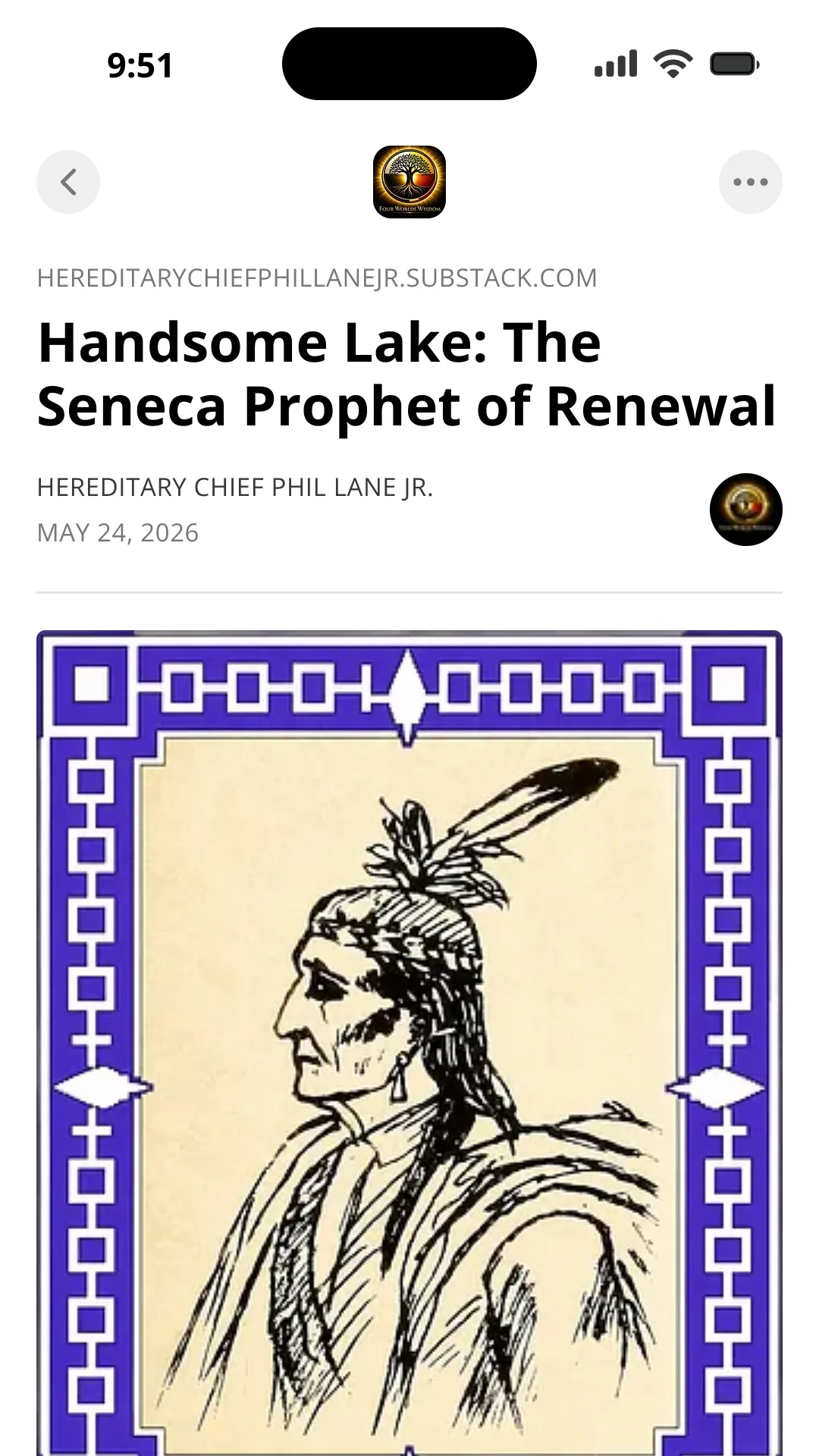
In the years following the American Revolution, as the Seneca people grappled with lost lands, broken communities, and the ravages of alcohol, a quiet transformation began in a longhouse in western New York. There, a man once lost to despair rose to become one of the most important spiritual leaders in Native North American history.
His name was Handsome Lake, known in his language as Ganyodaiyo. Born around 1735 in the Seneca village of Canawaugus, he was half-brother to the respected war chief Cornplanter. For much of his life, Handsome Lake struggled with alcoholism, watching his people suffer through poverty, disease, and cultural collapse. But in 1799, everything changed.
Lying near death in his longhouse, Handsome Lake received a series of powerful visions. Three spiritual messengers appeared to him, sent by the Creator. They showed him the will of the Great Spirit and gave him a sacred message to carry back to his people. When he miraculously recovered, he laid down the bottle and began preaching what became known as the Gaiwiio, Good Word, or the Code of Handsome Lake.
His teachings were both a return to traditional values and a practical path forward in a rapidly changing world. He taught sobriety, respect for women and children, care for the elderly, sharing with the poor, and living in peace with one another. He encouraged his people to adopt new farming methods while fiercely protecting their remaining lands.
Importantly, Handsome Lake also spoke of a coming time of great suffering — a long, hard winter for Native peoples. He warned that difficult days lay ahead, filled with hardship and moral challenges. Yet he offered deep hope to those who remained faithful. He taught that those who held firmly to the Good Word would endure this difficult season and would one day arrive at a place of peace, beauty, and joy. He described a renewed world where the faithful would live in harmony with the Creator, free from sorrow.
Handsome Lake also alluded to the possibility that the Creator might send other messengers in the future. While he presented his own message as the path for his time, he left room in his teachings for continued divine guidance.
He traveled across Iroquois territories for the next fifteen years, carrying this Good Message. Though he faced opposition, his teachings took deep root. After his death in 1815, his words were carefully preserved and later written down. Today, the Longhouse Religion continues to be practiced among the Haudenosaunee peoples, and the Gaiwiio is still recited in longhouses.
Handsome Lake’s message carries a deep resonance that extends far beyond the Seneca. His prophecy of a long, difficult season followed by renewal and peace echoes in the teachings of many other Native prophets across North America. Like others before and after him, he warned of a great wintertime — a period of intense hardship and testing — yet consistently pointed his people toward hope.
He made clear that those who stayed faithful to the sacred teachings, who chose sobriety, kindness, unity, and moral courage, would not only survive that difficult season, but would eventually arrive at a place of profound peace. In his visions, he described a renewed world where suffering would end, where families would be whole, where justice would prevail, and where the faithful would live in everlasting harmony with the Creator and with one another.
More than two centuries later, Handsome Lake stands as a powerful example of Indigenous prophecy and resilience. In the midst of profound suffering, he delivered a message that acknowledged the coming storms, yet promised that faithfulness, unity, and kindness would ultimately prevail, that after the long winter comes the return of spring, and with it, a new day of peace. His Good Word was not just a call to survive. It was a call to live beautifully, together, in harmony with the Creator’s will.