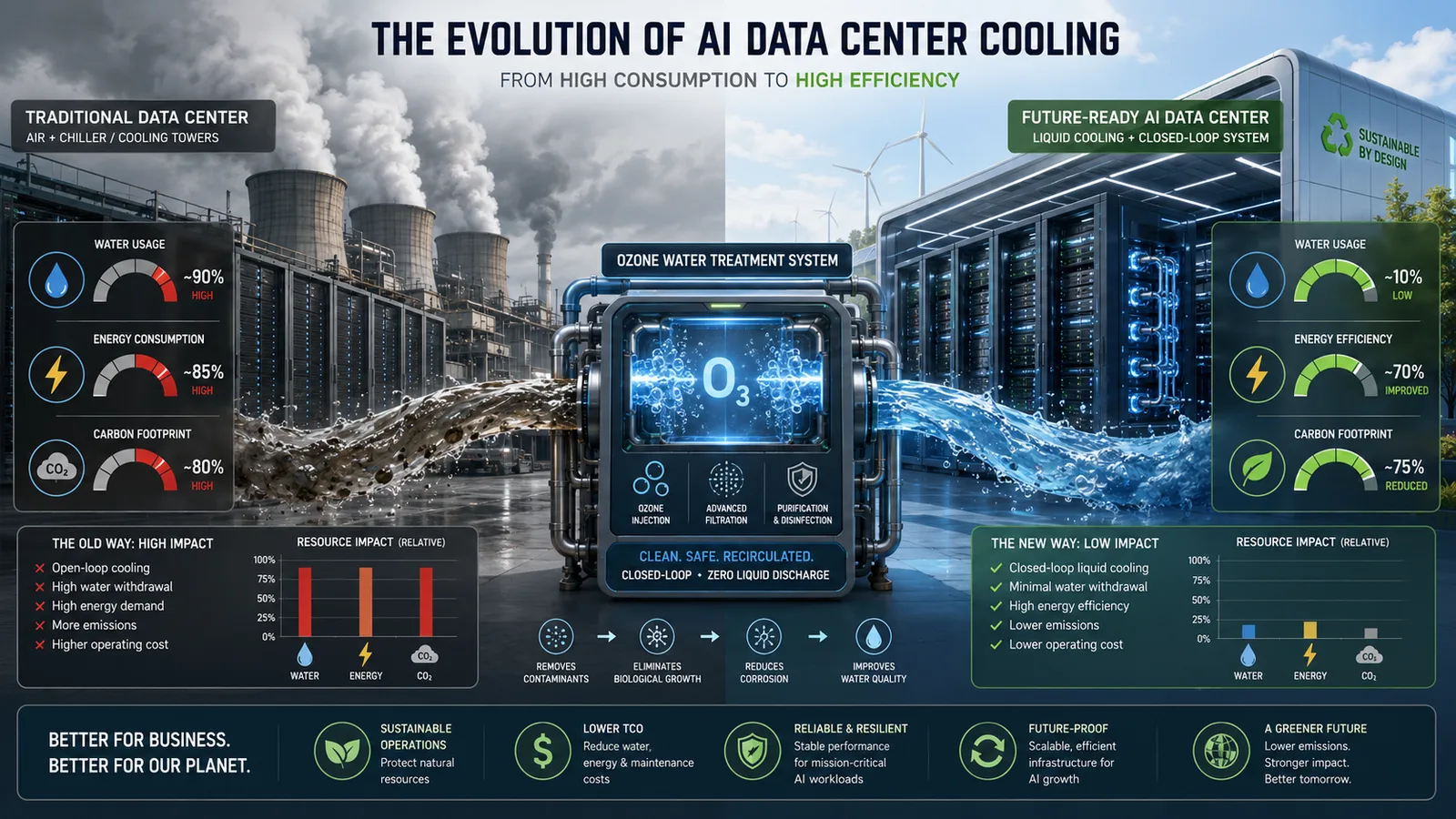
The AI industry is shifting from traditional water-hungry evaporative cooling systems to more efficient liquid cooling and closed-loop technologies. These newer systems drastically reduce water consumption and, in many cases, eliminate evaporation entirely. Companies like Microsoft are already rolling out these solutions, and AI-powered optimization is further cutting energy use for cooling.
However, some wastewater will still be generated from data centers. This discharge is typically warmer and contains added chemicals, minerals, and contaminants. Treating this water is especially difficult for local municipal plants because of its high temperature, chemical content, and high mineral concentration, which can overwhelm existing treatment systems and lead to poorer downstream water quality.
Terra Tech’s ozone and quantum-enabled oxygen treatment technology offers an effective approach for handling this remaining wastewater. Their system breaks down organic contaminants at a molecular level and restores dissolved oxygen without using harsh chemicals. This allows the discharged water to be cleaned more effectively and returned to the environment in better condition.
Looking ahead, the next two years will bring even greater progress. Widespread adoption of direct-to-chip and immersion cooling, along with new server-level spray cooling systems, will further slash both water and energy use. Closed-loop designs that recycle the same water with zero evaporation are moving from pilot to standard.
Operators are also advancing waste-heat recovery, capturing server heat to warm buildings and district heating networks rather than wasting it. These innovations are making AI infrastructure significantly gentler on both water resources and our Mother Earth.