Executive Summary
This living draft proposes a practical, nonpartisan pathway for bringing Peace Through Unity into community life through Town Halls, Talking Circles, consultation, and united action. Offered through Four Worlds and Compassion Games International, it carries forward the commitment to Choose Peace, Live Peace, End War. The proposed September–December 2026 process will bring people together across differences to strengthen relationships, address shared concerns, and build cooperation from the community level to the wider Human Family.
The foundation is the Sixteen Guiding Principles for Building a Sustainable, Harmonious, and Prosperous World, expressed in the understanding: “Starting from within, working in a circle, in a sacred manner, we heal and develop ourselves, our relationships, and our world.” Healing, clear vision, justice, participation, cultural integrity, spiritual and moral development, and care for Mother Earth will guide the work. People of every political background and spiritual tradition are welcome, with a shared agreement to practice respectful listening and leave campaigning, personal attacks, and adversarial politics outside the circle.
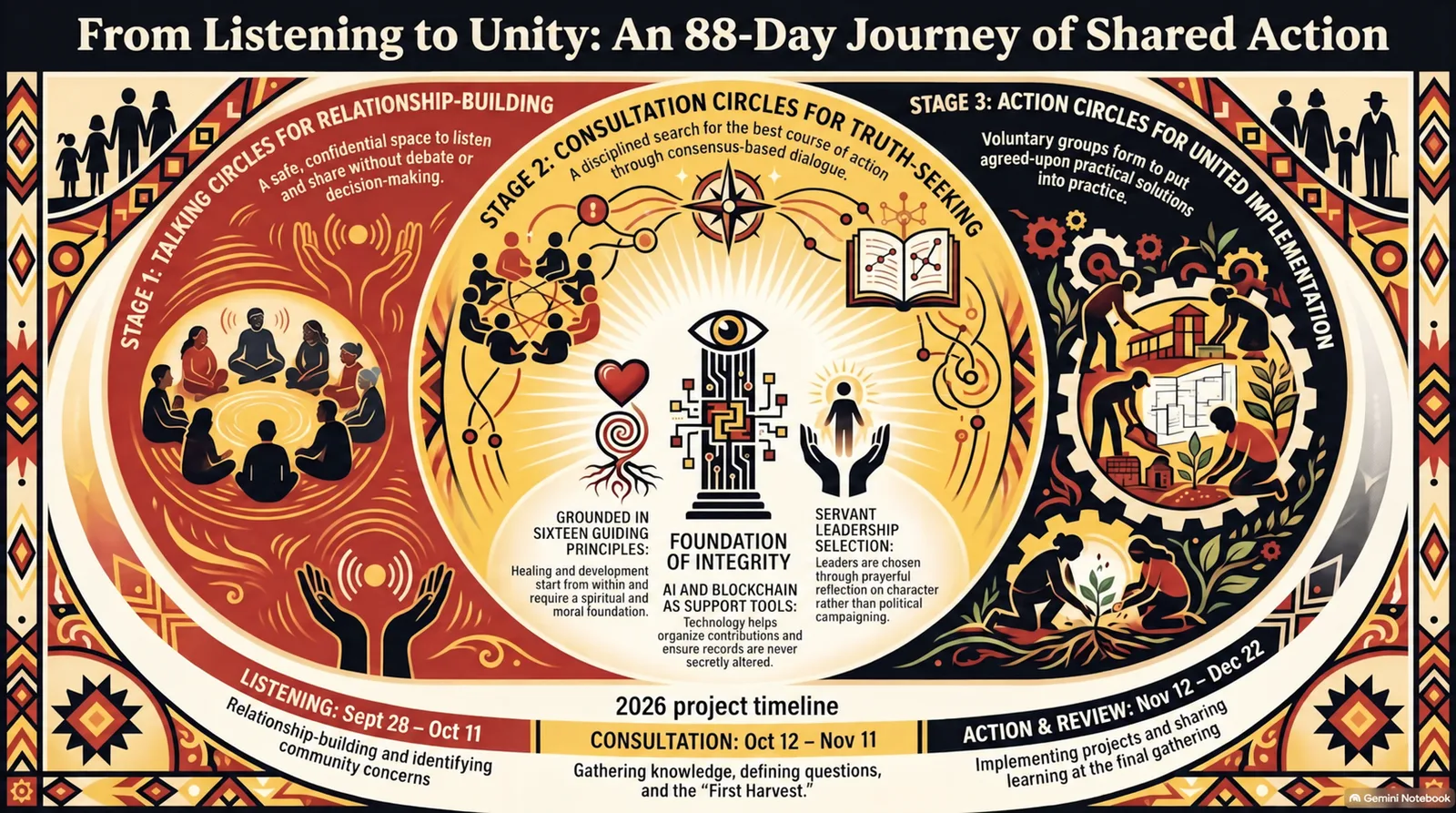
The process will move through four connected stages. Talking Circles will create a confidential space for people to share their experiences, concerns, hopes, and gifts, building trust before seeking solutions. Consultation Circles will define the issues, identify guiding principles, gather knowledge, hear those most affected, and seek the wisest course of action. Action Circles will carry agreed proposals forward with clear responsibilities, resources, timelines, and accountability. Review Circles will examine results, correct mistakes, and bring the learning into the next round of consultation.
Consensus will be sought first. Where it cannot be reached, circles may use a decision process agreed upon beforehand, including an appropriate majority threshold. Every decision must respect human rights, Indigenous sovereignty, treaty rights, cultural authority, and Free, Prior, and Informed Consent. Participants will support properly reached decisions while retaining clear ways to raise concerns, address harm, and reconsider decisions as new understanding emerges.
The Good Machine will be a core part of the entire process, connecting people, knowledge, circles, and opportunities for united action. It will provide the main doorway for participation, help welcome and orient people, connect them with appropriate circles, and bring relevant learning materials into their work. It will connect approved learning across communities, help identify shared concerns and emerging agreement, and enable circles to find one another and act together at local, regional, bioregional, national, and international levels. This capacity to connect each circle with the larger whole is central to the proposal. People and communities will retain authority over their knowledge, consent, and decisions.
Participation agreements and fair human oversight will protect the process. A growing learning library will draw on more than four decades of Indigenous-led work through Four Worlds and its partners, including the Sacred Tree teachings, healing, consultation, servant leadership, women’s equality, youth and Elder engagement, sustainable development, and protection of Mother Earth. Communities will adapt these resources to their own cultures and circumstances.
Artificial intelligence will help organize approved records, prepare draft summaries and translations, retrieve relevant knowledge, and identify connections among circles. People will approve every official summary and retain authority over every decision. Personal stories and sacred or culturally protected knowledge will remain under the control of those to whom they belong. Participation will not require placing personal experiences into an AI system.
A common recording structure and a living map of agreement will help learning move among local, regional, bioregional, national, and international circles. Records will distinguish what has been heard, what remains under consultation, where agreement exists, and what is unresolved. Larger circles will respect local authority, and shared patterns will not be presented as consent or representation that communities have not given. This will allow cooperation on concerns ranging from youth, Elders, housing, food, and water to reconciliation, disarmament, climate, and redirecting resources toward life.
On September 28, 2026, at the conclusion of the 99 Days of Peace Through Unity Ceremony, we will convene two Core Consultation, Planning, and Implementation Circles via Zoom. The first will meet from 1–3 p.m. Eastern Time (10 a.m.–noon Pacific Time), and the second from 8–10 p.m. Eastern Time (5–7 p.m. Pacific Time). These two meeting times will give people across Mother Earth an opportunity to participate in shaping and carrying forward this next stage of Peace Through Unity.
Listening and relationship-building will lead into issue-focused consultation during October. A first gathering of findings and commitments will be shared on November 11, followed by continued action and learning. Enlightening Our Way Together, December 18–22, will bring forward community reports, prayer, music, art, research, and practical experience to shape the work continuing into 2027.
A small Stewardship Circle and working team will prepare participation agreements, facilitator guidance, privacy protections, learning resources, and initial pilot circles. Success will be measured by whether people feel heard, trust grows, decisions improve, and united action makes life better. The proposal will remain a living draft, growing through participation, experience, and collective ownership as communities learn to embody the peace they seek.
Everything we offer through Four Worlds and Compassion Games International and Four Worlds is a living draft. Always open to input, deeper understanding, and the gifts and experience of others. We are in draft ourselves. In this understanding, the universe is in draft: creation continues, relationships unfold, and new possibilities emerge. There is always more to learn, more to understand, and more we can become together.
This proposal carries that same spirit. As we listen, consult, act, and reflect on what our actions teach us, it will grow through our collective participation. Each person brings something that can help the whole see more clearly. Our commitment to peace remains firm, while our understanding of how to live that commitment deepens through experience, humility, and relationship. We begin with what we understand today, with open hearts and minds for what we will discover together.
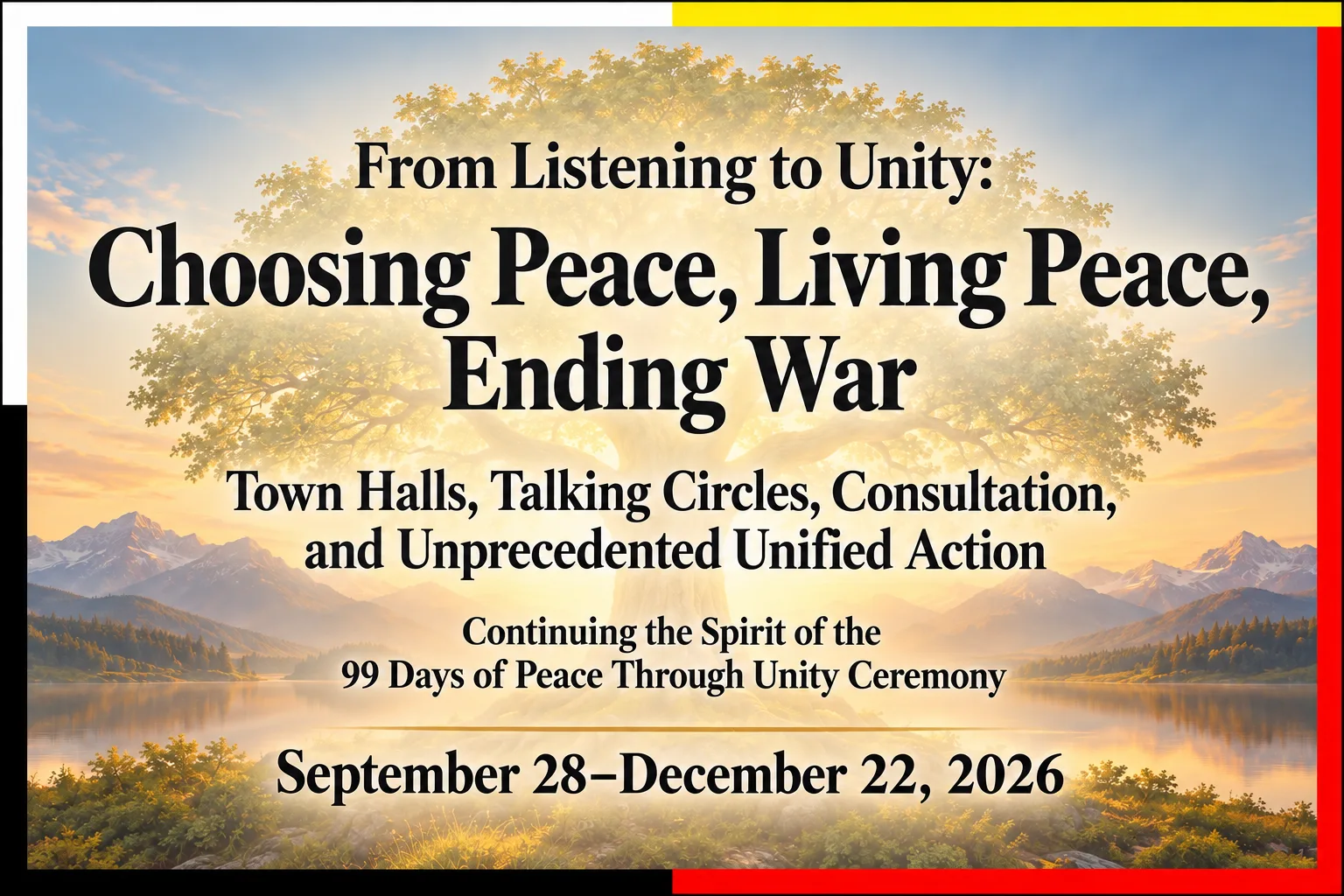
Moving from Listening to Unity Through Town Halls, Talking Circles, Consultation, and Unprecedented Unified Action for Planetary Peace
Our nonpartisan process for people to come together, build relationships, consult on the issues affecting their communities, and find practical ways forward will begin as the 99 Days of Peace Through Unity Ceremony concludes on September 28, with a Zoom meeting with a Core Consultation and Planning Circle.
This is not a political campaign, a new party, or an effort to advance candidates or partisan positions. People from all political backgrounds, including those with no political affiliation, are welcome. When they enter the process, they will agree to leave adversarial politics outside the circle. The purpose is not to determine who is right or wrong, or who is for us and who is against us. The purpose is to listen, understand, consult, and work together.
The process will be grounded in the Sixteen Guiding Principles for Building a Sustainable, Harmonious, and Prosperous World:
Starting from within, working in a circle, in a sacred manner, we heal and develop ourselves, our relationships, and our world.
These principles teach us that people can transform their world, that development comes from within, that healing is necessary, and that a clear vision is essential. They remind us that everything is interconnected, that development cannot happen without unity, participation, and justice, and that development must have a spiritual and moral foundation. They call us to honor culture, continue learning, live sustainably, move toward the positive, and become the change we want to see.
How People Will Enter
The Good Machine will provide the main doorway into the process. Anyone wishing to participate will introduce themselves, say where they come from, explain why they want to join, identify the issues they care about, and describe what they can contribute.
Every person will receive a straightforward orientation before joining a circle. The orientation will explain the Sixteen Guiding Principles, the difference between a Talking Circle and a Consultation Circle, confidentiality rules, and expected participant conduct. Each person will agree to listen respectfully, speak truthfully, avoid personal attacks, protect confidential information, and refrain from political campaigning, recruitment, harassment, or deliberate disruption.
The Good Machine will help determine the most appropriate first circle for each participant, considering language, location, interests, experience, culture, accessibility, and the gifts they wish to offer. New participants will normally begin with an orientation circle or Talking Circle. This will allow people to understand the process and allow relationships to grow naturally before anyone enters deeper consultation or takes on responsibility.
The screening process will be based on conduct and intention, not political belief. A No oneill no excluded because they are conservative, progressive, Green, independent, religious, secular, or hold an unpopular opinion. Honest differences are necessary for real consultation. What will not be accepted are threats, harassment, racism, dehumanization, undisclosed recording, violations of confidentiality, deliberate sabotage, personal attacks, or repeated refusal to follow the agreements of the circle.
No screening process can know everything about a person in advance. The Good Machine will therefore combine clear agreements, orientation, human judgment, supported participation, and fair accountability. Sensitive roles—including facilitators, recorders, moderators, interpreters, youth-circle leaders, and those handling confidential knowledge—will require additional preparation and, where appropriate, references.
If a participant breaks the agreements, the first response, when safety permits, will be a direct and respectful conversation. The person will be reminded of the purpose, allowed to understand the concern, and encouraged to correct their conduct. Serious or repeated violations may lead to a pause or removal. Trained people, not an automated score, will make important decisions about participation, and a fair review process will be in place.
The Good Machine will collect only the information needed to support the process. Personal information, circle conversations, and Indigenous or culturally protected knowledge will not be used for surveillance, commercial purposes, political targeting, or public distribution. Technology will serve the people and the circles. It will not replace their judgment or authority.
The First Stage: Talking Circles
Everyone will begin with relationship-building. Talking Circles will give people a safe place to introduce themselves, speak from their lives, hear what others have experienced, and begin to understand ththeir communities’trengths and concerns wTalking Circles are not debates and are not decision-making meetings. No one is expected to defend a position or propose an immediate solution. Participants listen without interrupting, correcting, arguing, or giving unwanted advice. Each person has an opportunity to speak, and each person may also choose to pass.
The questions can be simple: What is happening in your community? What are people carrying in their hearts? What is hurting? What is healing? What do you want for your children and future generations? What gifts and strengths already exist? What do you wish others understood?
What is shared personally in a Talking Circle remains confidential unless the person gives clear permission to share it. The circle may identify common themes, but no one’s story or words will be attributed outside the circle without consent.
The Talking Circle is where people begin to move beyond labels. They meet each other as human beings before meeting each other as representatives of political positions, professions, organizations, cultures, or interests. This relationship-building is not separate from solving problems. It is the foundation that makes honest problem-solving possible.
The Second Stage: Consultation Circles
As trust grows, participants who wish to address a particular issue may move into a Consultation Circle. Consultation is different from ordinary political discussion. It is not about winning an argument, protecting a personal position, or defeating an opponent. It is a disciplined search for truth and for the best course of action.
A Consultation Circle begins by clearly defining the issue. It then identifies the principles that should guide the response. The group gathers the information it needs, including lived experience, Indigenous knowledge, community wisdom, history, research, science, and professional knowledge. It ensures that the people most affected are heard and that everyone understands the information before reaching conclusions.
Each person is encouraged to speak freely, honestly, and respectfully. Everyone should have an opportunity to speak once before anyone speaks twice. Participants may challenge ideas, but they do not attack people. Once an idea is offered, it belongs to the circle. The person who offered it does not have to keep defending it. The circle may strengthen it, combine it with other ideas, change it, or set it aside.
The facilitator listens for areas of agreement, important differences, missing information, and possible courses of action. If something essential is missing, the group pauses and seeks the needed knowledge or invites the missing voices. The purpose is not to force a quick result. The purpose is to reach the wisest decision the circle can make.
The Principles of Consultation
Every Consultation Circle will follow the same basic principles. Participants will respect every person and welcome diversity. The circle will consider every contribution, and none will be belittled. People will be free to express their views, as long as they do so respectfully. Everyone will listen carefully and be willing to recognize truth in another person’s contribution.
The circle will remain focused on its purpose. Participants will share a desire for the whole’s well-being, even when they disagree about how to achieve it. Differences will be treated as a possible source of greater understanding. Participants will release ownership of their ideas and will not turn consultation into a struggle between personalities.
The atmosphere will be warm, loving, truthful, and disciplined. The circle will seek consensus. When consensus cannot be reached after full consultation, it will follow the decision process agreed upon before the discussion began.
The Steps of Consultation
Each circle will move through a straightforward process. It will first prepare the relationship by identifying the people, rights, territories, knowledge, and interests involved. It will clearly define the question and ensure the people most affected agree that the question is framed properly.
The circle will identify the principles that apply. It will clarify who is offering advice, who is affected, who has authority to decide, and what consent is required. It will then gather knowledge without judging it too early and make sure the information is understandable across languages, cultures, generations, and different levels of education or expertise.
Everyone will be given a fair opportunity to speak. The group will examine differences without personalizing them and will release ownership of the ideas offered. A facilitator or another participant will bring the strongest parts together into a possible way forward.
The circle will then ask whether anything essential has been left out. It will consider likely consequences, required resources, effects on relationships and Mother Earth, and the interests of future generations. It will seek consensus, make and record the decision, name responsibilities, and establish a time to review what happened.
Finally, the participants will act, learn, correct, and renew. Consultation is not complete when people leave the meeting. Its truth is tested through action.
How Decisions Will Be Made
Consensus will always be sought first. Consensus does not mean that everyone must think exactly alike. It means that the circle has made every sincere effort to hear the appropriate voices, understand the facts, consider the principles, and find a course of action people can support.
If consensus cannot be reached after free, prior, informed, warm, loving, and thorough consultation, the group may use the majority process it agreed upon beforehand. For important decisions, the circle may choose a higher threshold than a simple majority. The threshold must be settled before the disagreement arises, not changed to secure a desired result.
A majority cannot override Indigenous sovereignty, treaty rights, human rights, sacred knowledge, or the proper authority of the people directly affected. When the rights, lands, waters, knowledge, or future of Indigenous Peoples are involved, Free, Prior, and Informed Consent must be respected according to the laws and protocols of those Peoples.
Once a proper decision has been made, the participants will support it wholeheartedly, even when it was not everyone’s first choice. They will not work privately to undermine it or make it fail. The understanding is simple: if the decision contains an error, united action will make it clearer and easier to correct than disunity and divided implementation.
This does not require blind obedience. Every decision will include a review date and a way to bring forward new evidence, unintended harm, changing circumstances, or a concern about rights. Unity includes the willingness to admit mistakes, repair harm, and consult again.
The Third Stage: Action Circles
When a Consultation Circle agrees upon a practical response, people who wish to carry it forward may form an Action Circle. Participation will be voluntary. Some will offer time, research, skills, funding, technology, translation, prayer, ceremony, art, communications, mentoring, or community relationships.
Each Action Circle will state clearly what it intends to do, who or what it will serve, which principles guide it, who has authority, what resources are needed, who is responsible, how long the work will take, and when the results will be reviewed. It will report honestly about what was accomplished, what did not work, what was learned, and what should happen next.
This creates a natural movement. Talking Circles build relationships. Consultation Circles find a way forward. Action Circles put agreed ideas into practice. Review Circles bring the learning back so that the next decision can be wiser.
The Learning Library
Participants will have access to a growing library of learning drawn from more than four decades of Indigenous-led community development, healing, education, consultation, and practical work through Four Worlds and its many partners.
The library will include the Sixteen Guiding Principles, the Sacred Tree teachings, the principles and steps of consultation, Talking Circle guidance, approaches to healing and reconciliation, culturally based development, community participation, servant leadership, youth and Elder engagement, the equality and leadership of women, sustainability, economic development, and the protection of Mother Earth.
It will also carry what Indigenous Peoples and communities have learned about moving from hurt to healing. Communities that have experienced colonization, violence, poverty, forced displacement, addiction, racism, cultural loss, or other deep wounds are not empty or broken. They carry knowledge, relationships, language, culture, spiritual strength, memory, resilience, and the power of renewal. Healing and development begin by recognizing these inner strengths and supporting people to become the principal authors of their own future.
The library will not present one rigid program that must be imposed everywhere. It will offer principles, teachings, stories, tools, research, recordings, music, and examples that communities can adapt to their own cultures and circumstances. People can prepare before a circle, deepen their understanding afterward, and bring relevant materials into consultation.
The Good Machine can help people find materials related to the questions they are addressing. It can support translation, accessibility, and connections between people working on similar issues. Human knowledge keepers will guide the meaning and appropriate use of the materials, especially when they involve Indigenous or sacred knowledge.
How Artificial Intelligence Can Support the Process
Artificial intelligence can help us listen across many circles without losing sight of where each contribution came from. Its role is to support human understanding, not replace human judgment. AI will not decide whether a circle has reached consensus, determine whose words matter more, or make decisions for a community. It can help people organize what has been shared, check whether anything important has been missed, find connections between circles, and return the results to the people for confirmation.
Tools such as NotebookLM, now called Gemini Notebook, can create a trusted digital notebook for each circle. With the circle’s permission, that notebook may contain the approved meeting transcript, the recorder’s notes, relevant materials from the learning library, local reports, research, maps, and earlier circle harvests. Because the notebook draws on its sources, participants can ask questions about their own material and trace a summary back to the source.
At the end of a meeting, AI can prepare a first draft of the circle record. It can identify the main concerns, the principles mentioned, the knowledge offered, areas of agreement, areas where views remain different, unanswered questions, missing voices, and possible next steps. It can also separate personal stories from proposals, facts from opinions, and decisions from matters that still require consultation.
The draft will then return to the circle. The participants—not the AI—will decide whether it is accurate. They may correct the language, restore something that was overlooked, remove something that should remain confidential, or reject the summary and prepare their own. Nothing will be treated as an official circle harvest until the circle has approved it.
AI can also help make the process more accessible. It can prepare plain-language summaries, translations, audio versions, visual maps, short briefing documents, and questions for further reflection. People who prefer listening may hear an audio overview. People who think visually may explore a map of the themes and relationships. Participants joining in different languages may receive translated versions, with bilingual people reviewing important language before it is relied upon.
The technology can support the facilitator throughout a consultation without directing it. It can maintain a list of unanswered questions, identify information the group agreed to seek, retrieve relevant materials from the learning library, and prepare a comparison of proposals. It can show where two differently worded ideas may share the same underlying principle. It can also warn the facilitator when a conclusion in the draft record does not appear to be supported by the approved sources.
The purpose is not to use AI to push people toward artificial agreement. Genuine consensus cannot be calculated by counting repeated words or measuring sentiment. Sometimes a quiet voice carries the most important truth. Sometimes a minority concern identifies a danger that the majority has not yet seen. AI may show patterns, but the circle must determine their meaning.
From One Local Circle to the Larger Whole
Imagine that twelve people hold a Talking Circle in Walla Walla, Washington. They speak about young people leaving the community, pressure on water and farmland, loneliness among Elders, the need for cultural renewal, and the lack of places where people from different backgrounds can meet without arguing about politics.
With permission, the meteam recordsr carefully dodocuments the meetingThe participants are told in advance what will be recorded, how it will be used, who may see it, and what will remain confidential. The team removes or protects personal stories not intended for sharing before any material enters the larger system.
The approved record and relevant learning materials go into the Walla Walla circle’s digital notebook. AI prepares a draft harvest. It may show that the circle heard five central concerns: youth belonging, water, food and land, Elder connection, and the need for nonpartisan community relationships. It may also identify strengths already present: experienced farmers, Indigenous knowledge, youth leadership, local schools, spiritual communities, arts organizations, and people willing to convene further circles.
The Walla Walla participants review this draft together. They correct it and approve the final harvest. They may decide that they are not yet ready for solutions and need two more Talking Circles. Or they may choose one issue, such as youth belonging, for a Consultation Circle.
The Good Machine then compares the approved Walla Walla harvest with approved harvests from other places. A circle in Yakima may also be concerned about youth, water, agriculture, and cultural continuity. A circle in Spokane may be discussing loneliness among Elders. A circle in British Columbia may have developed a successful intergenerational mentoring process. AI can identify these possible connections and bring them to human coordinators, who can ask the circles whether they wish to meet.
Nothing is merged automatically. Walla Walla keeps its own voice and record. Yakima keeps its own. Spokane and the British Columbia circle keep theirs. The Good Machine simply shows that related wisdom, needs, and gifts may be present. Each circle chooses whether to connect.
If several circles agree to meet, a regional or bioregional Consultation Circle can be formed. Before that meeting, AI can prepare a briefing based only on the approved local harvests. The briefing can show what the circles clearly share, where their situations differ, what solutions have already been tried, what knowledge is missing, and what matters must remain under local or Indigenous authority.
The regional circle then consults. It may find broad agreement on an intergenerational youth and Elder initiative, but no agreement yet on a regional water proposal. The record should say exactly that. Consensus on one matter must not be used to imply consensus on another.
The agreed regional harvest can later be compared with other regional and bioregional harvests. InThisay, learning can move from Walla Walla outward without beleavingalla Walla. Local circles remain the source. Larger patterns emerge from their approved contributions.
A Living Map of Agreement
The Good Machine can maintain a living map of the consultation process. It can show where circles are located, the issues they are considering, the principles they are applying, the gifts and needs they have identified, and the stage they have reached. It can also show the strength and limits of agreement.
The map should distinguish clearly among several conditions. A matter may have been heard, meaning it arose in a Talking Circle. It may be under consultation, meaning no conclusion has been reached. It may show emerging convergence, meaning several circles are moving toward a similar understanding. It may have local consensus, regional consensus, or broad convergence across many circles. It may also remain unresolved, or require the consent and decision of a particular Nation, people, community, or rights-holder.
These distinctions prevent exaggeration. Ten circles expressing a similar idea do not automatically speak for a whole country. A global pattern does not override a local reality. Numerical popularity does not replace Free, Prior, and Informed Consent. The map is a picture of the consultation, not a claim of authority that the process does not possess.
When many approved harvests show a genuine area of convergence, the Good Machine can bring the evidence together. It can display the exact principles involved, the communities contributing, the different words they used, any cautions they raised, and the actions they are prepared to support. The people can then determine whether the convergence is strong enough to become a shared commitment.
A Common Digital Structure
For this process to work, every circle should answer a small set of common questions while remaining free to add what its culture and situation require. The digital record should state what question was considered, who participated in general terms, what principles guided the circle, what knowledge was considered, what was heard, where agreement emerged, what remains different, what is confidential, whose consent or authority is still required, what action is proposed, and when the matter will be reviewed.
Using the same basic structure allows AI to compare hundreds or thousands of circle harvests without flattening them into one voice. Each conclusion remains connected to its source. Participants should be able to move from a broad summary back to the regional harvest, then to the approved local harvest that supports it.
NotebookLM or a similar source-grounded system can hold separate notebooks for individual circles, topic consultations, regions, and the overall process. Only approved material should move from a private local notebook into a wider regional or global notebook. Access should follow the permissions the circle establishes.
The learning library will form another trusted source. When a circle addresses community healing, youth development, leadership, water, economic development, or another concern, AI can bring forward relevant Four Worlds teachings, Indigenous knowledge approved for this use, earlier experiences, research, and practical tools. The circle can learn from what has already been discovered without being told that one model must fit every community.
Human Stewardship and Protection
Every use of AI in this process will be governed by consent, privacy, cultural authority, and human review. Talking Circles should not be recorded unless participants have freely agreed. Participants must be able to join a circle without entering a personal story into an AI system. Sacred, ceremonial, culturally restricted, legally protected, or highly personal material will not be uploaded simply because it was spoken.
Each circle will decide what remains private, what may be summarized, and what may enter the wider Peace Through Unity process. Indigenous knowledge will remain under the authority of the people and knowledge keepers to whom it belongs. The system must include the right to remove or correct material.
AI summaries can be incomplete or wrong. Names, cultural meanings, emotions, humor, silence, and a circle’s deeper spirit can be misunderstood. Every important summary, translation, comparison, and claim of agreement therefore requires human validation. Where accuracy or cultural meaning is uncertain, the system must say so rather than present an interpretation as fact.
AI will never vote, declare consensus, decide who represents a community, or rank the worth of people’s contributions. It can help us see; it cannot replace the circle. It can help us remember; it cannot carry the spiritual and moral responsibility of making a decision. That responsibility remains with the people.
Used in this way, digital technology can become a form of collective memory and a bridge between circles. It can help a local voice be heard without being absorbed, help communities find one another without being controlled, and help the Human Family recognize where unity is already emerging. The final goal is not a larger collection of data. It is stronger relationships, clearer understanding, wiser consultation, and united action in service to life.
Circles at Every Level
The same process can be used at different levels. Local circles may address family well-being, housing, food, education, youth, Elders, healing, safety, or nearby lands and waters. Regional circles may address fires, transportation, health services, migration, watersheds, or food systems. Bioregional circles may follow rivers, forests, oceans, mountains, and ecosystems that cross political boundaries.
National circles may consult about reconciliation, justice, economic priorities, public policy, and peace education. International and global circles may address war, disarmament, climate change, humanitarian action, artificial intelligence, human rights, and redirecting resources from destruction toward life.
The larger circles will not control the smaller ones. Local knowledge and community authority must be respected. The Good Machine will help related circles find one another, share what they are learning, and work together where cooperation will help.
What Each Circle Will Share
Each circle will prepare a short record of what it learned. It will identify the topic, the principles used, the main concerns, the central wisdom, the areas of agreement, the important differences, the voices or knowledge still missing, and the recommended next step.
Talking Circle reports will contain general themes, not personal stories or names. Consultation reports will clearly distinguish between evidence, lived experience, proposals, agreements, cautions, and unresolved questions. Confidential, personal, sacred, or culturally protected knowledge will not be published.
These reports will become part of a shared Peace Through Unity learning process. They will help everyone see what concerns are appearing in different places, what solutions are emerging, what resources are needed, and where people can assist one another.
The Schedule
On September 27, we will complete the first 99 Days of Peace Through UnUnity Ceremony, with Consultation and Planning Circle, via ZoomWe will inintroducehe Good Machine entry process, the learning library, and the first Talking CiCirclesFrom September 28 through October 11, the main focus will be listening and relationship-building. People will enter Talking Circles, facilitators will be trained, and participants’ main concerns and hopes will begin to emerge naturally.
From October 12 through October 25, circles will begin organizing around the questions that arose during the listening period. They will identify ththoseost affected, gather knowledge, study thlevant principles, and invite voices that may be missing.
From October 26 through November 5, Consultation Circles will work toward practical proposals and areas of agreement. Where participants are ready, Action Circles will begin to form.
From November 6 through November 10, we will gather the first harvest. It will show what was heard, what was learned, where agreement is emerging, what remains unresolved, and what commitments people are prepared to make.
On November 11, we will gather in remembrance and recommitment. We will remember those who have suffered through war, violence, injustice, and the destruction of Mother Earth. We will share the first consultation harvest and announce the actions that people and communities are ready to carry forward.
From November 12 through December 17, the circles will continue. Action Circles will begin their work, new people will enter Talking Circles, and Consultation Circles will refine their proposals in light of experience.
From December 18 through December 22, we will gather for Enlightening Our Way Together. We will share what has been learned, what has changed, what needs correction, and what should be carried into 2027. The gathering will include consultation, community reports, prayer, music, art, stories, research, and living examples of people putting the principles into practice.
December 22 will not end the process. It will gather the clearest learning and commitments into the next stage.
What Is Needed to Begin
A small Stewardship Circle will be formed to protect the purpose and nonpartisan character of the process. It will include people from different cultures, generations, regions, and fields of experience. Its responsibility will be to uphold the agreements, oversee facilitator preparation, protect privacy and safety, address serious concerns fairly, and ensure that no organization or political interest takes control.
A working team will prepare the short orientation, participation agreement, facilitator guide, Talking Circle guide, Consultation Circle guide, record and harvest forms, privacy and consent standards, and the first part of the learning library. The team will also establish the Good Machine entry and matching process.
We will begin with several pilot circles drawn from the people and organizations already connected through Peace Through Unity, Compassion Games International, Four Worlds International Institute, Indigenous networks, peace organizations, spiritual communities, youth networks, educators, artists, community developers, and other partners. We will learn from these first circles and improve the process before opening it more widely.
The first measure of success will not be how many people register. It will be whether people feel heard, whether trust grows, whether participants can remain in relationship across differences, whether decisions become wiser, and whether agreed actions actually improve life.
The Way Forward
We will begin with relationship. We will listen before we attempt to solve. We will consult before we decide. We will seek consensus before we vote. When we reach a proper decision, we will act together and learn together.
We are not asking people to become the same. We are asking people to discover how their different knowledge, experience, and gifts can serve a shared purpose.
The way forward is not adversarial politics. The way forward is relationship-building, honest consultation, principled decision-making, and united action.