From Laighin to Lane: A Story of Exile and Endurance in Manchester, and a Journey Home to Standing Rock
The name Lane carries within it a silence, an echo of a deeper, older name: Laighin, sometimes rendered Leighton in English phonetics. It is a name that once spoke of place, kinship, and sacred belonging on the soil of Ireland. It is not a name that was lost, but one that was forced into hiding, not forgotten, but reshaped in the crucible of survival.
My grandfather, Fred Lane, on my father’s side, carried this name not as an inheritance freely passed down through generations of peace, but as a name bent by trauma, anglicized by necessity, stripped of its rhythm, its accent, its spirit. Beneath the single syllable "Lane" lies the story of an ancient people, torn from their land, from their language, and their dignity.
It was not by choice that Irish families like ours found themselves pressed down into Manchester, that grey, industrial sprawl rising in the north of England. This was no migration of opportunity, it was a forced descent, a flight from terror, hunger, and colonial cruelty.
The Long Descent into Manchester
The chain began with centuries of dispossession, from the Norman invasions to the Tudor conquests, but it was under Oliver Cromwell’s brutal campaign in the 17th century that this violence took a devastating scale. His soldiers burned villages, genocided many, confiscated ancestral lands, and deported thousands. Families were torn from their sacred homelands and shoved into foreign towns and colonies, treated as subhuman by the empire that had crushed them.
Then came An Gorta Mór, the Great Hunger. The Potato Famine of the mid-19th century was not merely a natural tragedy but a holocaust by hunger, born of greed and indifference. While food was exported by the ton, the Irish starved by the million. Another million took to the road of exile, walking with empty bellies and broken hearts, some finding themselves in places like Manchester, drawn by the promise of work in the mills, only to find grime, slums, and suffering.
Manchester: The City of Smoke and Survival
There, in that city of smoke and soot, my Irish ancestors, the Laighins, were among tens of thousands crammed into cellar dwellings, often five or more family members to a single damp, windowless room. The air was choked with coal smoke. Children were sent to the factories, where they worked 12-hour shifts. Typhus and cholera swept through the alleys like shadows. Signs in windows read: “No Irish Need Apply.” Still, the Irish endured.
They found solace in the church basements, in whispered stories, in shared sorrow, and in sacred songs carried across the sea. The flame of memory did not go out. It smoldered deep in the soul of Fred Lane, a man whose silence, whose endurance, bore the weight of generations of grief and quiet strength.
The Erasure of a Name, the Survival of a People
When Laighin became Lane, it was not simply the dropping of a prefix. This action was a colonial act of erasure, reducing a sacred lineage to a single English syllable. Yet even in that syllable, like a seed buried deep beneath scorched earth, the memory remained, of green hills, of belonging, of a people who would not be broken.
Fred Lane carried that name into the 20th century. He may not have known the full story, but it lived in his bones, in every quiet moment, in every act of love, in the strength with which he carried the pain of two peoples.
A Journey Home to Standing Rock
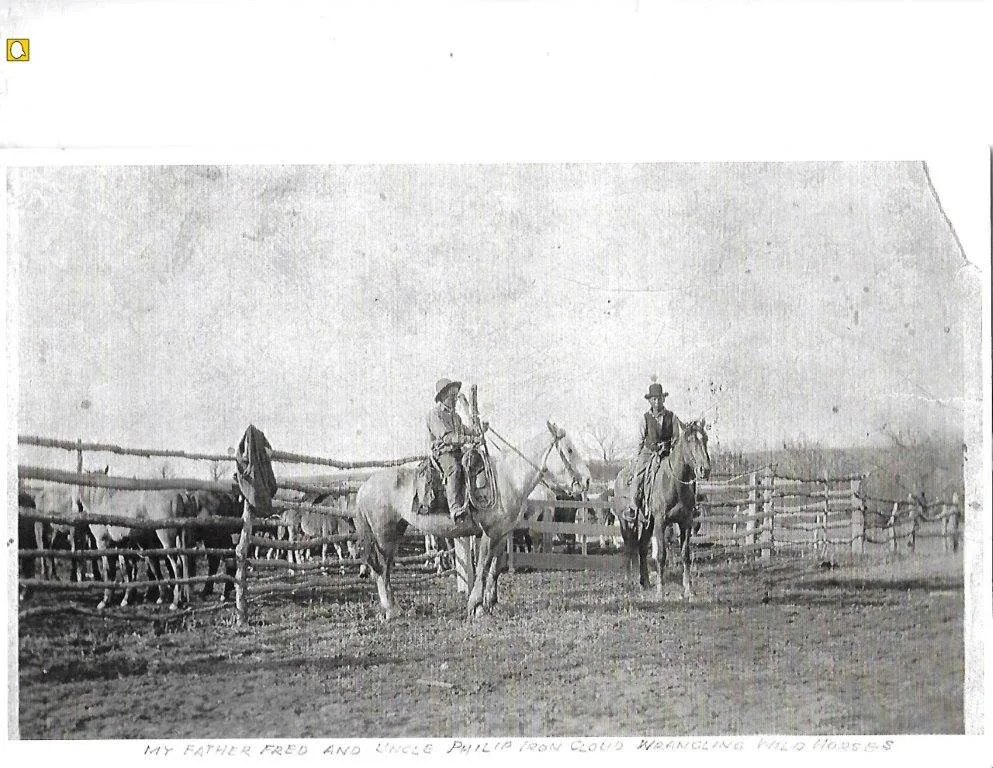
Like many Irishmen searching for a sense of belonging, Fred Lane found his way back to the Indigenous world. The journey took him across the ocean and over plains to the sacred lands of Standing Rock, where he met and married my grandmother, Lyma Deloria, who carries the legacy of another lineage, her father Tipi Sapa-Black Lodge(Philip Deloria) and her grandfather, Hinhan Wicasta, Owl Man, an Itacha and a leader of the Holy Man’s of the White Swan Dakota.
There, along Oak Creek, close to Wakpala, that my grandfather Fred found not only love but a home, a reconnection with Mother Earth, and with a people who, like his own ancestors, had known dispossession, exile, and endurance.
My grandfather, Fred, stayed by my side of my Grandmother, Lýma, at the TB Sanitarium, near Custer, South Dakota, until the very end, caring for the sanitarium’s cattle, including milk cows, as well as my father’s sisters, Elizabeth and Jean. His younger brother, Wilfred, was adopted by Fred and Elma Cadotte when my grandmother could no longer care for him, because of the TB.
It was there, at the TB Sanatorium, that my father, Mato GI, Phil Lane Sr., watched his mother die of tuberculosis when he was five years old.
My father told me that after his mother died, he never saw his father again. Being a great horseman, like my father, he told me that his father began to work at a racetrack training race horses, and my grandfather was murdered for refusing to dope race horses. Anyway, that is how the story was told.
Whatever, we have never surrendered spiritually, and never will, except to Wakan Tanka, and before we know it, we will all be together again!
“There is no death, only a change of worlds” -Chief Seattle.
A love that anyone may have had for anyone will not be forgotten in the spiritual world, nor will we forget our life in this physical world.
In the spiritual world, we will recognize one another. We will seek union, a spiritual union.
Our soul's relationship with our body is like the connection between a lamp and a mirror. If the mirror is polished and perfected, the lamp's light appears, but if the mirror is broken or covered with dust, the light remains concealed.
Our rational soul—the human spirit—does not descend into our bodies or exist through our physical bodies. It is just the opposite. Our soul is the substance and foundation upon which our body depends for existence.
The soul has no gender, race, ethnicity, or class. This reality makes all forms of prejudice, whatever they may be, intolerable and unacceptable. The soul is not divided. It is a reflection of the Oneness of our Creator.
Our soul is endowed with its unique individuality from the beginning of our existence in this physical world of time and space. Our soul does not acquire it because of our body.
The individuality and identity of our soul are strengthened in this physical world through our spiritual tests and challenges.
Our soul is independent of and the very source of our body's existence. If our body is destroyed, our soul and spirit remain unharmed.
Our soul, our human spirit, is independent of our physical body. Our soul is free and sanctified beyond this physical plane of time and space.
All the powers that distinguish us as human beings - reason, memory, abstract thought, creativity, inventiveness, and willpower - are all properties of our soul, not the body!
At the same time, it is very important always to remember that only hurt people hurt people, only colonized people colonize people, only abused people abuse people, and the long-promised time has come to leave this cycle behind forever, step into our spiritual adulthood, unite humanity, end war, and restore our Mother Earth.