
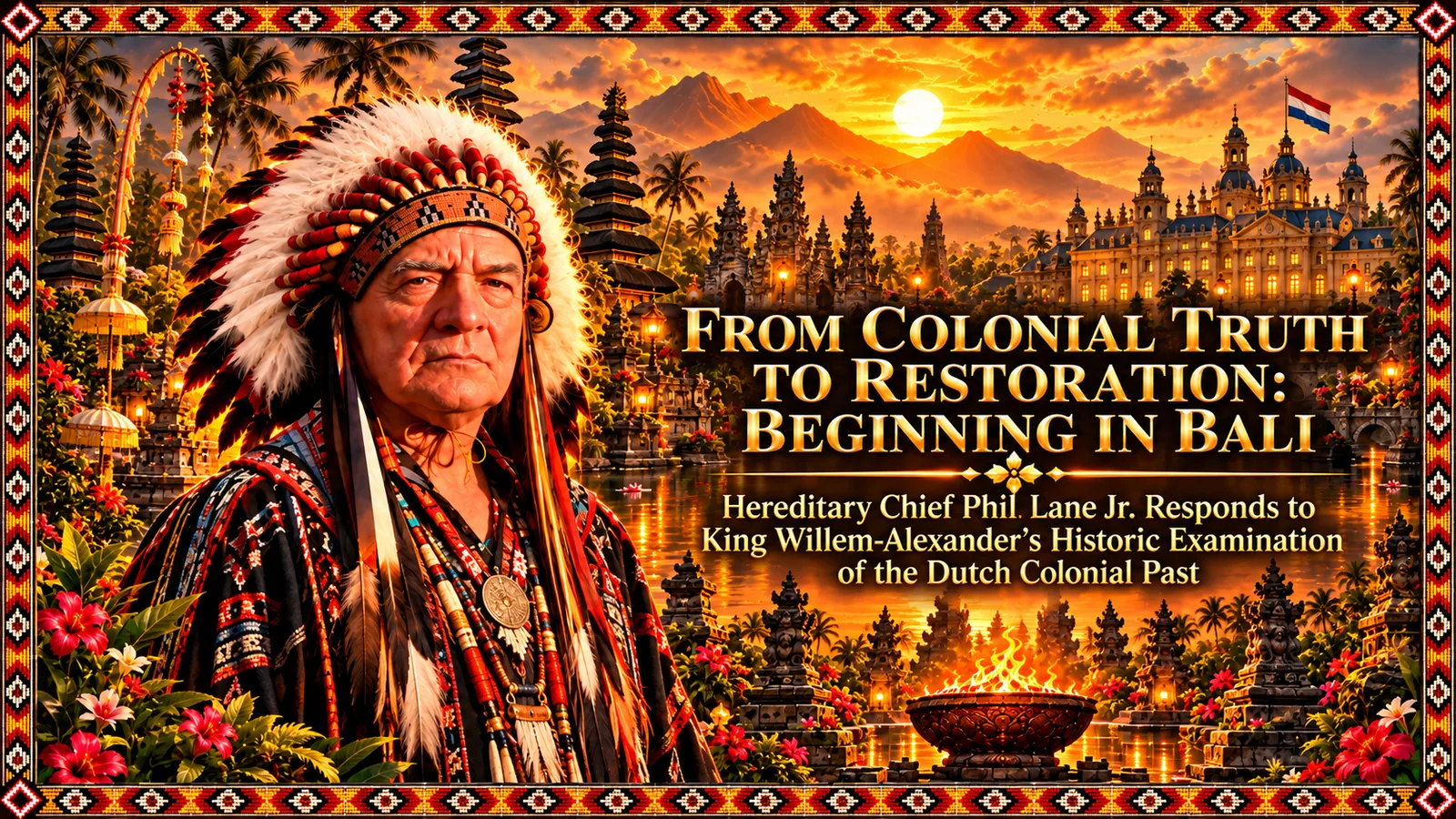
A Seventy-Three-Year Relationship
My spirit is tied to this Dutch journey of colonial truth, restoration, and reconciliation—through ceremony, kinship, and decades of shared service.
That journey began seventy-three years ago, in 1953, when my father taught me, an eight-year-old boy carrying our White Swan Dakota teachings, to pack my best toys and send them across the ocean to a boy my age in Rotterdam after the catastrophic North Sea flood. Ten years later, I had lunch with Hans and his family in Rotterdam.
Decades later, that early connection became a living circle of friendship and shared service. Beginning in 1995, introductions through a dear Dutch brother opened relationships that grew through Talking Circles, Principles of Consultation, and Teachings of the Sacred Tree, and living alongside relatives recovering from heroin at Nora’s Nest. We focused on healing ourselves, our families, and our communities.
Especially between 2003 and 2008, this work brought us into relationship with more than a hundred Dutch relatives — community leaders, businesspeople, military leaders, social workers, police, public officials, and people from diverse spiritual traditions. Through deep listening, consultation, and the teachings carried in The Sacred Tree and our Sixteen Guiding Principles, we explored how personal transformation and community development must grow together.
More than a hundred Dutch relatives also took up the sacred vow of the Staking Ceremony, giving personal expression to their commitment to walk these teachings in their own lives.
These relationships have continued through Four Worlds Europe and the enduring dedication of our Dutch relatives. They form a living foundation for renewing our work together: facing historical wounds honestly, bringing our gifts into shared service, and turning the recognition of our interconnectedness into practical action for the well-being of our Human Family.
The King Opens a Door
Now these two streams of my life have converged. Against that backdrop, the news from Leiden University reached me.
When I learned of King Willem-Alexander’s address at Leiden University on October 2, 2026, my heart was deeply moved. By undertaking an independent study of the colonial history of the House of Orange-Nassau, the King demonstrated moral and spiritual courage unmatched in modern history.
No colonial hereditary leader, no European monarch, and no church denomination has dared to step into the light of truth as he has. While leaders in Belgium, Britain, and Spain have offered words of sorrow or admitted past excesses, none has formally apologized for slavery and other related colonial acts, and not one has personally funded and made public an unvarnished examination of their own family’s colonial history.
The King looked at that difficult truth and declared that this accounting is not an ending, but a spur to positive action. For that honesty and leadership, we offer genuine praise and respect.
The State Enters the Reckoning
The King’s initiative did not remain a personal act. The Dutch Attorney General’s office affirmed that the independent study would proceed under full transparency, with its findings made public and its recommendations taken seriously by the government. That official endorsement matters: it means the reckoning is not merely a royal gesture but a matter of state.
When a state enters a reckoning, the stakes change. A monarch can apologize; a state can legislate, fund, and bind. The Attorney General’s affirmation signals that the Dutch government accepts the study’s findings as a foundation for policy — not a footnote to history.
This is where the questions raised in this reflection become questions the Dutch state itself has committed to answering. The invasion of Indigenous lands, the suppression of sovereign resistance, the intergenerational trauma carried across the Americas, Suriname, Indonesia, Maluku, and Papua — these are no longer matters for historians alone. They are matters for the government that inherited the empire’s debts.
The four-fold path proposed here — deep listening, inclusive consultation, united action, and continual reflection — offers a framework the state can adopt. Not as a replacement for the study’s archival work, but as its necessary complement: the ledgers tell what was extracted; the living voices tell what was lost.
When the state and the sovereign peoples sit at the same table, the reckoning becomes restoration. That is the door the King’s courage opened, and the Attorney General’s affirmation has now made it a matter of national record.
The Voices Left Out
Yet, as I sat with his words, I also listened closely to the voices of our relatives impacted by Dutch colonialism. While the study’s examination of the transatlantic slave trade is necessary and commendable, Indigenous peoples from the Americas to Suriname, and across the Indonesian archipelago — from Java and Sumatra to Maluku and Papua — felt a heartfelt sorrow. They recognized that something vast and essential had been left out.
The report focuses on slavery and institutional ledgers, but where is the reckoning with the invasion of Indigenous lands? Where is the acknowledgment of the violent suppression of sovereign resistance, the breaking of sacred customary life, and the deep intergenerational trauma carried by families to this very day?
When an empire examines its own history primarily through its own colonial records, the truth remains incomplete. Archives record what the colonizer wrote down, but oral tradition and human memory carry what was actually done. The descendants of those who lived through that conquest have not yet been fully invited into the circle to speak of what their families suffered and what is still needed for their lives to flourish.
This is not spoken in condemnation. It is offered as an invitation to complete what the King’s courage has opened. When King Willem-Alexander called this study a spur to action, he opened a doorway. What we must now address are precisely the truths that imperial ledgers could not hold: the living memory of sovereign peoples, the trauma still lingering in their soil, and the practical road to mutual restoration.
What follows, from Four Worlds and myself, is a brief unfolding of that history and that living relationship: the pattern of conquest across the archipelago, the sacred sacrifice of the puputans, the modern realities of the Balinese people today, the ledgers that still need to be opened, and the four-part path that can transform an apology into lasting life.
Executive Summary: The Living Wound and the Sacred Road Forward
This is Four Worlds’ response to King Willem-Alexander’s historic sharing at Leiden University on October 2, 2026 — an independent study of the colonial role and financial fortunes of the House of Orange-Nassau. It honors the King’s unprecedented moral courage in commissioning the first unvarnished examination, by a European monarch, of his own family’s direct enrichment from colonial domination.
Yet Four Worlds offers a vital critique: by centering primarily on transatlantic slavery and archival accounting, the report leaves unaddressed the vast reality of colonial conquest, land expropriation, military subjugation, and the enduring trauma carried by Indigenous peoples. True restoration cannot be achieved through imperial ledgers alone. It requires bringing the Crown’s top-down moral willingness into direct, humble alignment with bottom-up grassroots sovereignty and the lived memory of original peoples. The four-part path is set out in full after the history that makes it necessary.
Imperial archives record what colonial administrators calculated, taxed, and seized. They do not record the unbroken oral histories, customary laws, and lived spiritual realities of the peoples whose lands and governance were dismantled. Descendants from the Americas to Suriname, from the Caribbean across Java, Sumatra, Maluku, West Papua, and Bali cannot remain passive spectators while metropolitan papers alone evaluate their ancestors’ subjugation.
Modern socioeconomic data in Bali shatters the Western illusion of an untouched paradise. While the island’s economy expanded 5.82 percent in 2025, the poorest 40 percent receive barely 19 percent of total income. The highest concentrations of deprivation sit precisely in the historic kingdoms that bore the direct violence of the 1906 and 1908 puputan massacres — Karangasem at 6.40 percent poverty, Buleleng at 5.20, and Klungkung at 5.18. Bali also carries the highest suicide rate in Indonesia: 3.07 per 100,000 in 2023, roughly 27 percent above the national average.
Dutch colonial extraction operated as a single global apparatus. The transatlantic plantation economy in Suriname and the Caribbean, powered by chattel slavery and the violent displacement of Indigenous nations, was directly linked to the East Indies through military subjugation, forced cultivation, and the later migration of indentured laborers from Java. The wounds of racial hierarchy, landlessness, and dependency on both sides of the planet share a common origin.
Bali is the prepared ground where renewal can begin. Through ceremonies in January 2025 at Akasha NewEarth Haven, and the Eighth Fire alignment with High Priest Ida Rsi Wisesanatha and High Priestess Ida Rsi Mahadevi, a spiritual covenant joined the Global Eighth Fires with more than two hundred sacred fires across Indonesia, in alliance with the Americas and with relatives in Suriname, through the Union of the Condor, Hummingbird, Quetzal, and Eagle. The proposal is rooted in the seventy-three-year relationship that began when an eight-year-old Dakota boy sent toys to flood survivors in Rotterdam.
The Pattern of Conquest
All human virtues rest on truth. To walk the road King Willem-Alexander has opened — a road that moves beyond acknowledgment into genuine, lasting restoration — we must look clearly at the historical machinery that preceded it.
What happened in Bali in the early twentieth century was not an isolated incident or an administrative misunderstanding. It was the final expression of a continuous colonial pattern methodically executed across the Indonesian archipelago for over three hundred years.
Where our shared history remains contested and partisan — the Japanese occupation, the national revolution, the mass tragedies of 1965 and 1966 — this account takes no partisan side. Those memories belong sacredly to the people and families who lived through them. Our focus is the documented lineage of foreign domination, the extraction of ancestral wealth, and the unbroken spirit of the Indigenous peoples who refused to surrender their dignity.
The pattern began with spice. In 1596, the first Dutch merchant fleet anchored off Java, driven by European hunger for cloves, mace, and nutmeg. In 1602, Dutch merchants unified under a single charter: the United East India Company, the VOC. It was not an ordinary trading company. The Dutch state granted it sovereign prerogatives: it could wage war, sign treaties, build fortresses, mint currency, and maintain armies and fleets. It was an armed corporate empire answerable only to its private shareholders.
The first brutal test came on the Banda Islands—then the only place on Earth where the nutmeg tree grew. When the Bandanese refused to surrender their harvest at ruinous prices, Governor-General Jan Pieterszoon Coen sailed in 1621 with an overwhelming invasion fleet. Before that fleet arrived, the islands supported an estimated fifteen thousand people. When Coen’s soldiers finished, only about a thousand remained alive on their own ancestral soil. The rest were slaughtered, starved through naval blockades, or driven into the sea. Surviving families were sold into chattel slavery. Forty-four respected village leaders, the orang kaya, were beheaded, their heads impaled on bamboo stakes. The Dutch divided the islands into plantation parcels and brought in enslaved laborers from across Southeast Asia.
That tragedy established the enduring template: demand an absolute trade monopoly; treat sovereign refusal as an act of war; unleash crushing naval bombardment; expropriate the land, destroy hereditary leadership, and replace self-sufficiency with an extractive plantation economy.
For the next two centuries, that template repeated itself. In 1619 Coen obliterated the Javanese port of Jayakarta and built Batavia, now Jakarta, on its smoldering ruins; in 1740 racial fear culminated in the Batavia massacre, in which Dutch soldiers and colonial mobs slaughtered an estimated ten thousand ethnic Chinese men, women, and children within days.
By 1799, hollowed out by corruption and debt, the VOC collapsed into bankruptcy. The Dutch government assumed both its debts and its conquests. Corporate exploitation became formal state governance. The spirit of extraction did not change.
Under direct Crown rule, colonial pressure intensified. In Central Java, encroachment on royal lands and the taxation of peasant communities sparked the Java War of 1825–1830, led by Prince Diponegoro. An estimated two hundred thousand Javanese lost their lives, dying predominantly from famine, displacement, and disease. When Diponegoro agreed to meet Dutch military leaders under a flag of truce, he was arrested in violation of diplomatic honor, stripped of authority, and exiled for life.
After suppressing Java, the Dutch institutionalized extraction on an unprecedented scale. In 1830, Governor-General Johannes van den Bosch introduced the Cultivation System, the Cultuurstelsel. Javanese villagers were forced to surrender their best rice lands and provide unpaid labor for export crops—sugar, coffee, and indigo. While the system funneled hundreds of millions of guilders into the Dutch treasury, it triggered catastrophic famines across Central Java in the 1840s.
With Java subdued, the machinery turned toward the outer islands. The Sultanate of Aceh refused Dutch overlordship. The Aceh War of 1873–1904 became one of the longest and most destructive colonial counterinsurgencies in world history, with estimates reaching one hundred thousand Acehnese dead.
Over these decades, the colonial net closed on Bali. Dutch forces launched punitive expeditions against northern Bali in 1846, 1848, and 1849, seizing Buleleng. In 1894, they invaded Lombok, burning the royal court at Cakranegara and systematically looting sacred treasures, royal krises, and gold heirlooms. The southern kingdoms — Badung, Tabanan, Mengwi, Gianyar, and the supreme royal seat of the Dewa Agung in Klungkung — remained independent. By the turn of the twentieth century, under the banner of the Ethical Policy, the colonial government resolved to pacify the entire archipelago.
The Puputan Massacres
The pretext for the final conquest was trivial. In May 1904, a Chinese-owned schooner, the Sri Kumala, ran aground on the reef off Sanur. The colonial authorities accused the Balinese of plundering the wreck under their ancestral maritime custom of tawan karang — the right of coastal communities to salvage stranded vessels. The Raja of Badung, I Gusti Ngurah Made Agung, denied the accusation and refused to pay the extortionate compensation Batavia demanded. He declared he would rather face destruction than accept humiliation.
On September 14, 1906, a massive expeditionary fleet of the Royal Netherlands East Indies Army dropped anchor off Sanur, landing infantry, artillery, and naval guns. They advanced inland, shelling ancestral villages along their path.
On the morning of September 20, 1906, Dutch troops approached the royal palace of Badung. The gates swung open, but the soldiers found no opposing army. A silent, solemn procession emerged, led by the Raja, borne on a gilded palanquin. He wore spotless white ceremonial garments, adorned with gold, and held a sacred ancestral kris encrusted with diamonds. Behind him walked hundreds of his court — wives, daughters, noblemen, priests, court dancers, and small children — all in immaculate white, wearing the finest jewelry, their hair freshly scented with frangipani. They had consecrated themselves to the puputan: a sacred fight to the absolute end, where honorable death is chosen over the spiritual defilement of colonial subjugation.
When the procession reached roughly one hundred paces from the Dutch lines, the Raja stepped down, gave the signal, and the court drew their sacred daggers. The Dutch commander ordered his troops to open fire. Rifles, machine guns, and field artillery poured volleys into the advancing crowd. Those who fell wounded were dispatched by their own kin with ceremonial krises, to spare them capture, before the living charged forward. The air filled with gunpowder, blood, and the final prayers of women who threw their jewels at the soldiers in disdain before taking their own lives.
Hours later, the same tragedy unfolded at the palace of Pemecutan. The elderly, paralyzed Prince of Pemecutan, seated in his palanquin in white, led his court into the rifle fire, choosing sacred death rather than exile or foreign rule. Between the two palaces, more than a thousand Balinese lay in mounds of white robes and gold. Colonial soldiers looted the bodies, stripping emerald rings, diamond-encrusted krises, and gold necklaces from the dead.
Two years later, in April 1908, the colonial army marched on Klungkung, Bali’s oldest and most sacred court. Facing overwhelming artillery, the Dewa Agung emerged from his palace in white, accompanied by two hundred wives, children, and court followers. Drawing his ancestral kris, he advanced into the Dutch lines. He was cut down, and his followers died beside him in a final puputan.
The Dutch conquest of Bali was complete, but it was purchased through atrocity. The puputans were not acts of despair. They were supreme spiritual protests — sovereign leaders and their people demonstrating that their soul, their land, and their ancestral covenant were beyond the ownership of an empire. The blood spilled in 1906 and 1908 soaked into the soil of Denpasar and Klungkung. That wound was never acknowledged on an imperial balance sheet. Its memory lives on, waiting for the work of honor, restoration, and spiritual peace.
The Archival Void
When King Willem-Alexander received the independent inquiry’s findings on October 2, 2026, the international press heralded a milestone in royal accountability. For three years, historians combed the Royal Collections, the National Archives in The Hague, and institutional repositories to calculate the House of Orange-Nassau’s financial enrichment from colonial exploitation.
The study’s revelations were staggering in their archival specificity. It showed that the royal house had accumulated the modern equivalent of hundreds of millions of euros through transatlantic chattel slavery, dividend payments from the Dutch East India Company and the West India Company, shares in the Cultivation System, and direct colonial state stipends.
Yet the Leiden study suffers from an intrinsic blind spot: the archival void. When a European monarchy commissions an academic audit of its colonial past, the method relies on what imperial administrators chose to write down — ledgers of customs houses, minutes of colonial boardrooms, diaries of governors-general, portfolios of princes. It measures suffering through the metrics of property: profits extracted, dividends distributed, tonnage shipped, compensation paid to enslavers upon emancipation.
What imperial archives do not, and cannot, contain is the living reality of the colonized. The spiritual rupture when ancestral temples were desecrated, sacred groves felled, and hereditary lines severed. The customary law, adat, treated communal land not as an alienable commodity but as a living mother held in trust for future generations. The unrecorded casualties of pacification — civilian deaths, burned villages, engineered famines — were reduced to footnotes or suppressed.
By relying almost exclusively on the conqueror’s paper trail, the study centers the colonizer once again. It reduces a vast spiritual and cultural catastrophe to a balance-sheet audit. It answers “How much did the Crown receive?” and leaves unasked the moral questions: What was ripped away from the living peoples? What trauma remains rooted in their soil? What must be done to restore balance?
True history lives in oral traditions, ceremonial songs, customary council fires, and the memories carried by descendants across the Indonesian archipelago, Suriname, and the Americas. Until those voices are invited into the center of the circle — not as subjects to be studied, but as sovereign partners — the imperial ledger will remain half empty. Archivists alone cannot walk through the doorway opened in Leiden.
The Transatlantic and Transpacific Relationships
The Dutch empire was never a set of disconnected outposts. It was one apparatus of extraction spanning two oceans, and the capital from one hemisphere financed the subjugation of the other.
In Suriname and the Caribbean, extraction took the form of the plantation complex. Indigenous nations — the Kali’na, the Lokono, and others — were the first dispossessed, pushed into the interior as coastal lands became sugar, coffee, and cotton plantations. Between the seventeenth and nineteenth centuries, Dutch slavers transported over half a million captured Africans across the Atlantic. In Suriname, the plantation regime earned a notorious reputation for calculated cruelty.
Escaped Africans — the Maroons, including the Ndyuka, Saramaka, Matawai, Kwinti, Aluku, and Paramaka — forged independent nations in the rainforests and compelled the Dutch Crown to sign formal peace treaties in the 1760s, recognizing their territorial autonomy a century before emancipation. When slavery was abolished in Suriname in 1863, a mandatory ten-year period of state supervision kept formerly enslaved people bound to plantation labor. The colonial apparatus solved its labor shortage by turning east. Between 1890 and 1939, nearly 33,000 Javanese indentured laborers were transported to Suriname, alongside tens of thousands of Indian contract workers.
Across the Indonesian archipelago, the VOC, and later the colonial state, executed an extractive campaign of equal devastation. In the Moluccas, the Dutch asserted absolute control over the world’s supply of cloves and nutmeg through total war, naval terror, and the burning of Indigenous trading networks that had connected Southeast Asia for millennia. By playing rival sultanates against one another, the colonial administration turned ancient royal houses into hollow administrative subordinates.
These two oceans were united in the ledgers of Amsterdam, Rotterdam, and The Hague. Ships built in Dutch yards carried Moluccan spices to European markets; the profits were reinvested in the transatlantic slave trade and Caribbean plantation mortgages. Techniques refined in the Dutch West Indies informed the Cultivation System in Java. Wealth from enslaved African labor and forced Javanese labor flowed into the same royal vaults, merchant banks, and state funds.
When the King’s inquiry examines slavery in the Atlantic while treating conquest in the East Indies as a separate chapter, it obscures this structural truth. An African descendant in Paramaribo, a Kali’na elder in Suriname, a Javanese family whose grandparents were transported across the seas, a Moluccan elder in exile, and a Balinese descendant whose ancestors fell at the puputans are bound by the same apparatus. Their healing cannot be addressed through fragmented gestures. The wound is planetary.
The Unopened Ledgers
The King has taken a courageous personal step by placing his family’s historical fortune under independent public scrutiny. The House of Orange-Nassau did not construct or profit from this empire alone. The royal family operated at the apex of an interlocking financial ecosystem — merchant banks, shipping cartels, commodity syndicates, and municipal chambers of commerce.
By focusing public attention almost exclusively on the royal household, the wider Dutch establishment risks creating a convenient moral shield. The monarchy becomes the sole public bearer of historical guilt, while the private institutions whose modern wealth was forged in colonial exploitation remain in the shadows.
The modern Dutch financial sector was built on the infrastructure of colonial subjugation. The Nederlandsche Handel-Maatschappij, the NHM, established in 1824 by King William I to finance and execute the Cultivation System in Java, collected, transported, and auctioned the coffee, sugar, and indigo forced from Javanese peasants. The capital reserves it generated fed into the foundations of modern banking giants, including ABN AMRO. De Nederlandsche Bank, founded in 1814, had early reserves, board members, and liquidity entangled with Caribbean plantation mortgages, compensation paid to enslavers after abolition, and colonial state transfers. The bank has published a historical investigation. Translating that acknowledgment into restorative justice remains largely unfulfilled.
Merchant fleets whose corporate successors still dominate logistics, commodity trading, and the ports of Rotterdam and Amsterdam grew wealthy by transporting forced crops, enslaved human beings, and plundered resources. Colonial customs duties, colonial loans, and the dividends of merchant families who sat on colonial boards while governing Dutch cities financed the canal houses, town halls, endowments, and cultural institutions of Amsterdam, Rotterdam, Middelburg, and Utrecht.
It is unjust to ask the monarch to acknowledge historical guilt alone while the corporate and banking sectors treat colonial history as a closed chapter. When a private bank holds billions in assets whose foundational equity was accumulated through forced labor in Java or enslaved labor in Suriname, an apology without structural restitution is an evasion.
These institutions must be invited to the circle. Every major Dutch financial institution, shipping conglomerate, and trading house whose lineage connects to the VOC, the WIC, or the NHM must open its historical ledgers to independent public investigation for transparency and healing, mirroring the standard Leiden set for the royal house.
Calculations must account for corporate profits, compound interest, and institutional assets accumulated through uncompensated labor. They must seed independent, community-governed restorative trust funds for land restoration, community economic development, and cultural preservation in the territories from which the original capital was extracted. Token philanthropy will not do. True reconciliation cannot occur if the state and the Crown apologize while the beneficiaries of corporate extraction retain the spoils.
The royal ledgers are only one book in a library of unopened accounts. Still to be examined: the VOC’s private shareholders, the names of families who profited directly from the Banda massacre, the Batavia massacre, and the exploitation of the archipelago; the WIC’s Caribbean plantation mortgages, the instruments that bound enslaved human beings as collateral, and the compensation paid to enslavers in 1863; the NHM’s Cultivation System revenues, the flows of forced-labor capital from Java into the treasury and the private banks; the royal stipends and colonial appointments granted to members of the House of Orange-Nassau; and the municipal and cultural endowments — customs duties and dividends that financed the canal houses, museums, and universities of the Dutch cities. Each ledger tells a story the royal study could not tell alone.
The Continuing Trauma
Colonial history is not a completed chapter locked behind museum glass. It is a living reality carried in the nervous systems, cultural memories, and socioeconomic conditions of living human beings. The trauma did not end when imperial flags were lowered. It mutated into modern structures of displacement, identity fracture, and economic marginalization.
For the descendants of Badung, Pemecutan, and Klungkung, the memory of the puputans is immediate family history. Grandparents and great-grandparents witnessed the white-robed lines cut down. Colonial land registries confiscated ancestral estates and sacred customary grounds and reallocated them. Today many hereditary families watch luxury resorts and commercial developments occupy the lands where their forebears consecrated their lives. In contrast, local families struggle to maintain the ceremonial duties required to keep their spiritual cosmos in balance.
Following the dissolution of the federal Republic of the United States of Indonesia, more than twelve thousand Moluccan soldiers who had served in the Royal Netherlands East Indies Army were transported with their families to the Netherlands in 1951. Promised a temporary stay until their Republic of South Maluku could be realized, they were discharged upon arrival and housed in former wartime transit camps, including Westerbork and Vught. For decades, generations lived in administrative limbo — stripped of homeland, denied formal citizenship for years, battling institutional neglect. A wound of broken imperial promises still echoes through Moluccan communities in Dutch society.
The unresolved transfer of West New Guinea in the early 1960s, overseen through international diplomacy without authentic Indigenous self-determination, left the peoples of West Papua under continuing military occupation, severe human rights violations, and catastrophic resource extraction. For Papuan communities, the Dutch departure was an abandonment that facilitated their modern dispossession.
The Kali’na and Lokono peoples continue to fight for collective title to ancestral lands in Suriname’s interior and coastal zones. Despite Inter-American Court of Human Rights judgments affirming their customary land rights, a state apparatus built on colonial legal frameworks often ignores those rulings, allowing logging, gold mining, and commercial incursions to poison rivers and fragment territories. Maroon nations who won freedom through centuries of armed resistance now face unregulated gold concessions and mercury contamination in homelands secured by ancestral blood. For hundreds of thousands of Javanese and Indo-Caribbean families in Suriname and the Netherlands, the legacy of indenture — the poenale sanctie, contracts that criminalized resistance — remains a wound of language loss, cultural fragmentation, and racialized political tension engineered to prevent solidarity.
When imperial powers evaluate their history through legalistic apologies, they isolate these communities into competing categories: enslaved Africans, indentured Asians, dispossessed Indigenous peoples. That division extends the imperial mind. The pain of stolen land, outlawed ceremonies, suppressed language, and exploited labor springs from the same root. Until living descendants sit as sovereign equals—not to plead for charity, but to speak their truth and guide the terms of their own restoration—the wound will remain raw.
Where the Fire Is Ready
If we wish to see the living consequence of colonial extraction, we need only walk the roads and villages of modern Bali. For over a century the international imagination has embraced Bali as an earthly paradise — emerald rice terraces, sacred stone shrines, timeless temple ceremonies. Beneath that facade lies an unresolved landscape of economic and social inequality.
While Bali’s economy expanded 5.82 percent in 2025 — its strongest growth in seven years — this prosperity conceals a structural fracture. The bottom 40 percent of the population receives only about 19 percent of total income. The official poverty rate stands at 3.44 percent, with roughly 162,000 people living below a line of barely $1.46 a day in urban areas and $1.26 in the villages. In rural Bali, the poverty depth index worsened from 0.55 to 0.77. People in poverty are falling deeper below the survival threshold, not climbing toward security.
The geography of deprivation reveals the footprint of conquest. In Badung, home to the resort corridors of Nusa Dua and Kuta, poverty sits at 1.90 percent. Denpasar at 2.16. Then the ancient kingdoms that bore the direct brunt of the invasions: Klungkung at 5.18, Buleleng at 5.20, and Karangasem, the highest poverty on the island, at 6.40 percent, with some 27,000 people living in deep deprivation. These are the districts where the puputan massacres were executed, where the royal families were broken, and where ancestral lands were confiscated. Today ancestral estates sit under luxury hotels and private villas owned by outside syndicates and Jakarta elites, while the descendants labor for survival wages, work as day laborers, or farm marginal plots.
The despair runs deeper than economics. Bali has the highest suicide rate in Indonesia — 3.07 per 100,000 in 2023, 135 reported deaths, roughly 27 percent above the national average of 2.4, and nearly double the rate in Yogyakarta. In the first five months of 2026, narcotics cases surged by nearly 24 percent, preying on vulnerable youth, concentrated where tourism wealth and local poverty sit side by side — Tuban, Kuta, Pemogan, Sesetan, Pemecutan Kelod. The causes named by clinicians are debt, including online loans, and mental illness. We do not claim a simple line from 1906 to a death in 2023. We say the despair runs deeper than the income tables, and that the wound is still open.
Nowhere is the weight heavier than upon Balinese women. They make up roughly 70 percent of traditional market traders and dominate food stalls, handicrafts, and small homestay operations. Their labor-force participation fell to 68.5 percent in late 2025 even as male participation rose. Women earn only 77 to 78 percent of what men receive for comparable work, and they carry the uncompensated burden of household labor, family care, and the temple ceremonies that preserve Bali’s spiritual identity for the outside world.
The poverty, the displacement, the narcotics, the burden on women, and the despair are not separate problems. They are the colonial wound, still unhealed. Bali’s royal houses and people once chose to give everything rather than surrender their spiritual sovereignty. Today we invite life, restoration, and honor back to what they gave. Our Elders teach that when the forest is damp, you do not try to ignite every green tree at once. You look for the place where the wood is dry, and the sacred fire is ready to catch. Bali is that place.
The Spiritual Covenant
The January 2025 ceremonies were acts of spiritual covenants entered into with living traditions, witnessed by the ancestors, and bound by the sacred fires themselves.
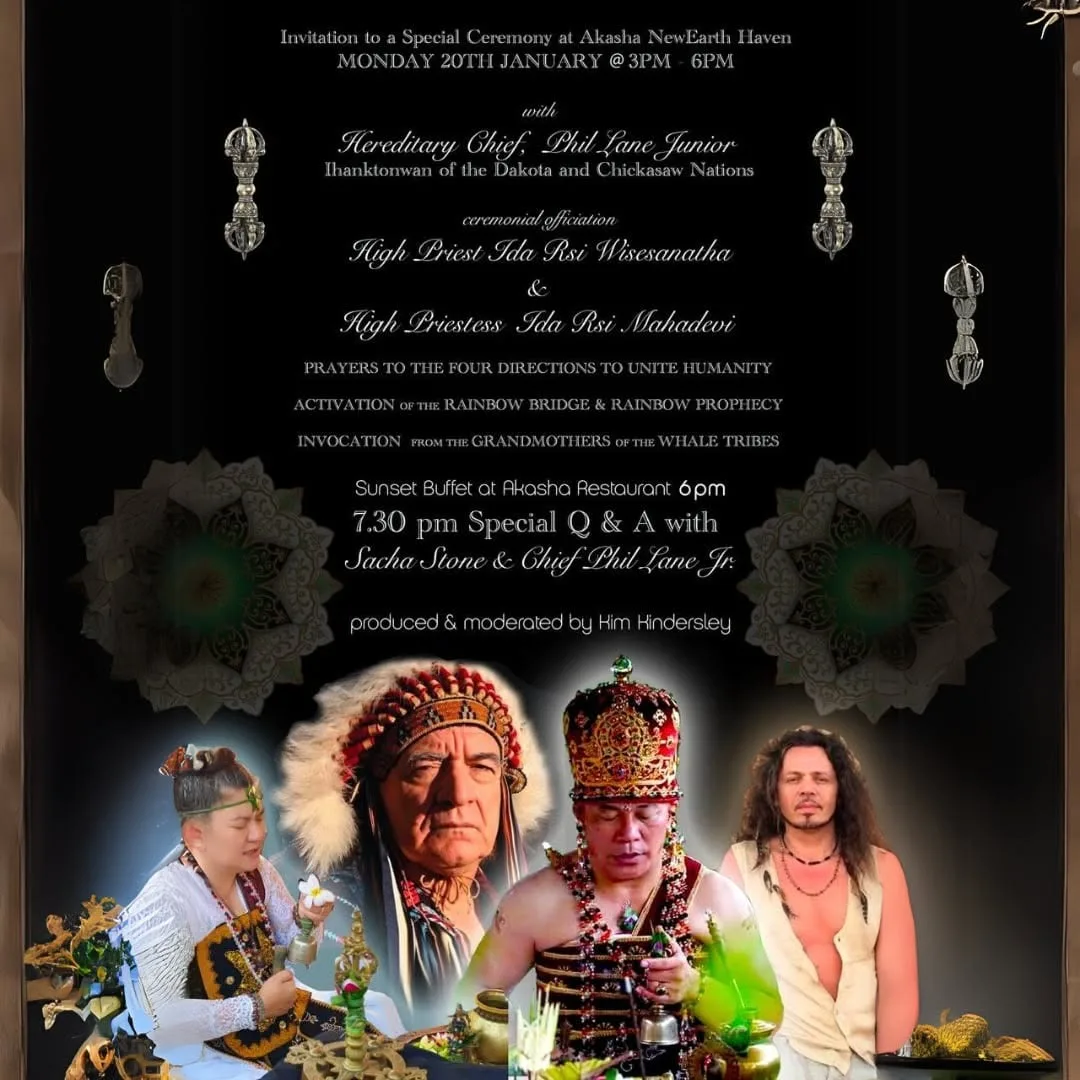
On January 20, 2025, at Akasha NewEarth Haven in Keliki, Ubud, the Bali Four Directions Ceremony for World Peace was co-officiated with High Priest Ida Rsi Wisesanatha and High Priestess Ida Rsi Mahadevi. The ashes of the Eighth Fire of World Peace — ignited in Hidalgo, Mexico, in October 2023 — were added to Bali’s sacred fire, weaving a braid between the Indigenous peoples of the Americas and the archipelago’s living traditions.
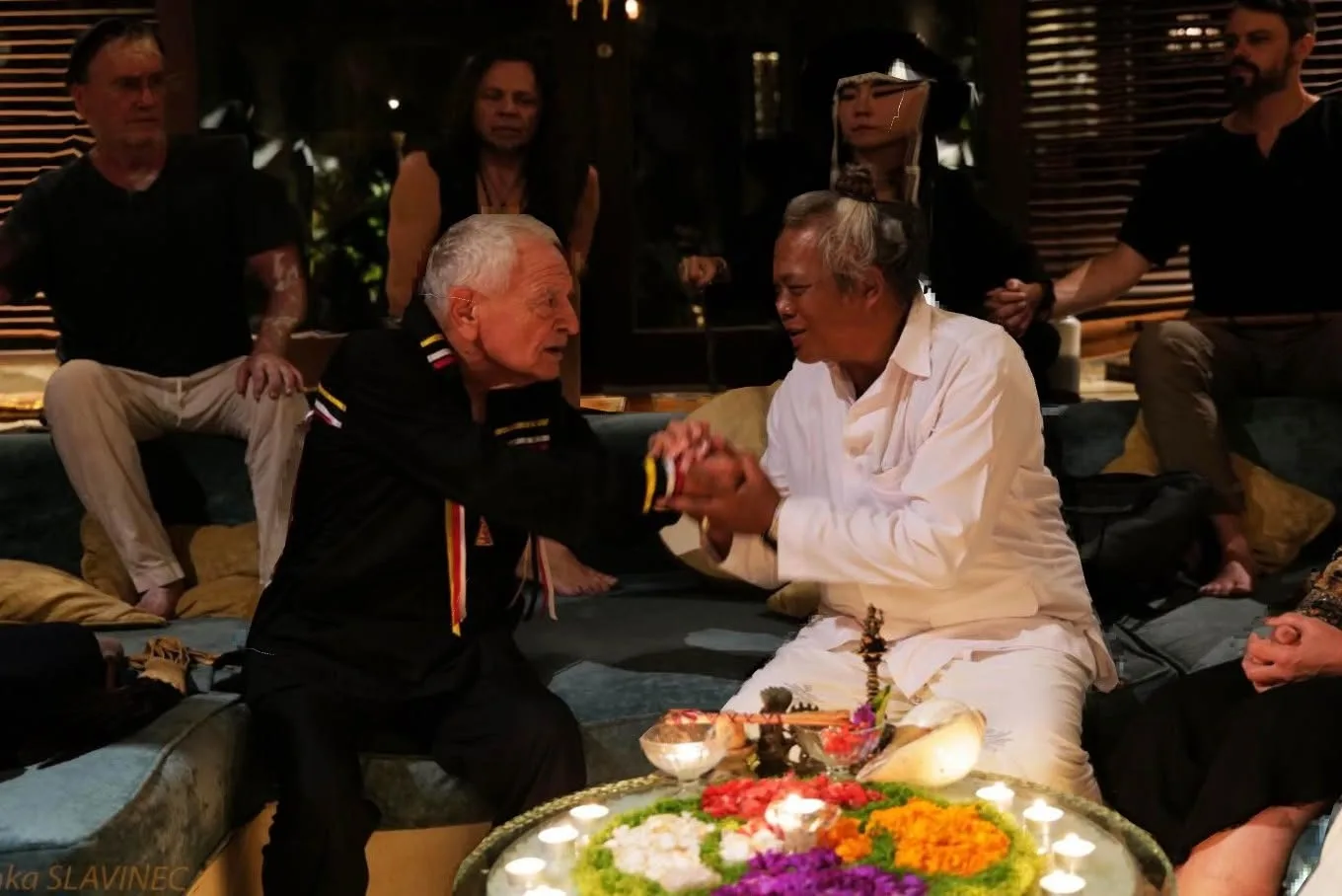
On January 25, we sat with the Bali High Priest of Fire for the Eighth Fire unification. From the moment we looked into one another’s eyes, our spirits recognized a timeless connection. Together we joined the Indonesian sacred-fire ashes with the Global Eighth Fires, and entered a solemn covenant to unite these ashes with more than two hundred sacred fires burning across Indonesia. I pledged my full support through the Union of the Condor, Hummingbird, Quetzal, and Eagle.
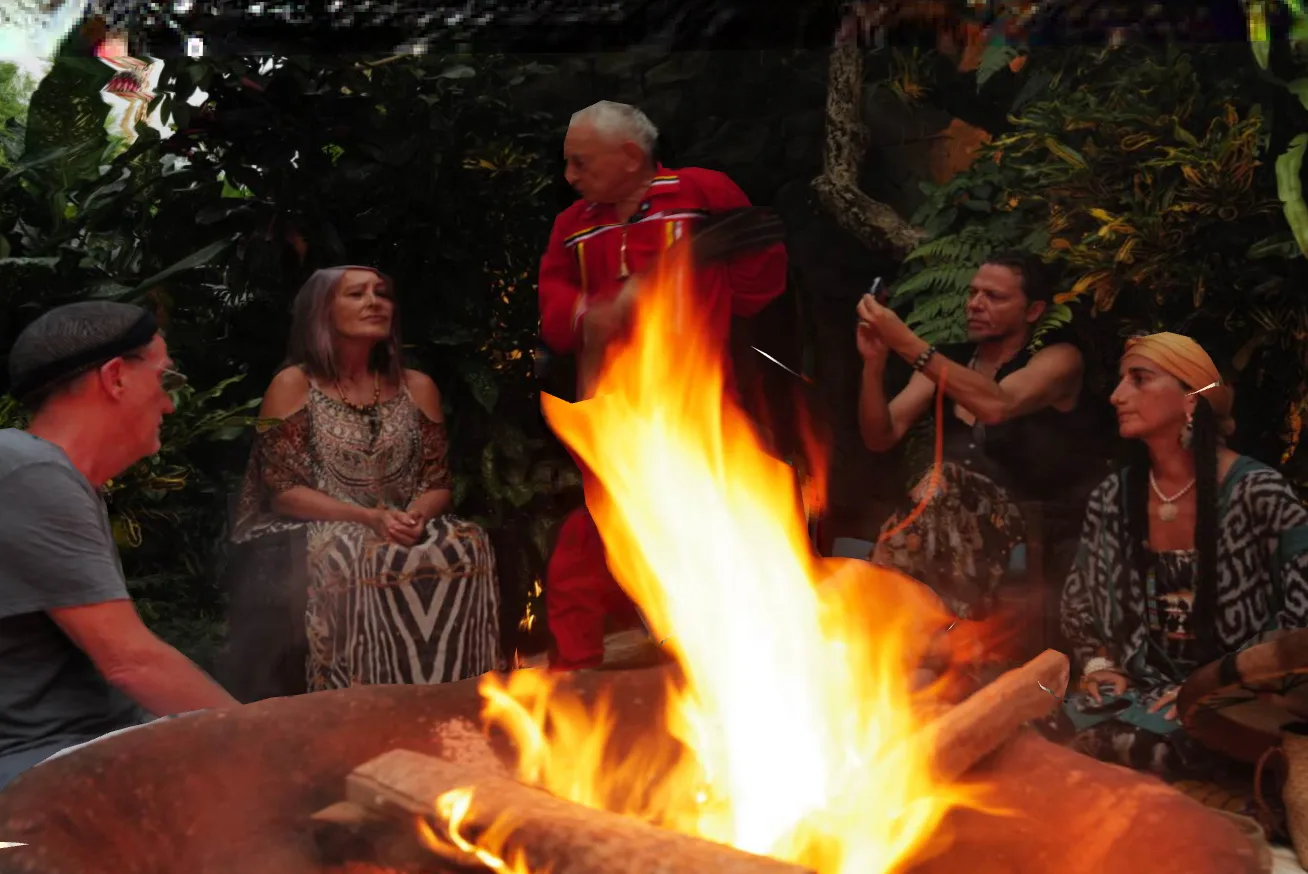
When we sit in sacred fire ceremonies, we apply spiritual medicine to the wounds of invasion, military subjugation, and economic displacement. We ask Wakan Tanka, the Great Spirit, to open the doors, prepare the way, and make the path safe, so that we may be guided to those souls — and they to us — who are walking toward reconciliation, healing, restoration, and peace. The covenant is not a substitute for material restitution. It is the ground on which material restitution becomes possible.
Deepening the Roots
Our connection with the peoples of Indonesia also rests on five years of shared work, from 2008 to 2013, supported by the Canadian International Development Agency. Four Worlds International Institute and Four Directions International, together with regional partners, helped build networks connecting Indigenous young people, ethnic minority communities, and human rights organizations across Indonesia and Southeast Asia. Guided by the Digital Fourth Way — a framework for building a people-centered ASEAN — this work helped communities share their cultures, strengthen their voices, and organize around priorities they identified.
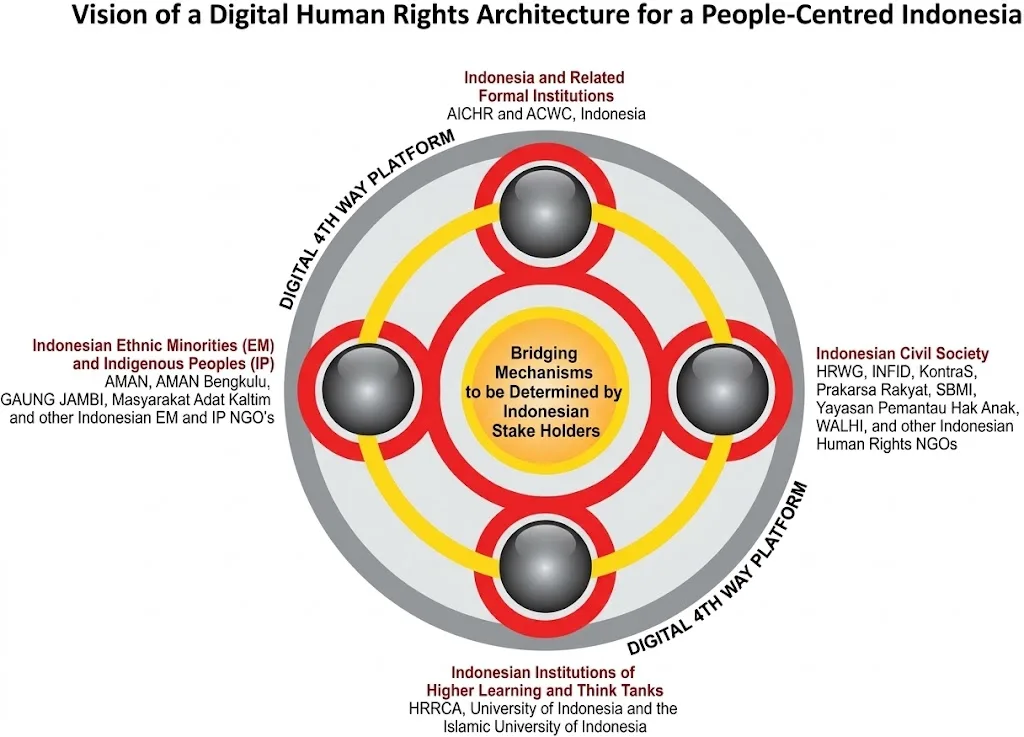
In Indonesia, collaboration with AMAN, the Indigenous Peoples’ Alliance of the Archipelago, brought participants from diverse Indigenous communities together for training in 2010. That led to ten community websites, a national Indigenous youth network, and a regional Indigenous network. Wider Indonesian work involved WALHI, the Indonesian environmental forum; KontraS, the Commission for the Disappeared and Victims of Violence; INFID, the International NGO Forum on Indonesian Development; and the Human Rights Working Group Indonesia. Together, these relationships connected Indigenous priorities with environmental protection, human rights, and the well-being of women, children, and migrant workers.
Across the region, the initiative involved hundreds of young people from Indonesia, Cambodia, the Philippines, Thailand, and Myanmar. These connections bring us into relationship with relatives throughout a region shaped by Dutch, British, French, Spanish, Portuguese, and American colonial rule, each carrying distinct histories and responsibilities for healing. The ceremonies in Bali join an earlier foundation of practical cooperation. Lasting transformation grows from within communities, through their own leadership, cultural knowledge, and united action.
The Circle Returns to Bali
On Saturday, October 10, 2026, that covenant returns to the same altar. At Akasha NewEarth Haven in Keliki, Ubud, Raja Samu Samu VI and Sacha Stone have called a royal ceremonial gathering, NewEarth — Bridging the World. I will join His Majesty King Cornelius Botha of South Africa and other beloved relatives who keep the Balinese fire, receiving goodwill from across Mother Earth. Goodwill from across Mother Earth.
In every place on Mother Earth where there has been colonization, healing needs to happen. These movements are growing. It is only through the unity of everybody coming together, sharing resources, and working with a common vision that we can see a world in which we have transcended the extremes of wealth and poverty — where there is equality of women and men, where every person receives basic nourishment and the things they need to live, where we understand that we are sacred beings, and where everybody receives a culturally respectful universal education.
I will bring this reflection into that circle — the King’s opening at Leiden, the archival void, the living wound in Karangasem, Klungkung, and Buleleng, and the four-fold path. What was written as an invitation becomes, on that ground, a spoken covenant.
The Heart of the Work
All of this rests on a foundation we did not borrow. It was carried to us. In December 1982, on the high plains of southern Alberta, forty elders, spiritual leaders, and community members sat together through four days and nights. They had come because the darkness was real — alcohol, poverty, powerlessness moving through nearly every Indigenous community they knew. That council produced four principles. Development comes from within. Where there is no vision, there is no development. A person’s healing and a community must go hand in hand. Learning is the engine of change. For twelve summers after that, from 1983 to 1995, up to five hundred relatives a year came to the University of Lethbridge to test those four against lived work. By 1995 the four had become sixteen. They are the hundred-percent foundation. Not a paper we wrote. A treasury gathered from the people who had already paid for it.
The sixteen open with one line that holds all the rest: starting from within, working in a circle, in a sacred manner, we heal and develop ourselves, our relationships, and our world. Starting from within means the web that made the wound can change, and no outsider can walk the change for us. A child learning to ride a bicycle may be steadied, but the child has to ride. No vision, no development — if a people cannot see a life other than the one they are in, they are trapped. Healing is not a side door to development. It is the door. Trust broken, grief unburied, the old habit of hurting before we are hurt: leave those in place and the finest plan dies in the room where it was made.
Working in a circle is the second treasury. Everything is connected to everything else, so work on any one part moves the whole. No unity, no development — disunity is the primary disease of a community. No participation, no development — minds, hearts, and energy have to be in the work, or it is someone else’s work. Justice means every person, regardless of gender, race, age, culture, or religion, has an equal place in the healing and a fair share of what comes of it.
In a sacred manner is the third. We are material and spiritual, and a community that feeds only one of those will not hold. Morals and ethics are the heart’s wisdom; when that foundation is lost, development stops. The hurt of one is the hurt of all, and the honor of one is the honor of all. Development for some at the expense of others is not sustainable, and it is not allowed. Authentic development is culturally based. Culture is the soil. Pull a people out of it, and you have pulled up the plant. You build on who the people are, not on what an outside eye says is missing.
The last four are how the treasury is walked, not admired. We are learning beings from the womb onward, and learning is central to healing. To sustain a thing is not to use up what it needs to continue. Move to the positive: the critical problems are best met by moving into the life we mean to create, building on strength already in hand, rather than giving our energy away fighting the negative. Be the change you want to see. By walking the path, we make the path visible. That is what these forty-four years have been. Not teachings stored. Learning how to walk with our feet on the ground. The principles now serve movements across the Americas and beyond because they were walked before they were taught.
The Community Story Framework
Out of that foundation came the grid. We call it the Community Story Framework. It is how a people tell their own story, in every dimension, in their own words, and then act on what they have told. It is not a survey done to a community. It is a community doing its own seeing.
The grid has two axes. One is the life cycle: children, from birth to twelve; youth, from twelve to twenty-five; women; men; elders, fifty-five and older. The other is the life of the community: family life, political life, economic life and the care and use of the land, social life, cultural life. Leave any of them out, and the story is partial, and a partial story produces a partial plan.
Of each square, four questions are asked. What is life like now? What can we learn from the past? What would this be if it were good — a healthy, balanced future the people can believe in? What has to happen, and what must we ourselves do, to get from where we are to where we mean to go? Small circles of eight to twelve take a square. They bring what they have seen back to the whole gathering. Consensus is negotiated on what is true. Where the community holds two views and cannot resolve them, both are written.
A community research team, in close consultation with a community advisory circle, writes what is agreed, topic by topic. That first writing goes back — in a small place, to every household; in a larger place, to the representatives and organizations that carry the life of the people. The report is not finished until the people who lived it say it is theirs. Only then does Round Two begin: targets are chosen, action starts, and healing continues alongside the building. Round Three addresses root causes and creates a learning plan. Round Four builds the organization that can hold the work after the visitors have gone. About a year later, the same grid is laid down again. The first report is the baseline. People see what moved and what did not, and they correct course without blame.
That is exactly what we have done. Fifty years ago, in communities where this work began — some of them places I was already working in 1969 — the story on that grid was devastation. Alcohol. Poverty. A powerlessness that felt permanent. Today those same communities have come to almost complete sobriety, and to a prosperity that is still growing. The people caused it by telling the truth of their own story and then walking what the story required. We are not offering a method we have read about. We are offering a path already walked, and the evidence is on the ground.
As Within, So Without
As within, so without, a human being does not arrive finished. We come as infants. We move into childhood, where the world is first named. We pass through adolescence, where strength arrives before wisdom, and the arrogance of that passage is real: the belief that we already know, that we can take without returning, that the ones who came before us were smaller than we are. Adulthood, when it comes, is the laying down of that arrogance. It is strength that has learned it belongs to something larger than itself.
A person’s spiritual journey follows the same road. So does the journey of a people, and of the human family. The prophecies of the Fifth World speak of a widening circle that was always the pattern. It begins in the family. It moves to the tribe, the city, the state, the nation. Each widening has carried its own adolescence — the moment a people could organize more power than it had the maturity to hold. Empire is that adolescence at its largest. The taking of land, the breaking of customary life, the ledger that counts spice and not the dead: these are the spiritual immaturity of a civilization that learned to reach across oceans before it learned how to be a relative.
We are at the next widening. The circle the prophecies promised is the planetary circle, and the time they promised is the time we are in. Spiritual adulthood begins when the taking stops being mistaken for destiny. The Balinese who walked in white already knew this. They would not subject the Creator’s dignity to assignment. That was adulthood, chosen in a single morning, while the empire facing them was still adolescent with its guns. A civilization entering adulthood needs what a person entering adulthood needs: a way to see its own life honestly, a discipline for deciding together, and a practice of coming back a year later to see whether the decision held.
The Braid of Covenants
The covenants already signed are the same path, walked at a larger scale, and they are how the circle reaches Bali.
On Mother Earth Day, April 22, 2016, in New York City, Indigenous leaders from the Condor, the Quetzal, and the Eagle, together with relatives from Indonesia, signed the International Treaty to Protect and Restore Mother Earth. It binds. Protect the sacred, and return sacred places and heirloom objects to their original purpose. Foster the Seventh Generation in every decision that touches life. Reduce consumption, beginning with those who have the most. Secure women’s reproductive rights and the equality of women and men. Leave fossil fuels. Restore forests, reefs, and soils. Permit only organic and traditional farming. Wage peace, because war is the greatest consumer of oil and the greatest destroyer among us. Uphold free, prior, and informed consent. Decide for seven generations. If developing Mother Earth’s gifts is not sustainable, they will not be developed, no matter the profit. Sacred places are not for sale.
On March 21, 2023, after solstice ceremonies at Palenque, in Chiapas, the First Council of the Union of the Condor, Hummingbird, Quetzal, and Eagle was unanimously elected. The process was spiritual, nonpartisan, and nonpolitical: prayer first, then consultation on the qualities a leader must have—not on names—then reflection, then the choice. Fifty-two years had passed since the Reunion of the Condor and the Eagle was fulfilled at the Islands of the Sun and Moon on Lake Titicaca, on July 9, 1971, a fulfillment that had begun in Cochabamba on March 21, 1970. Leaders came from colonial nation-states where more than eighty million Indigenous peoples live. Many more could not come, for lack of funds. The absence is part of the record.
On July 20, 2025, the braid was tied again. The fires had been lit on the Buck Moon of July 10, at the Kindred Spirits monument in Midleton, Ireland — the place that remembers the Choctaw gift to the starving Irish in 1847. Ten days later, under the stones of Dripsey Castle, relatives of the Condor, the Hummingbird, the Quetzal, and the Eagle stood with peoples of Ireland, Europe, Africa, Asia, and Oceania and signed the Binding Planetary Peace Treaty to End War, in person and digitally. It opened ninety-nine days of peace through unity, leading up to the International Day of Peace. Renounce war. Resolve conflict without it. Turn war’s resources toward life.
These three are one braid. The 2016 treaty says what must be protected. The Union says who is responsible, and how they choose their own leadership. The 2025 treaty says the killing stops. None of them replaces the living voice of a people whose land was taken. They prepare the ground on which that voice can be heard without being managed.
The Four-Fold Path
The path is short on purpose. Everything above is the treasury. This is how it is walked.
Deep listening. Sacred Talking Circles, centered on the living descendants of the Badung, Pemecutan, and Klungkung courts, and on the banjar and subak keepers. The Community Story grid is the tool. Four questions only. What is life like now? What can we learn from the past? What would a healthy, balanced future look like? What must we ourselves do to get there? Circles of eight to twelve. Consensus on what is true. Difference named where it cannot be resolved. The writing goes back to the people before anyone calls it finished.
Inclusive consultation. Listening is not yet a decision. The Principles of Consultation carry the circle from story to choice: every voice respected, no contribution belittled, truth expected from differing views, and — once a decision is reached — wholehearted support from every participant, even those who did not fully agree. The circle widens to Indonesian, Moluccan, and Surinamese relatives; to independent historians; and to the banks, shipping houses, and trading companies whose capital was built on extraction. Free, prior, and informed consent is the floor. Consensus is the standard. When consensus cannot be reached, the decision still becomes the whole’s decision.
United action. Round Two is where the story becomes work. Targets chosen by the people. Community-directed trust funds, seeded by the institutions that hold the unopened ledgers, governed by the communities the capital was taken from. Legal protection for customary land and the subak. Support for the market women who already carry the ceremonial life and the local economy. The same models, under the people’s own consent, extended to Suriname and to Indigenous territories in the Americas. No brochure satisfies the debt.
Continual reflection. About a year later, the same grid is laid down again. The first report is the baseline. The people see what moved and what did not, and they correct the course without blame. That review is the multi-generational covenant.
We have walked this for forty-four years. The near-complete sobriety, and the prosperity still growing where devastation was, are the evidence. The fifteenth principle names the stance: move to the positive, build on strength already in hand, do not give our energy away fighting the negative. The sixteenth names the method: be the change, and by walking the path make the path visible. The invitation to the King, to the Dutch state, to the banks, and to the relatives of Bali is to walk it with us.
The Spiritual Foundation
None of this stands on paper alone. The moral and spiritual foundation of any transformation between peoples rests on a higher power — the Creator, Wakan Tanka, the Great Spirit — who has been in this history from the beginning. The Dutch came for spice and profit. The Balinese answered with prayer and sacrifice. The King’s courage at Leiden was not only political. It was a moment when conscience broke through the machinery of state. Such moments do not come from calculation. They come from the same source that moved the Raja of Badung to walk in white rather than bow.
The ceremonies of January 2025 were spiritual medicine, not a performance. We asked Wakan Tanka to open the doors, prepare the way, and make the path safe, so that those already walking toward reconciliation would find us, and we them. The covenant is not a substitute for restitution. It is the ground on which restitution becomes possible. The wound is spiritual as well as economic. The healing has to be both.
That work returns to the same altar on October 10, 2026. I will sit there as a Hereditary Chief of the Eagle, with King Cornelius Botha of South Africa and the relatives who keep the Balinese fire. The King’s historic action, the archival void, the living wounds in Karangasem, Klungkung, and Buleleng, and this four-fold path will be shared with the people whose ancestors walked in white. What was written as an invitation becomes, on that ground, a spoken covenant.
The presence of King Cornelius Botha names a further arc — the Cape, and the peoples of southern Africa — and they already know it. We do not unfold that reckoning here. There is a gap in the whole, and it is named with respect for the journey our African relatives have walked, year on year, often without the circle being wide enough to hold them. Our full support is with them. What we are for is moving forward together on an honest path, not on a claim that the world is already healed, and not on a claim that the wound is too large to walk. The same care we bring to Bali is the care we owe them, when they are ready to speak, and before that, in the support we give while they walk.
The four-fold path is not a bureaucratic framework. It is a spiritual discipline, grounded in the Sixteen Principles and in the oldest teaching we carry: that we are all related. When the Netherlands, Bali, Suriname, and the peoples of the Americas walk it together, they are not only settling accounts. They are answering a call that has been sounding for centuries — that we belong to one another, and to the Creator who made us.
Mitákuye Oyás’iŋ. All my relations. The King has opened a door. The ancestors are watching. The fires are burning. It is time to walk through.
With Warm, Respectful, and loving greetings,
Hereditary Chief Phil Lane Jr.
Shunkmanu He Me Yedo! Chanupa Sapa He Me Yedo!
Chickasaw and Ihanktonwan Nations — White Swan Oyate
Chairperson, Union of the Condor, Hummingbird, Quetzal, and Eagle
Four Worlds International Institute
Compassion Games International