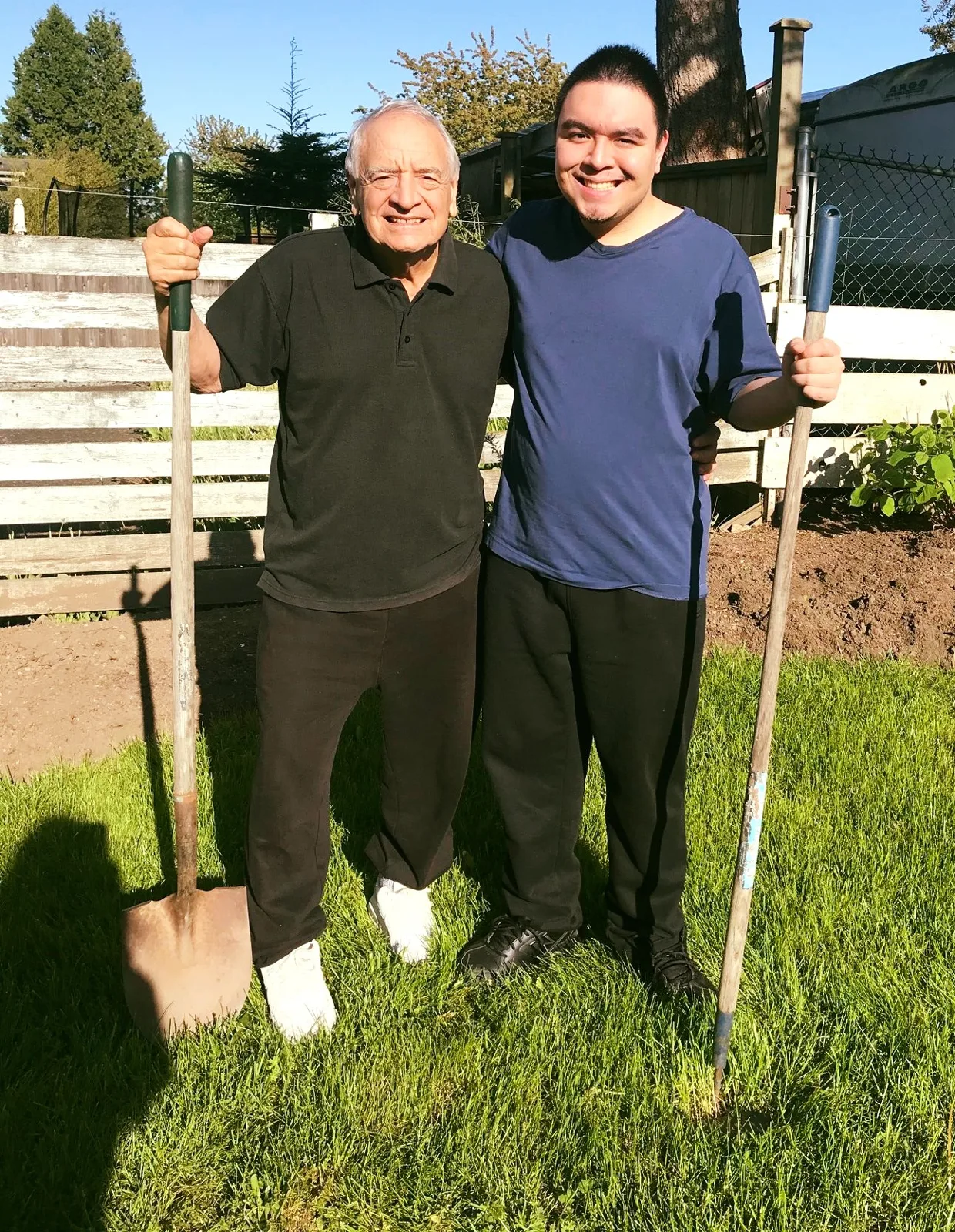
It is wonderful to be outside working with my beloved son and wife, (she is the small shadow, bottom left ), getting our garden ready. I never thought I would enjoy working like this again.
I begin selling newspapers and Christmas cards when I was 8. Every Thursday, my mother would take me to pick up my 40 Hermiston Heralds, in Hermiston, Oregon. This would earn me about $4.00.
After we picked up the papers, she would drop me off about three miles from our little house in Power City, Oregon, at Charleston, another tiny community, on the way home, on Highway 395.
I would walk home stopping at every house along the way, except for a few that had made it clear to me they did not want to buy a paper or those with extreme dogs. I was only bitten a couple of times and became pretty good at throwing rocks, yelling and looking scary, if necessary.
When I was 12 we moved to Walla Walla, from Power City. During the summer, from age 12-15, I picked Strawberries, at the beginning of the Summer, then came Pea Harvest, then cutting, bailing, and putting up hay, planting broccoli, planting, weeding, and suckering corn, and cutting Walla Walla Sweet Onions.
In those days, it was not unusual to work 14-20 days, 12 hours/7 days per week, beginning when you were 12. When the harvest comes, you can't wait around. That is also how you purchased your clothes and had spending money during the school year. It was the way it was.
As well, since I was very young, my father would tell me about, Lala Low Dog, who would come to visit his Lala Tipi Sapa, Philip Deloria. Lala Joshua Low Dog would come, when he was 12, for what my called " an Indian Visit. One of the stories, my father told me, many times, about Low Dog, was that he had killed his first man when he was 12. Lala Low Dog was fought at " Greasy Grass, the Little Big Horn.
My father recounted this story about Low Dog, many times. He said these Pawnees attempted a horse raid but were cut off. The trail they chose to escape was where Lala Low Dog, and some other boys, were taking care of some horses. There were 7 or 8 Pawnee's, I can't remember the exact number, but they could only ride on this trail, single-file.
My father would always ask me until I really understood, " If you were Low Dog, what man would you shoot first." Of course, Low Dog pulled back his bow and killed the last rider. The rest of the riders kept on, without knowing.
Of course, it was the last person, so the other riders would not know. There many, other good " Shunkmanu, " Horse Thief, " stories, and strategies, that he taught me. When I was 10, my father coached me in a couple of three-round smoker-type boxing matches, but I was too near-sighted to be a good boxer.
When I was young, he would also inspire me with stories about his boxing days, beginning at a barn at White Swan, Ihanktonwan Nation, with his older brother, Henry Spotted Eagle, who taught him the basics. Deshi Henry taught him well. Deshi Harry was quite a fighter, himself.
My father was sent to Haskell Indian School when he was 12. He immediately became a " Gym Rat," a name given those who spent all their free time at the Gym. When he was 14, the Kansas City Athletic Club came to fight Haskell. The Haskell boxer at my father's weight was sick, so Haskell needed a fighter. My father volunteered and fought to a draw, even though his opponent was 31.
In those days, my father loved to box, as I loved to wrestle. He went on to fight more than 250 amateur and professional matches, this includes fights, 3-6 rounds.
He finished boxing at 29, after winning the All Service Light Weight Championship, Caribbean, and Central American Division. I was running around Balboa Stadium, in the Canal Zone Panama, when he fought his last fight. I have always been able to vaguely remember the experience.
When I was 10, my father coached me in a couple of three-round smoker-type boxing matches, but I was too near-sighted to be a good boxer. I tried, but boxing was not for me.
I did go on to get into some street fights and brawls after I got contact lenses when I was 12. The contact lenses were a great blessing. No more was I called, four-eyes, or that my glasses were so thick, they looked that bottom of a coke bottle.
Some years before he died, he said to me, " Son, if I had my life to live again, I would never participate in a sport whose purpose was to injure and knock out your opponent." This has had a big impact on me.
As well, as most of my generation, we had daily chores, like feeding chickens, rabbits, pigs, horses, cattle, cutting wood for the kitchen stove, building and fixing fences, picking up rocks, cleaning brush and trimming trees, mowing the lawn with a push lawnmower, no electric or gas, etc. The summers are hot in Walla Walla, many of those days in the 90's F. and sometimes over 100 F. Hours working in that extreme heat also toughens you up.
When I was young I had a lot of energy. When I was 14, I began working for the Danielson Family, walking distance from our little "ranch" as my father called it, on Mill Creek, Road, just East of Walla Walla.
My father taught me to drive our 1938 Ford Truck when I was 12. As long as you did not drive on a public road you were ok.
Because I could drive well, at 14, the Danielson's gave me a job driving what they called a spreader/dump truck. Our job, much like wheat harvest, was to drive alongside amoving Pea Combine, sometimes on tricky hillsides, and fill the truck full of pea vines. Then we would go to a field that had already cut.
Then, beginning where the last load that had been spread, you pulled a gear with your right hand, put your foot down on the gas, and gunned it just right, and all the pea vines would come out of the back of the truck and spread nicely on the ground, so the pea vines could dry in the sun. Once dry, the pea vines would be bailed for feed.
One time, I started driving on the night shift, 6PM-6 AM. At 6AM I felt good, so I decided to drive a day shift, 6 AM-6PM, as they were short of drivers. At 6 PM, I said to myself, I can do another 12 hours, and I did.
At 6 AM, I caught a ride back to the Danielson's, where they served three great meals, every day during harvest. As well, food was delivered when we were working east of Walla Walla, past Waitsburg.
After breakfast, I walked home. My parents were at home. They said something like, " Son, you have been working a long time. I said, " Yes, three shifts." They said," Oh!" I said, " I am going to sleep now because I have to drive the night shift." They said, " Ok, have a good sleep." That was all that was said because working hard and long, if necessary, was naturally expected.
When the harvest comes, you can't wait around.
Then after pea harvest, I would work bucking bales, sometimes, on to big trailers, about 6 or 7 bales high and more bales wide. Alfalfa bales are light compared to pea bales. Pea bales are about 100-120 Lbs. Lifting those bales, 12 hours/7 days a week gets you in shape.
I was so tired of physical farm work, from 24, until the last few days, I have not enjoyed gardening, until the last few days. Now every day, I look forward to going out in the sun to do some gardening with Tiger, and Suthida.
It is true, as my father told me, "Son, we go from childhood to childhood. "