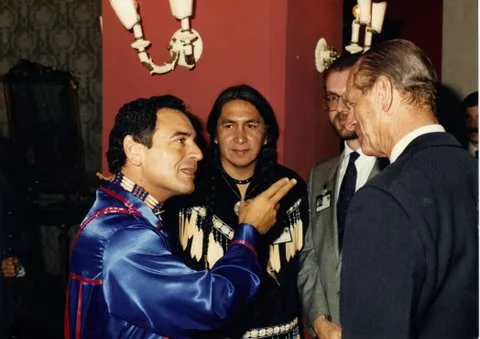
In 1986, forty years ago, my dear brother Chief Leonard George of the Tsleil-Waututh Nation and I traveled first to London and then onward to Assisi as guests of Prince Philip and the World Wildlife Fund.
The gathering in Assisi was not a political summit in the conventional sense. It was a moral and spiritual convocation.
Prince Philip’s leadership in convening the world’s major religious traditions alongside conservationists and Indigenous voices reflected a rare understanding: environmental destruction is not only a scientific crisis, but a crisis of conscience.
In the birthplace of Saint Francis of Assisi, who spoke of Brother Sun and Sister Moon, faith leaders were invited to articulate their sacred responsibilities toward Creation.
Brother Leonard and I spoke then from our Indigenous understanding that Mother Earth is not a resource to be exploited but a living relative to be honored. Development without spiritual responsibility, we said, is an imbalance.
What Prince Philip helped catalyze in 1986 was groundbreaking. As President of the World Wildlife Fund, he understood that policy without moral grounding would always fall short.
Prince Philip brought together Buddhism, Christianity, Hinduism, Islam, and Judaism to publicly affirm that care for our Mother Earth is embedded within their sacred teachings.
That convergence signaled something new in global leadership: royalty, religious authorities, explorers, scientists, and Indigenous representatives standing together to declare that conservation must be rooted in reverence.
One of the lifelong friends I met there was Thor Heyerdahl. I saw his film The Kon-Tiki Expedition in 1951, when I was 7. We had many wonderful conversations in Japan at the Launching of Green Cross and other similar international Forums.
The Kon-Expedition confirmed our Indigenous oral traditions that Indigenous peoples travelled from the Americas across the Pacific as far as Aotearoa. ( New Zealand)
It was an early recognition that power must answer to responsibility, and that the protection of the natural world requires humility before forces greater than ourselves.
Now, four decades later, I return to London to deliver a keynote address at the XIIIth edition of the CC Forum, a global platform that convenes heads of state, royal representatives, policymakers, institutional investors, entrepreneurs, and innovators focused on climate action and sustainable transformation.
In many ways, the purpose echoes Assisi: to align influence with accountability. Yet the context has evolved. Where Assisi centered moral appeals for conservation, the CC Forum focuses on mobilizing capital, on ESG frameworks, impact investment, decarbonization, and systemic transition.
The language has shifted, but the essential question remains unchanged: how do we ensure that human advancement does not unravel the web of life that sustains us?
The difference today is that Indigenous thought is no longer peripheral to these conversations.
Teachings once regarded as cultural or spiritual, such as intergenerational accountability, relational governance, and regenerative stewardship, are increasingly recognized as essential to planetary resilience.
What Brother Leonard and I carried into London and Assisi as land-based wisdom is now entering global systems dialogue.
As I return, I carry not only words but working initiatives: community-based sustainable development models and a digital backbone designed to unite Indigenous peoples across the Americas in coordinated, regenerative action.
The arc from Assisi to this moment reflects a deeper movement, from conservation dialogue toward structural transformation.
Forty years is brief in ancestral time, yet long enough to witness Indigenous wisdom moving from the margins toward the center. As our Elders always share, “ Life is a circle.” At 81 winters, I am now becoming very familiar with one of those circles, “ From Childhood to Childhood.
The responsibility before us now is to ensure that this era of transition becomes not another cycle of extraction, but a turning toward balance, justice, and harmony for all members of our World Family.