Beloved Relatives,
At this time of deep turmoil, grief, and confusion, our nations and communities are wrestling with the meaning of free speech, political violence, and the responsibilities of government. On one side, many voices call for limits on speech they see as hateful, dangerous, or threatening to social harmony. On the other hand, some believe any restriction opens the door to tyranny and repression. In between, countless people feel torn, desiring both safety and freedom, as well as both accountability and respect.
From the perspective of Indigenous Peoples, this moment is not new. For centuries, we have lived under governments that censored our songs, banned our ceremonies, and punished our languages. We know well the danger of allowing fear, prejudice, or anger to justify silencing. Yet we also know that words carry power. They can heal or they can wound. They can unite or they can divide. They are never neutral.
This crisis, therefore, is more than a political debate about rights. It is a spiritual question: How do we live together as one human family, respecting the sacred gift of speech while protecting the dignity of every person?
The Sacred Gift of Speech
In Indigenous teachings, speech is more than an entitlement. It is a sacred trust. The Čhaŋnúpa, the Sacred Pipe, teaches that every word we breathe out enters the world like a prayer, carried by the winds. Words can call forth healing, truth, and reconciliation. But words spoken carelessly or in anger can be like arrows, piercing the hearts of others and leaving scars for generations.
This is why our Elders teach: “Before you speak, let your words pass through three gates—Is it true? Is it necessary? Is it kind?”
From this perspective, freedom of speech is not just about what we are allowed to say, but about how we choose to speak. Protecting the right to speech is crucial, but equally important is the responsibility that accompanies it. Our words have the power to heal or wound, unite or divide. We must always be mindful of this power and use it with respect and care.
The Call to Censor
Across society, many now argue that certain voices must be silenced. They point to speech that demeans, speech that inflames, speech that justifies violence. They say that unchecked freedom allows hate to flourish. They demand governments, corporations, and platforms intervene.
We understand the fear behind these demands. Indigenous Peoples know what it means to be targeted by hateful words, treated as less than human, and dehumanized until violence becomes permissible. But we must also warn: giving governments or corporations the authority to decide which voices are allowed is a path that ends in repression. Today, it may silence the voices you despise. Tomorrow it may silence your own.
The Call to Absolute Freedom
Others argue that all speech must be protected, no matter how vile. They remind us that even hateful words are better met with debate, counter-speech, and truth than with bans and punishments. They point out that once free speech is curtailed, governments gain tools of control that are difficult to take back.
There is wisdom here as well. Indigenous Nations carry a living memory of being forbidden to speak our languages, pray in our ceremonies, or teach our children our traditions. That suppression was justified by governments claiming they were protecting order and unity. But it was destruction, not unity. The lesson is clear: no government can be trusted to be the gatekeeper of truth.
Hate Speech and the Sacred Hoop
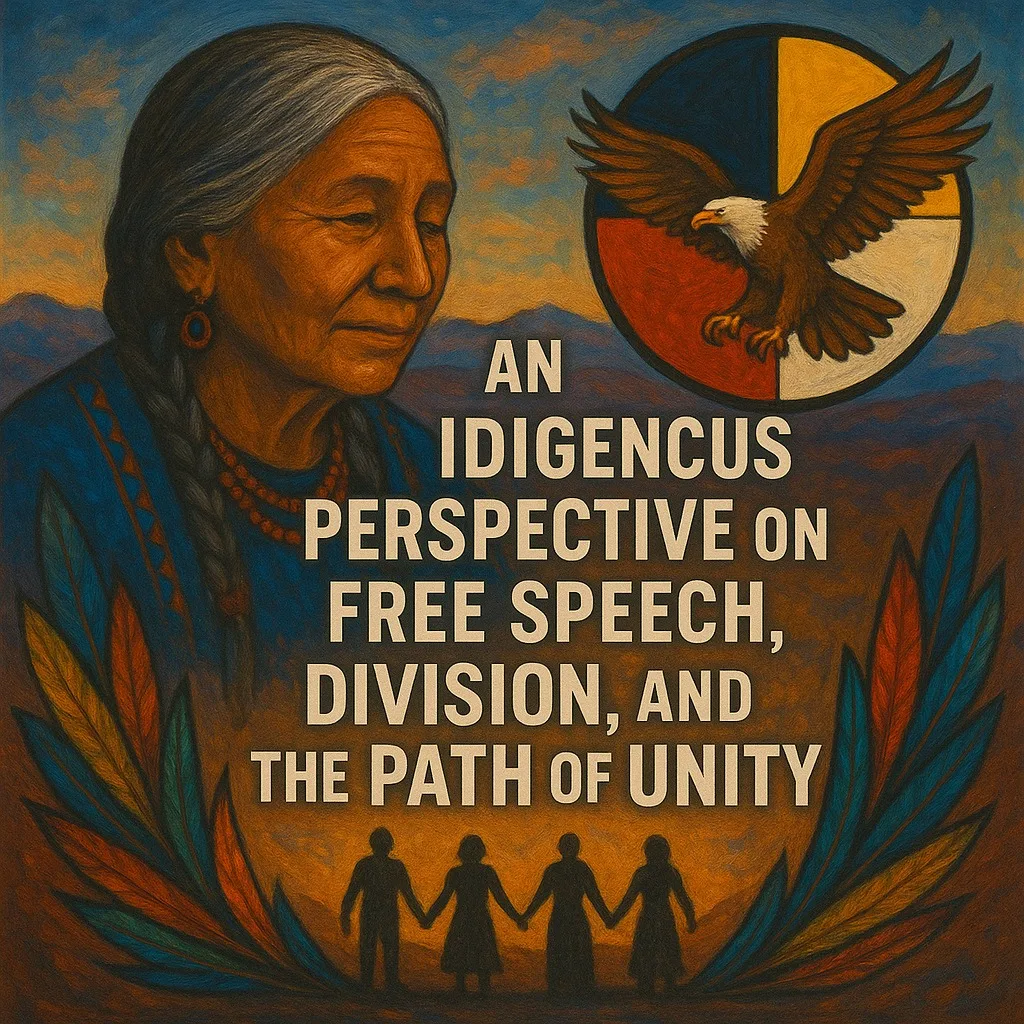
The truth lies in balance. Hate speech, though legally protected, is spiritually damaging. It frays the Sacred Hoop of Life, the Čhaŋgléska Wakháŋ, which binds all peoples together. The Sacred Hoop of Life is a symbol of interconnectedness and unity in many Indigenous cultures. When we speak in ways that dehumanize others, we weaken the bonds that hold the human family, and we damage this sacred unity.
But the response to hate cannot be repression alone. It must be education, healing, and the cultivation of compassion. Those who speak words of hate are revealing their own wounds. Our responsibility is not only to stop the harm they cause, but to ask: what suffering has led them to this place?
Political Violence and Division
More troubling still is the rise in acceptance of political violence. Surveys show growing numbers of people across the spectrum justifying harm against their opponents. Each side sees the other as a mortal threat, a “fascist,” a “terrorist,” or an “enemy.”
From an Indigenous perspective, this dehumanization is deadly. When you no longer see your reflection in the heart of your opponent, you open the door to cycles of revenge that can consume nations. We have seen it in our own history—villages destroyed, children taken, sacred lands stolen—all justified by rhetoric that declared us less than human.
Violence, once unleashed, does not end easily. It feeds upon itself. An eye for an eye will make the whole world blind.
Fear and the Shock Doctrine
Times of crisis often give rise to laws and policies that strip away freedoms. After September 11th, fear was used to justify surveillance, wars, and restrictions that remain with us today. Once power is given to governments in the name of safety, it rarely returns to the people.
This moment carries the same danger. Fear of violence, grief for those lost, and anger at those we oppose could become the justification for new forms of repression. We must be vigilant not to allow sorrow to be weaponized against freedom. The urgency of this vigilance cannot be overstated.
The Influence of Wealth and Power
Underlying this crisis is another reality: the outsized influence of money in politics. Billionaires, corporations, and foreign interests pour resources into shaping governments and public discourse. When cash becomes speech, the voices of ordinary people are drowned out.
Indigenous teachings remind us that leaders must serve the people, not wealth. If powerful interests capture governments, they will protect those interests first. This imbalance corrupts not only politics but also the media, which too often amplifies the narratives of power rather than questioning them. The media plays a crucial role in shaping public discourse, and when it is influenced by powerful interests, it can distort the freedom of speech, amplifying some voices while silencing others.
True freedom of speech requires not only legal protection, but also an honest reckoning with the structures that amplify some voices while silencing others through sheer economic force.
The Indigenous Path Forward
What then is the way forward? From the perspective of the Sacred Hoop, the path is neither unchecked hate nor enforced silence. It is balance, responsibility, and unity. Balance in our speech, ensuring it is not used to harm others. Responsibility in our actions, understanding the impact of our words. And unity, recognizing that we are all part of the same human family, and our speech should reflect this interconnectedness.
Protect speech as a sacred right. Governments must not be allowed to criminalize speech or dictate truth.
Teach responsibility with speech. Communities must cultivate wisdom, compassion, and accountability in their use of words.
Confront hate with healing. Hatred must be countered with education, dialogue, and compassion—not only punishment.
Resist cycles of violence. Political violence must be rejected in all forms. Conflict must be resolved through dialogue, not destruction.
Challenge the power of wealth. Campaign finance, corporate dominance, and media capture must be reformed so that ordinary people’s voices can be heard.
Remember our shared humanity. Above all, we must see one another as relatives, capable of change and deserving of dignity.
Beloved Relatives,
We stand at a crossroads. Our divisions are deep. Our anger is raw. Our trust in institutions is weak. But the way forward is not through censorship, repression, or violence. It is through truth, accountability, compassion, and unity.
The sacred teachings of our ancestors remind us that Mitákuye Oyás’iŋ—we are all related. Even those we fear, even those we oppose, are part of the Sacred Hoop. When one is silenced, we all lose a voice. When one is dehumanized, we all lose dignity.
Let us not be stampeded by fear. Let us not gaze too long into the abyss of anger. Let us walk instead toward the Sacred Fire of unity, speaking words of truth and compassion, holding leaders accountable, and remembering always that much more unites us than divides us.
This is the Indigenous way. This is the path that honors both freedom and responsibility, as well as justice and compassion. It is the path that can lead us through this storm into a future where our children may live in peace and dignity.
Mitákuye Oyás’iŋ — All My Relations.