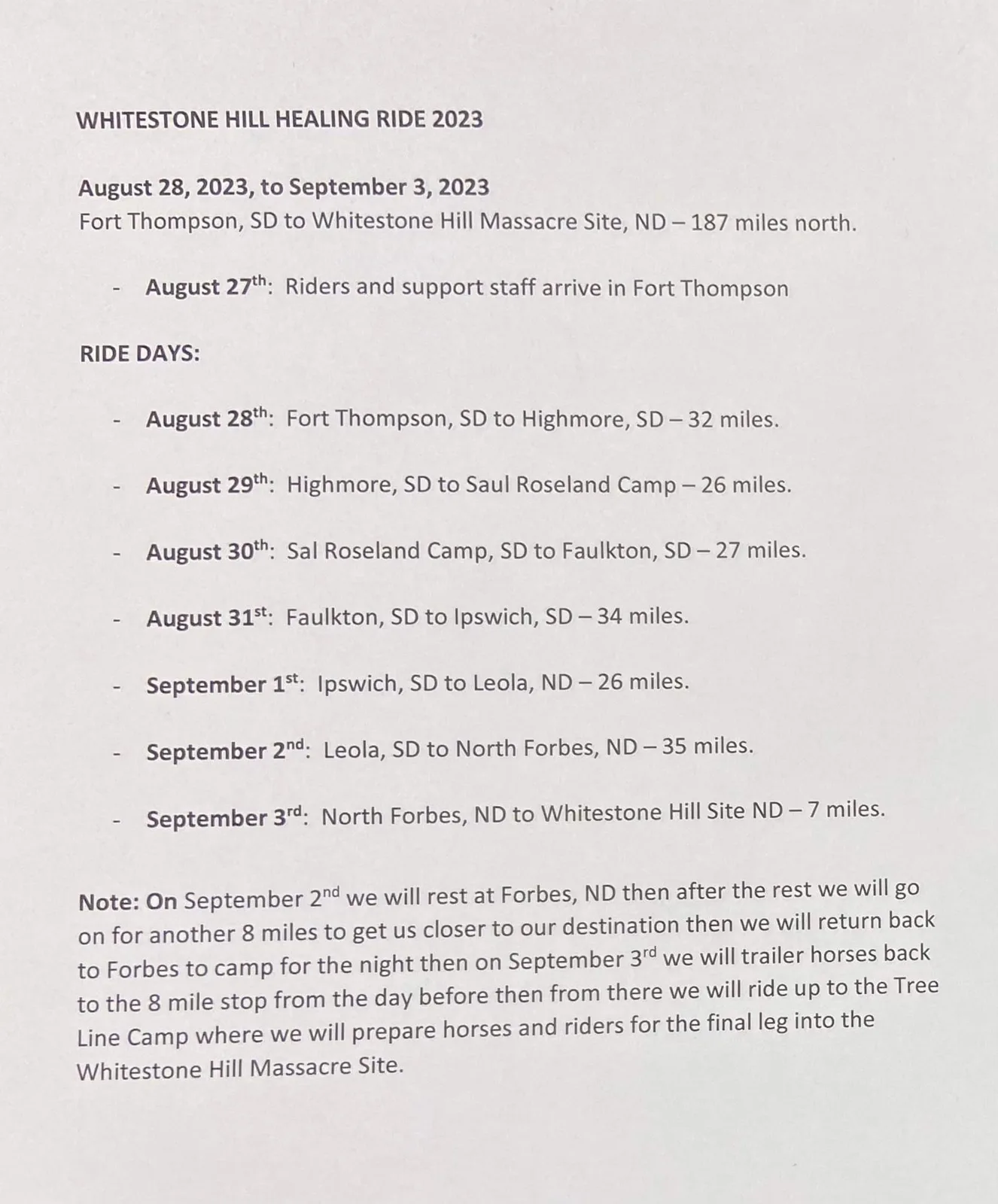
4th Year White Stone Massacre Healing Ride Will Be Joined And Supported By Japanese Relatives From Hiroshima, Japan, Representing the May Peace Prevail On Earth International Foundation.
On September 3, 1863, the Whitestone Hill Massacre occurred in Dakota Territory (present-day North Dakota). The Massacre aimed to suppress Native American resistance and retaliate for the “Dakota Uprising of 1862.”
At Whitestone Hill, a peaceful camp of Dakota, including Hunkpatina Yanktonai, Hunkpapa, Sihasapa Bdewakantuwan, Wahpekute Sissituwan, and Wahpetuwan, had gathered. Even though it was a peaceful hunting camp and those camped had nothing to do with the “Dakota Uprising of 1862,” a large force of soldiers surrounded it.
The soldiers involved in the massacre were from the Iowa Sixth Cavalry, the Iowa Seventh Cavalry, and the Nebraska Second Cavalry, totaling over 1,200 soldiers armed with rifles and cannons. They had been sent to the area by General Sully, intending to seek revenge for the Dakota Uprising of 1862 when the Dakota, who there starving, fought for their people and their very survival.
Negotiations occurred throughout the day between the Dakota chiefs and the soldiers. The chiefs offered to surrender, but without warning or orders, the Nebraska Second Cavalry suddenly opened fire on the camp just before dark. Approximately 300 to 400 Dakotas were killed in less than an hour.
When morning came, there were bodies strewn everywhere. One soldier testified he couldn't sleep at all for the women screaming and wailing in the dark and the dogs howling. There were also wounded everywhere. The soldiers killed anyone who couldn't walk, including infants. Some mothers had tied their babies to dogs to save them. They killed the infants and the dogs, as well.
Young women were raped and killed in despicable ways. The soldiers burned their bodies to conceal the evidence of their actions.
The aftermath of the battle was characterized by widespread destruction. The soldiers looted the camp, taking whatever they wanted as souvenirs of the massacre. They destroyed over 400 tipis and other belongings, preventing the Dakota people from using them. Additionally, over 500,000 pounds of dried buffalo meat, an essential resource for the Dakota people, were deliberately burned, even though it left the Dakotas with no food for the winter.
Those Dakotas who were left were marched barefoot, almost 300 miles from White Stone Hill to Fort Randall, South Dakota, where they were imprisoned. Those who could no longer walk, elders and children included, were killed and left behind without a burial.
The Massacre of Whitestone Hill represents just one of many episodes in the violent history of the genocide of Native American Nations by the U.S. government during the westward expansion era. The grave injustice and intergenerational trauma inflicted by the genocide of Indigenous peoples by the US Government on Indigenous peoples continues until today.