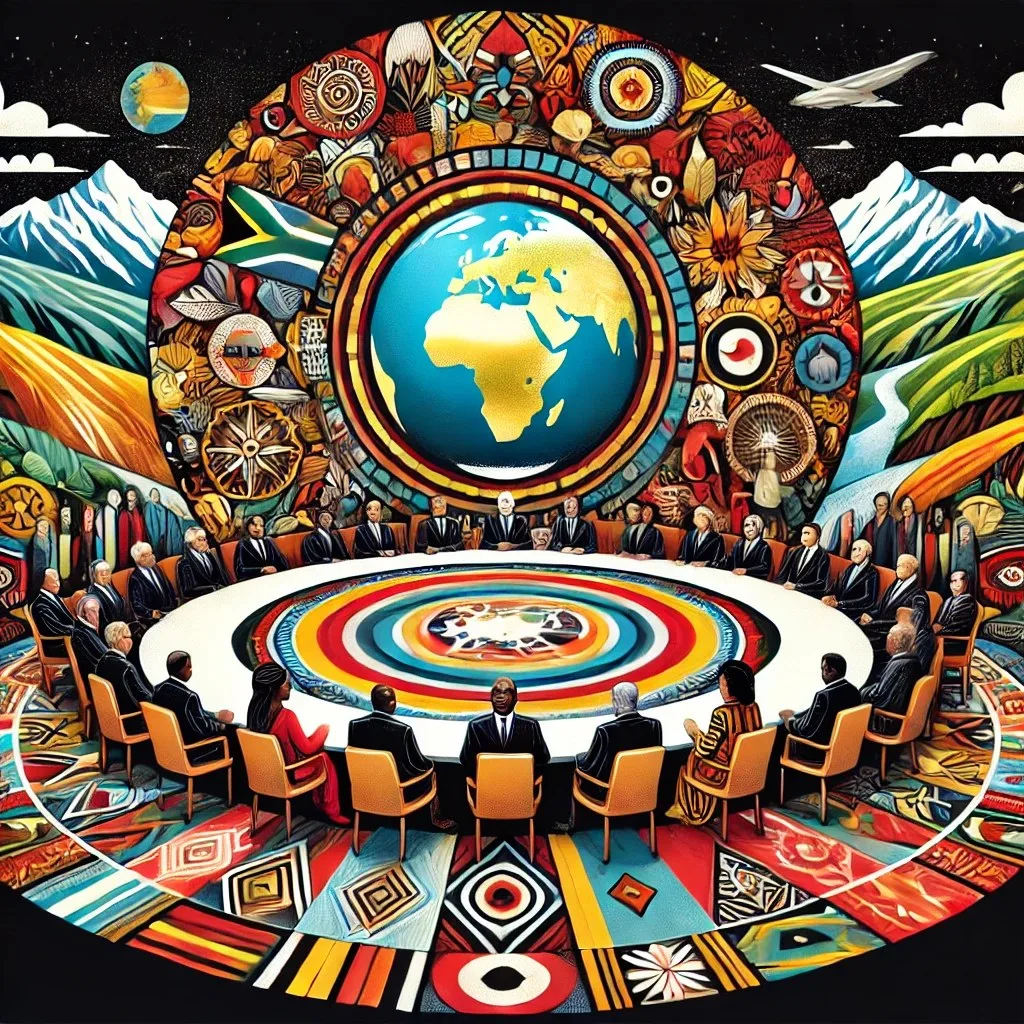
Fostering Unity: A Path for BRICS in a Divided World
From our Indigenous perspective, we recognize the importance of maintaining harmony, balance, and mutual respect among all nations. As the BRICS summit in Kazan, Russia, approaches from October 22 to 24, 2024, we see this as a profound opportunity for BRICS members to address the concerns of nations like India and Brazil—countries that have recently strengthened their ties with the United States and are cautious of being perceived as part of an anti-US bloc. The Saudis and the UAE also share similar sentiments, and it is crucial to consider how their perspectives can be embraced in a way that builds bridges rather than walls.
Our Indigenous teachings remind us that when different groups come together, whether nations or communities, the focus should be on shared values, respect for each other's sovereignty, and the collective good. The expansion of BRICS is a critical moment, not to foster division but to embrace a spirit of inclusiveness that brings the world closer to justice and equity. India and Brazil's concerns reflect the delicate balance they must maintain in their relationships with the West. A just and equitable way forward for BRICS would honor their positions, allowing them to contribute to the group without being forced into adversarial roles.
From our perspective, Russia's leadership at this critical crossroads must aim for unity rather than dominance. As we have always understood, authentic leadership fosters peace through understanding, listening, and seeking common ground. With its potential to create an alternative to the Western-dominated system, BRICS can be a beacon of hope. It must do so by offering a platform for dialogue that does not exclude or alienate any member, especially those like India and Brazil, who wish to maintain balanced relationships with all powers, including the United States.
BRICS can offer a viable path forward by focusing on economic collaboration rather than political antagonism. India and Brazil, for instance, can engage in economic projects within BRICS that strengthen their national interests without feeling trapped in anti-US rhetoric. This is an opportunity for BRICS to evolve as a space where nations can align on shared development, uplifting the Global South while respecting the diverse political landscapes its members navigate.
Including new members, such as Iran, raises important questions about the group's identity. However, if BRICS remains focused on addressing global inequities and fostering economic justice, it can sidestep the political divisions that threaten its unity. India and Brazil's concerns about appearing too closely aligned with any anti-US sentiment can be met with a clear commitment to maintaining nonalignment principles, emphasizing that BRICS is a platform for cooperation and prosperity, not conflict.
In the spirit of our ancestors, we recognize that cooperation and diplomacy must transcend short-term political gains. Under Russia's presidency, BRICS can embody the values of interconnectedness and mutual respect that have sustained our communities for generations. By listening to the voices of all its members, including India, Brazil, the Saudis, and the UAE, and respecting their desire for balanced international relations, BRICS can move toward a more just and equitable world order.
Ultimately, the summit offers an opportunity to showcase how nations can unite for humanity's greater good despite their different alliances and perspectives. This vision aligns with our understanding that all life is interconnected and should inspire and motivate us. Only through unity can we achieve lasting peace, justice, and prosperity for all.
Shunkmanu He Me Yedo! Chanupa Sapa He Me Yedo!
Hinhan Wicasta/Deloria Tiospaye, Ihanktonwan, and Chickasaw Nations