
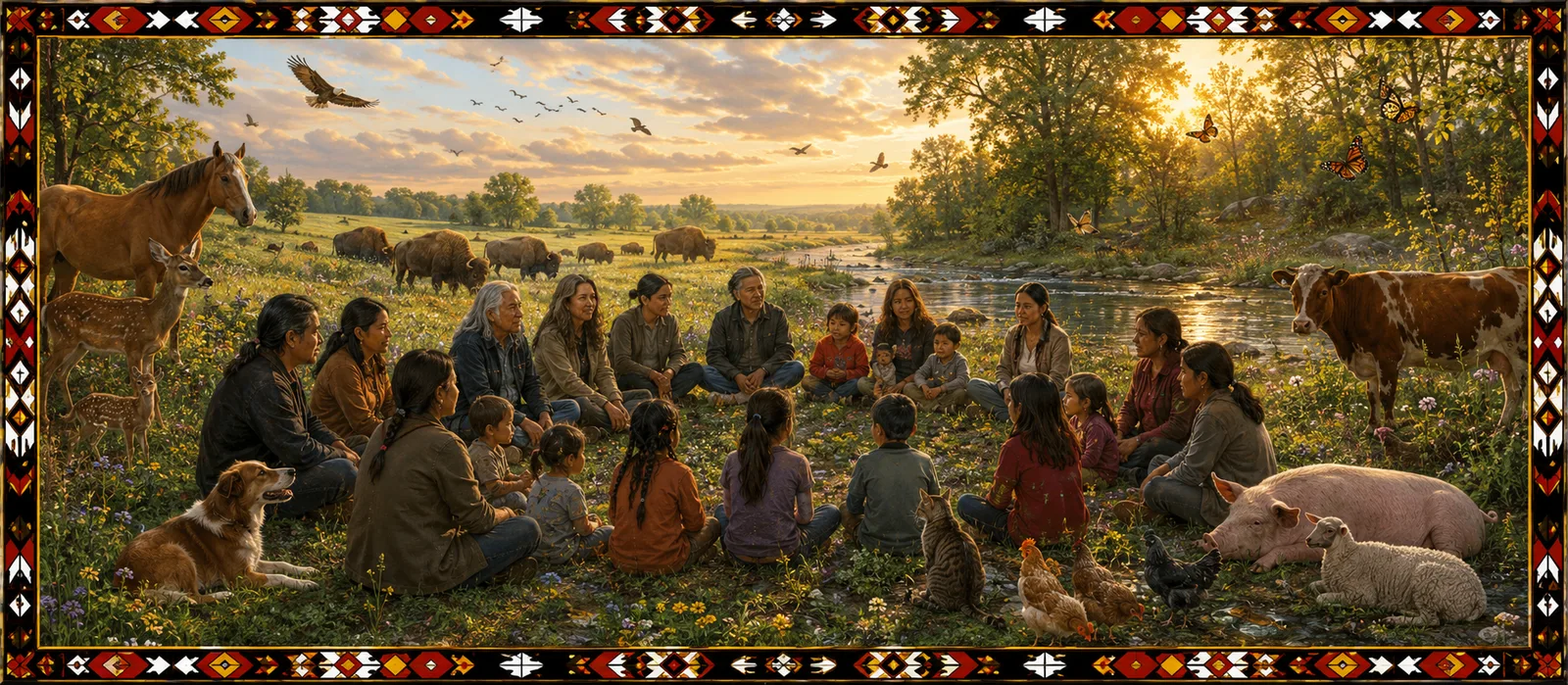
This must become a companion movement to “For the Children, We Must Become the Path.” If the children give humanity the reason to climb the Ladder of Peace, our animal relatives reveal how deeply peace must enter the human heart.
We cannot fully choose peace, live peace, or end war while permitting immense, organized suffering to remain hidden behind the walls of factory farms, transport vehicles, laboratories, slaughterhouses, and industrial food systems.
This is not written to condemn people. Most of us entered these systems as children. We ate what our families gave us, accepted what our societies normalized, and rarely saw the living being behind the finished product. The purpose is not to produce guilt. It is to awaken relationship, restore feeling, and open a compassionate path forward.
The Hidden Wound Within the Human Family
A child is not ordinarily introduced to a chicken, calf, piglet, lamb, or fish as someone who must suffer and die for them. A child commonly recognizes an animal as a living presence—a being to approach with wonder, tenderness, curiosity, and affection. But somewhere along the way, society teaches the child to divide reality into separate moral worlds.
In one world, animals are beloved companions. They have names, personalities, feelings, and families. We protect them from pain, grieve when they die, and may punish anyone who abuses them. In another world, equally sensitive beings are treated as products. Their individual lives disappear behind words such as meat, poultry, livestock, production, processing, and yield. Their confinement, fear, separation from their young, transportation, and killing are kept largely outside public sight.
This separation creates a hidden division in the human heart. We retain our capacity for kindness, but we learn not to apply it consistently.
What are human beings doing to animals? And what must happen within us so that we can permit suffering we would never willingly inflict upon an animal standing before us?
The Numbing of Compassion
Industrial animal agriculture depends upon distance. The animal becomes invisible, the killing becomes mechanized, and the final product is separated from the life that was taken. Language helps maintain that distance. We do not usually say that we are eating the body of a frightened, confined animal. We use words that remove the face, history, relationships, and experience of the being involved.
This moral distancing does not mean that people are naturally cruel. It may mean that their original compassion has been covered over by custom, convenience, economic necessity, advertising, family tradition, and the deliberate invisibility of industrial systems. Many people who consume animals would never knowingly torture one. They may deeply love their pets, rescue injured wildlife, teach their children kindness, and sincerely oppose cruelty. The contradiction is not proof that they are without compassion. It reveals how thoroughly society has separated personal goodness from collective participation.
That separation must be approached truthfully—but also compassionately. Shame often closes the heart. Relationship can open it.
The Connection Between Violence Toward Animals and War
War begins long before weapons are fired. It begins wherever living beings are turned into categories, objects, commodities, enemies, or disposable bodies. The psychological mechanisms are disturbingly similar: the living individual is made invisible; suffering is hidden or justified; language disguises the reality of violence; responsibility is divided among institutions; killing becomes routine; economic interests become more important than life; and those who question the system are told that change is impossible.
The slaughterhouse and the battlefield are not identical, and we should not erase their important differences. Yet both can depend upon the human capacity to disconnect action from empathy. If peace education teaches children never to dehumanize another person, it must also help them resist the broader habit of turning living beings into objects. A civilization that wishes to end war must examine every institution that teaches the human heart to look away from suffering.
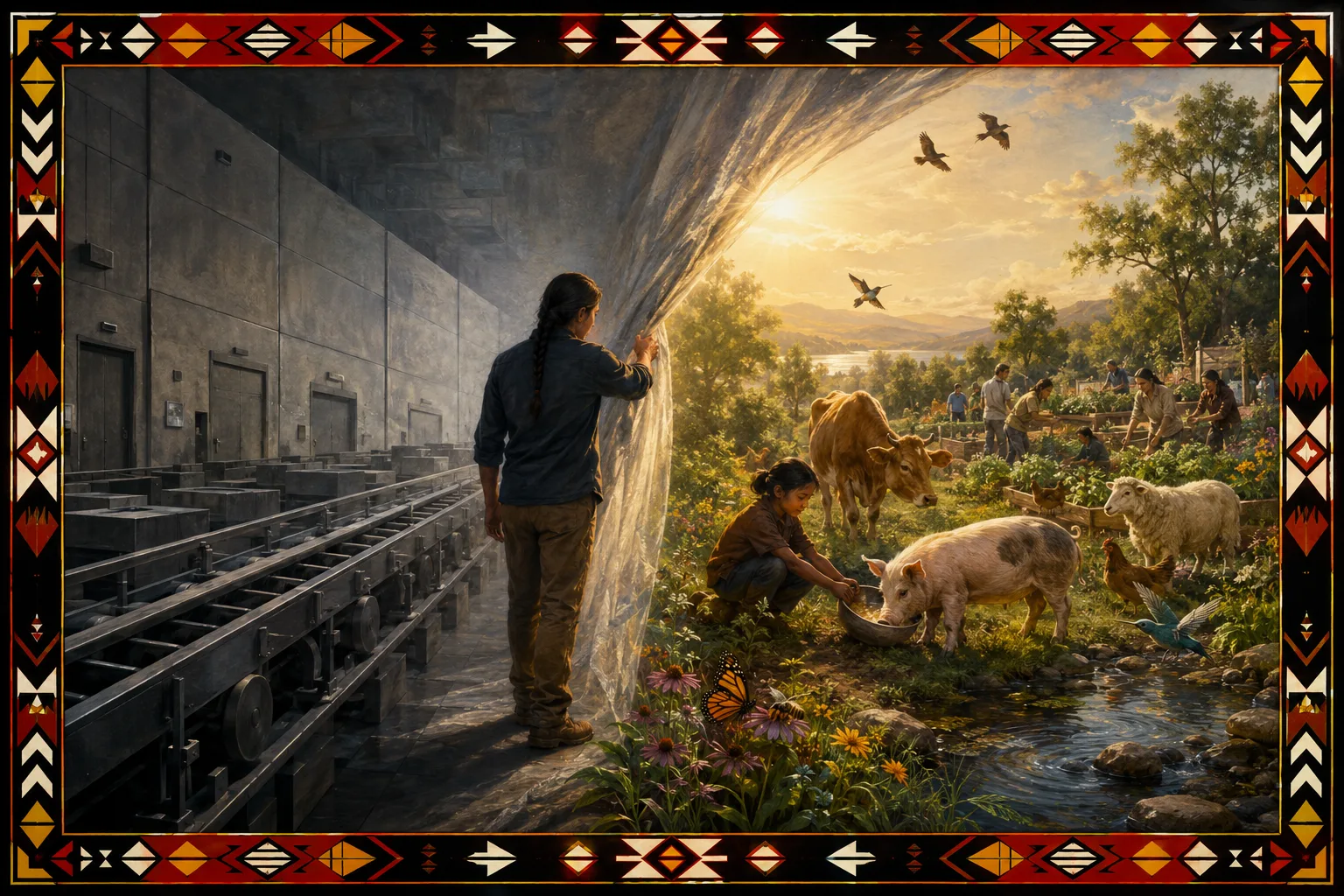
From hidden separation toward restored relationship, responsibility, and hope.
The Child and the Chicken
Give a young child a chicken to care for. Let the child feed her, hold her, watch her search the earth, hear her calls, and discover her individual ways. Then ask whether the child wants this relative frightened, confined, harmed, and killed.
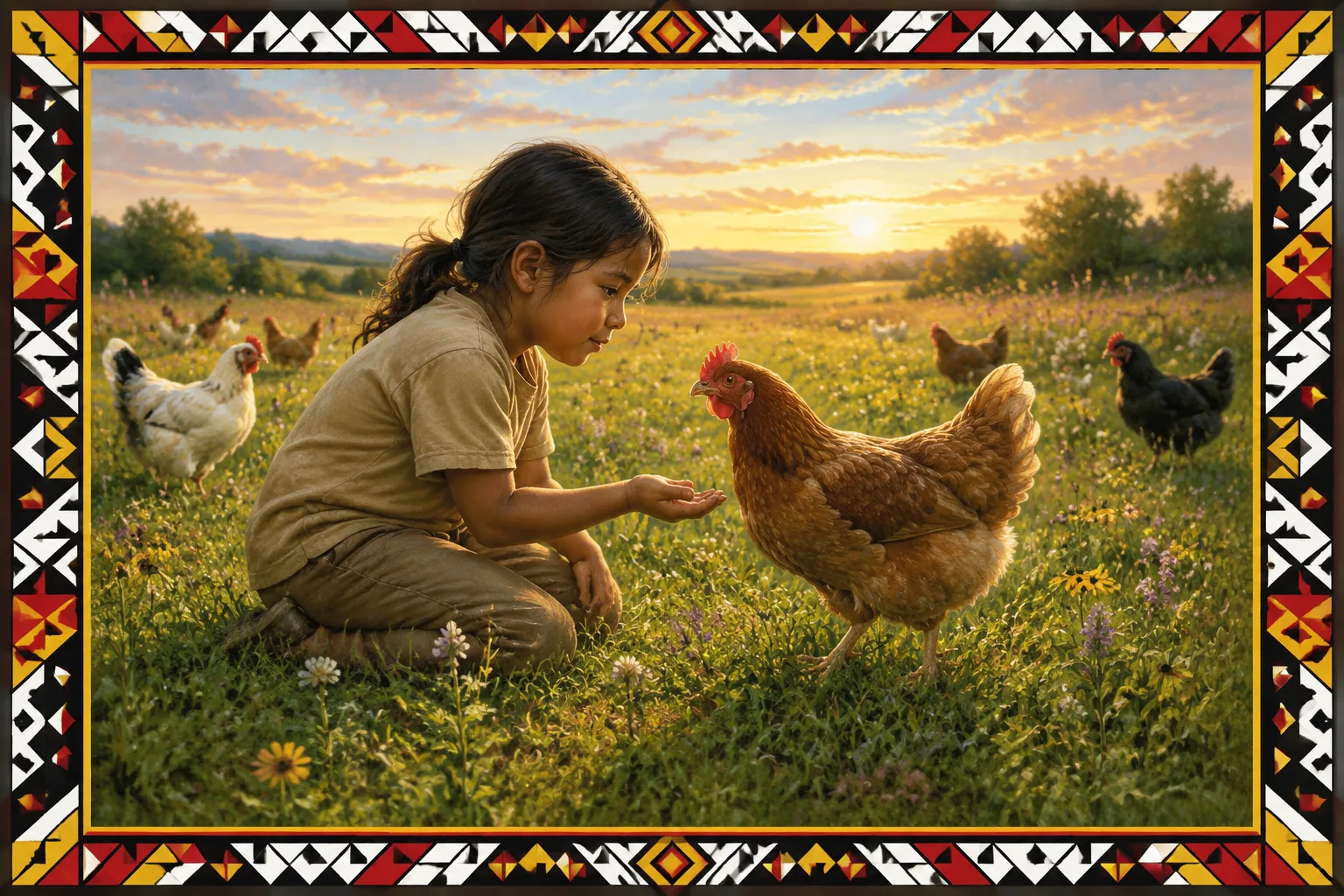
Relationship makes indifference more difficult.
The purpose of this image is not to claim that every child will respond identically or that human food traditions have always been the same. It reminds us of something elemental: relationship makes indifference more difficult. Once an animal is known as a living being, killing can no longer be treated as an abstraction.
Children should not be traumatized with violent imagery. But neither should they be systematically deceived about where food comes from. They deserve truthful, age-appropriate education grounded in tenderness, ecological understanding, gratitude, and freedom of conscience.
An Indigenous Foundation: All Life Is Related
From an Indigenous understanding, animals are not resources placed beneath humanity. They are Nations, teachers, helpers, companions, and relatives within the Sacred Hoop of Life. The words Mitákuye Oyás’iŋ—All My Relations cannot remain only a ceremonial expression. They carry obligations.
Traditional Indigenous hunting and contemporary factory farming must not be carelessly equated. Indigenous peoples have diverse food systems, histories, climates, treaty realities, and relationships with animal Nations. In many traditional contexts, taking an animal’s life occurred within a relationship of necessity, prayer, restraint, reciprocity, gratitude, and responsibility. Industrial confinement and mass slaughter operate through a profoundly different relationship: animals are bred in enormous numbers, separated from natural lives, confined for economic efficiency, transported under severe stress, and killed through systems designed primarily for volume and profit.
The movement should therefore respect Indigenous food sovereignty while asking every society—including our own communities—to examine whether present practices embody reverence, necessity, reciprocity, and the least possible harm.
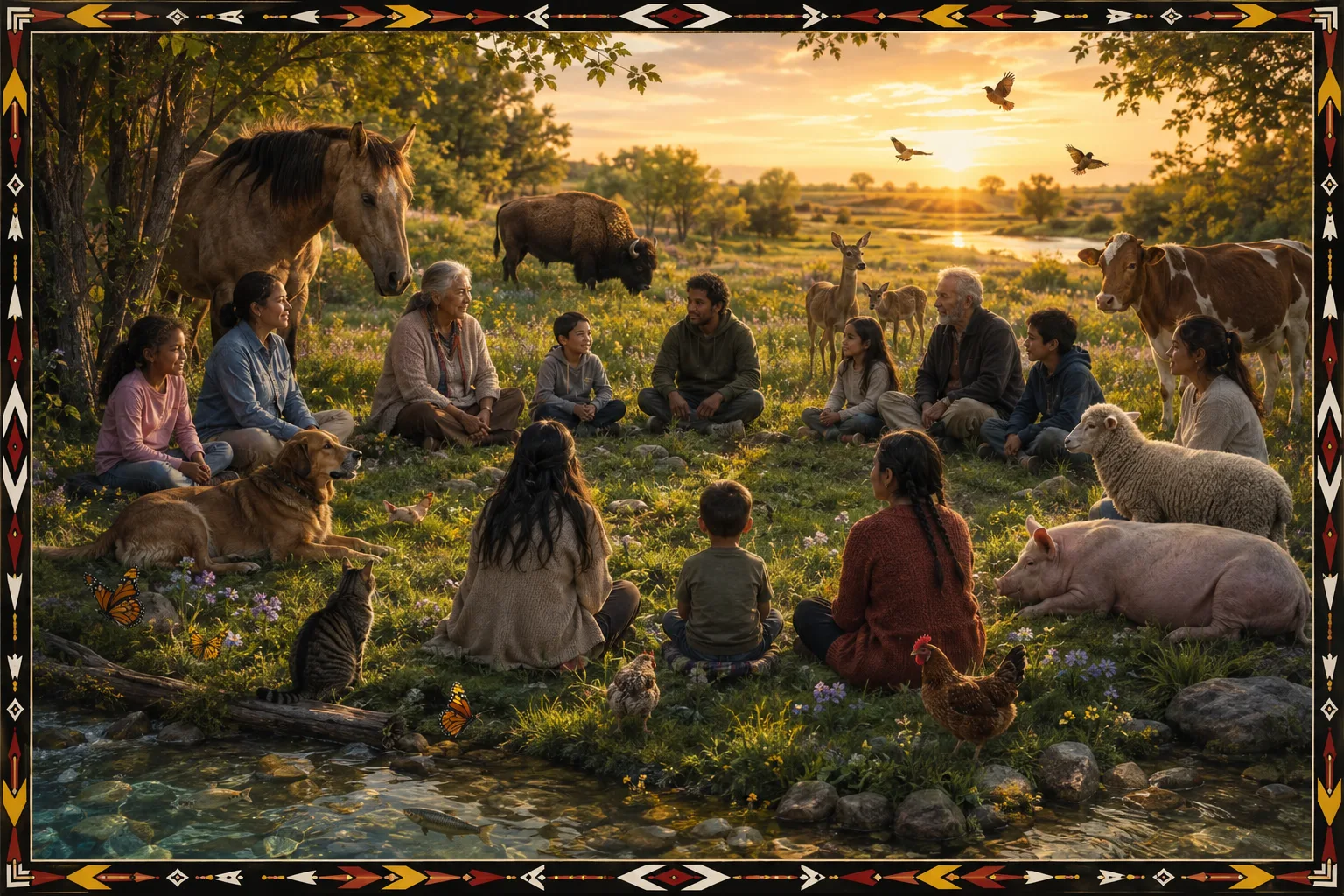
Humanity and the animal Nations belong within one Sacred Hoop of Life.
A Ladder of Peace with Our Animal Relatives
Just as humanity needs achievable steps from war toward peace, we need a practical ladder from industrial cruelty toward restored relationship. The first step is to see: to make the lives of animal relatives visible and support truthful, age-appropriate education about animal intelligence, emotional life, family bonds, food systems, farming, transportation, and slaughter. The second step is to feel: to create experiences through which children and adults encounter animals as living beings rather than commodities. Sanctuaries, ethical farms, wildlife centers, community gardens, films, stories, songs, and direct relationships can reopen empathy.
The third step is to protect by establishing enforceable safeguards against extreme confinement, mutilation without adequate pain relief, neglect, abusive transportation, reckless breeding, and cruel slaughter practices. Protection must include workers who are also harmed by dangerous and psychologically distressing conditions. The fourth step is to reduce harm by helping families, schools, spiritual communities, organizations, and public institutions progressively reduce their dependence upon industrially produced animal foods. Plant-forward meals, meat-free days, ethical purchasing, culturally appropriate alternatives, and accessible nutrition education can make participation possible.
The fifth step is to transform the system by moving public policy, investment, agriculture, and food production toward regenerative plant agriculture, cultivated and fermentation-based foods, humane transitions for farmers and workers, restored ecosystems, and the ending of factory farming. The sixth step is to restore sacred relationship by rebuilding a culture in which we receive food with consciousness, gratitude, accountability, and respect for Mother Earth. Our ultimate purpose is not merely to consume differently. It is to become different in our relationship with all life.
An Animal Relatives Peace Covenant
Individuals, families, schools, Lodges, communities, organizations, farms, businesses, and spiritual traditions could be invited to adopt a living covenant:
We recognize animals as sentient relatives within the Sacred Hoop of Life. We will not deliberately close our hearts to their fear, pain, intelligence, relationships, or desire to live. We will seek truth about the systems in which we participate, reduce the suffering caused by our choices, protect children from becoming numb to cruelty, support farmers and workers through a just transition, and continually move our lives and institutions toward kindness, reciprocity, and peace with all beings.
This covenant should be an invitation, not a weapon for judging others. People will begin from different places. Some may become vegan. Some may become vegetarian. Some may reduce their consumption considerably. Some Indigenous communities may strengthen traditional, land-based practices while rejecting industrial cruelty. What matters is that no one uses gradual change as an excuse for permanent inaction.
A Worldwide Animal Relatives Weekend
The existing Animal Relatives Weekend could become an annual global observance within the movement to Choose Peace. Live Peace. End War. Communities could gather for intergenerational visits to animal sanctuaries; blessings and ceremonies for animal Nations; children’s stories, songs, art, and messages of kindness; plant-based community feasts; and Indigenous teachings on kinship and reciprocity. Farmers, slaughterhouse workers, veterinarians, scientists, sanctuary keepers, and others with direct experience could share their testimonies in a spirit of truth and healing.
The Weekend could also invite public commitments from schools, organizations, and spiritual communities; vigils for animals who have suffered and died; practical workshops on compassionate nutrition and food access; policy dialogues concerning factory farming and animal protection; and restoration projects for wildlife habitat and biodiversity. It could culminate in a worldwide hour of gratitude, silence, prayer, and compassionate action. The circle of concern should include companion animals, farmed animals, wild animals, marine life, insects and pollinators, and threatened species whose homes are being destroyed.
Animal Relatives Lodges
Within the larger Sacred Lodge Keeper Network, Animal Relatives Lodges or circles could bring together approximately 25 to 100 people in local communities. Each Lodge could carry four continuing responsibilities: awakening through education, storytelling, and encounters that restore relationship; protection through local advocacy, rescue, habitat restoration, and opposition to cruelty; transformation by helping schools, families, and institutions adopt compassionate food practices; and celebration by honoring the beauty, intelligence, gifts, and sacred place of animal Nations.
Young people should have meaningful leadership roles. They often see the contradiction more clearly than adults and can ask the questions adults have learned to avoid.
The Good Machine for Our Animal Relatives
The Good Machine could help find and connect the immense amount of good already being done by sanctuaries, Indigenous land protectors, regenerative farmers, wildlife defenders, veterinarians, animal-welfare organizations, plant-based innovators, spiritual communities, educators, and compassionate individuals. It could help people find nearby sanctuaries, programs, and volunteer opportunities; share trustworthy educational materials; organize Animal Relatives events; record personal and institutional commitments; and locate culturally appropriate and affordable food alternatives.
It could also support farmers and workers making compassionate transitions, identify urgent animal-protection needs, measure suffering reduced and habitats restored, connect local Lodges into a global learning network, and celebrate successful models that can be adapted elsewhere. The Good Machine would not merely expose what is wrong. It would make compassionate action visible, connected, practical, and capable of multiplying.
The Sixteen Guiding Principles in Action
This work can directly express the Sixteen Guiding Principles for Building a Sustainable and Harmonious World. It begins from within by examining our own conditioning and choices. It recognizes that human beings and animal Nations exist within one interdependent field of life. It balances material needs with spiritual and moral responsibility. It encourages learning, participation, unity, cultural rootedness, justice, and sustainable action.
Most importantly, it embodies the principle that the change we seek in the world must become visible in the way we live.
A Possible Founding Declaration
PEACE MUST INCLUDE EVERY LIVING BEING
We cannot build peace upon hidden suffering. We cannot teach children that kindness is sacred while asking them never to question systems that confine, terrify, and kill billions of sensitive beings. We cannot condemn violence only when its victims are human. We cannot proclaim that all life is related and then refuse to examine our relationship with the animals whose bodies become our food, clothing, experiments, entertainment, and profit.
This is not a call to condemnation. It is a call to remembrance. Before we were taught to separate ourselves from the animal world, we encountered animals with wonder. We recognized eyes looking back at us. We heard voices, witnessed affection, observed fear, and felt the desire to protect rather than harm. That capacity has not disappeared. Distance, habit, language, convenience, and systems we inherited before we could choose have covered it over.
Now we can choose.
We can tell the truth without hatred. We can change without humiliating one another. We can protect animal relatives while supporting families, farmers, workers, and communities through a just transition. We can nourish our children without teaching them to silence their compassion.
To make peace on Earth, we must make peace with Mother Earth. To make peace with Mother Earth, we must make peace with the animal Nations. And to make peace with the animal Nations, we must awaken and heal the hidden place within ourselves that has learned not to see.
For the children, we must become the path. For our animal relatives, we must become the peace.