Over the last 500 years, ten European nations embarked on a path of global colonization, profoundly shaping the world's history, demographics, and cultural landscapes. These nations—Spain, Portugal, England, France, the Netherlands, Belgium, Germany, Italy, Russia, and Denmark—unleashed waves of conquest and domination that deeply impacted Indigenous populations, economies, cultures, and environments across the globe.
Despite their once-mighty empires, the combined population of these colonizing nations today, excluding those they colonized, is merely 435 million, constituting only 5.35% of the world’s population of 8 billion. This stark contrast underscores the colonizers' relatively small demographic footprint in the context of the vast human family. Yet, their historical actions have left an indelible mark on the world.
At the sametime, if you add the United States, these Nation States combined GDP is approximately $45.9 trillion, which accounts for about 43.71% of the world's total GDP. With this understanding, it is easy to see the logic BRICS and other efforts to become free from colonial dominance that continues economically until today.
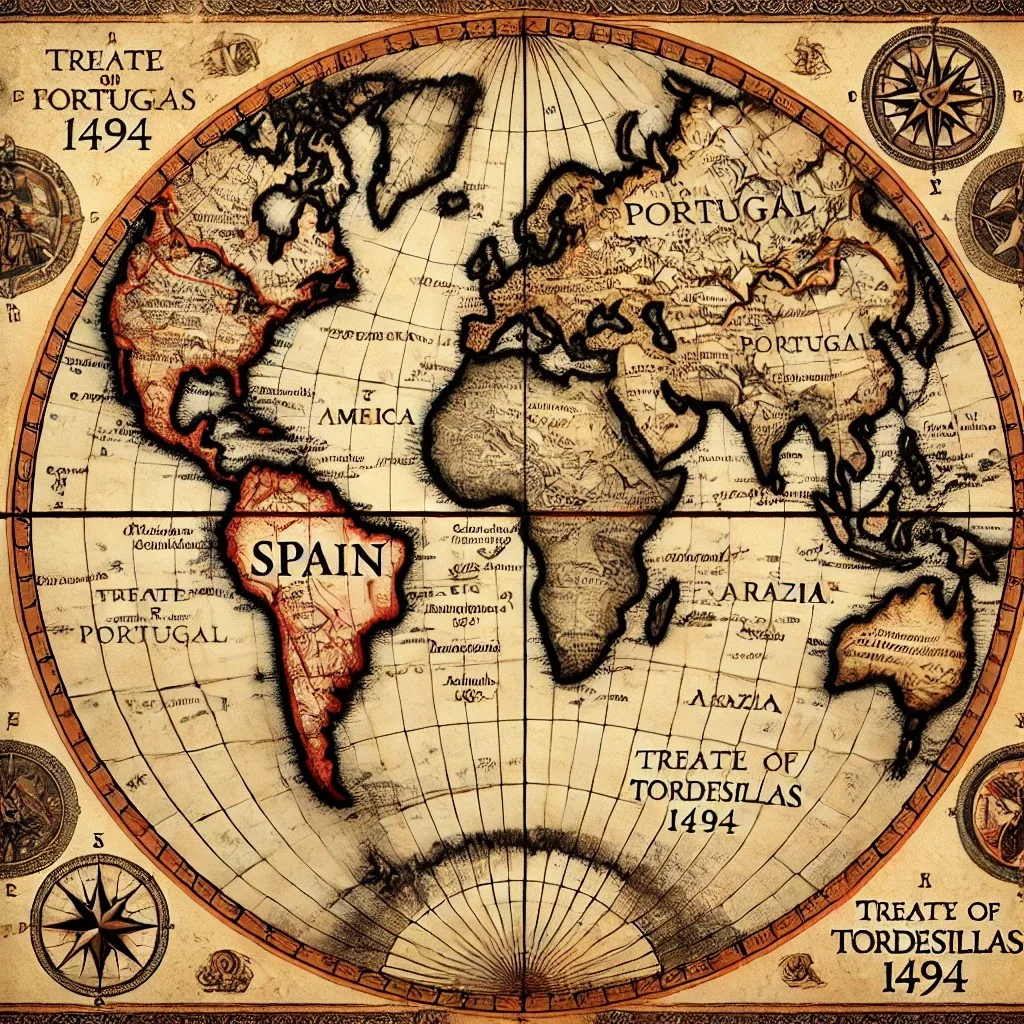
The origins of this colonial expansion can be traced back to the papal decree known as the “Inter Caetera,” issued by Pope Alexander VI in 1493. This papal bull, which remains unrescinded to this day, granted Spain and Portugal the divine right to claim vast territories across the Americas, Africa, and beyond. The decree not only sanctioned but also encouraged the colonization, conversion, and enslavement of Indigenous peoples, declaring that these newly discovered lands were now the domain of European crowns.
The papal bull arrogantly divided Mother Earth in half—one part to Spain and the other to Portugal—ignoring the sovereignty of the millions who inhabited these regions. Though initially exclusive to these two nations, this so-called "Divine Decree" eventually opened the floodgates for other European powers to engage in similar exploits, each carving out its own empire.
Spain, ignited by Christopher Columbus’s 1492 voyage, quickly established a sprawling empire across the Americas, from Mexico and Central America to South America, the Caribbean, and parts of the United States. The Spanish Empire became one of the most powerful and influential forces, leaving a lasting impact on the cultural and linguistic fabric of the Americas.
One of the earliest European colonizers, Portugal focused on Brazil and African and Asian regions, including Angola, Mozambique, and Goa (India). The Treaty of Tordesillas in 1494 formalized this global division, granting Portugal control over Brazil and other territories, further entrenching its colonial ambitions.
England, later evolving into the British Empire, expanded its reach across every continent, establishing colonies in North America, the Caribbean, Africa, India, Australia, and Southeast Asia. The British Empire became the largest in history, and its influence was felt worldwide through the imposition of its language, laws, and economic systems.
France followed suit, establishing colonies in North America (notably in Canada and the United States), the Caribbean, Africa, Southeast Asia, and the Pacific. Like its European counterparts, the French colonial empire left an enduring cultural and linguistic legacy, especially in Africa and Asia.
The Dutch East India Company made the Netherlands a dominant global trade and colonization force. The Dutch established colonies in the Americas (including New Amsterdam, now New York), the Caribbean, South Africa, and Southeast Asia (notably Indonesia), contributing to the complex web of European imperialism.
Belgium, though a more minor player, had a particularly brutal colonial history, especially in the Congo Free State, where the exploitation of resources and people reached horrific levels. The legacy of Belgium’s colonial rule is still felt in the Democratic Republic of the Congo today.
Germany’s colonial ambitions, which emerged later in the 19th century, focused on Africa and the Pacific. Although Germany’s empire was relatively short-lived, its colonial practices, particularly in places like Namibia, had devastating effects on Indigenous populations.
Italy concentrated its colonial efforts in Africa, establishing control over Libya, Eritrea, and Somalia and briefly occupying Ethiopia during the 1930s. Italian colonization was marked by its attempts to expand its influence in the Horn of Africa.
Though often overlooked in discussions of colonialism, Russia's imperial expansion involved colonizing vast territories in Siberia, Central Asia, and North America (including Alaska, which was later sold to the United States). Russia’s colonial practices contributed to the displacement and assimilation of numerous Indigenous groups within its expanding borders.
Although smaller in scale, Denmark also colonized, with territories in the Caribbean (the Danish West Indies), Africa (the Gold Coast), and Greenland. The Danish empire played its part in the broader European colonial project, shaping the regions it controlled.
These nations’ colonizing activities set in motion a series of events that led to the displacement, exploitation, and suffering of countless Indigenous peoples. The forced imposition of foreign rule, the extraction of resources, and the erasure of cultures left deep scars on the world’s Indigenous populations.
The geopolitical and economic structures established during this era continue to influence global relations today, with the legacies of colonization still resonating in the form of ongoing social, financial, and environmental challenges. Despite their relatively small population today, the impact of these colonizing nations is a testament to the profound and far-reaching consequences of their actions over the last five centuries.