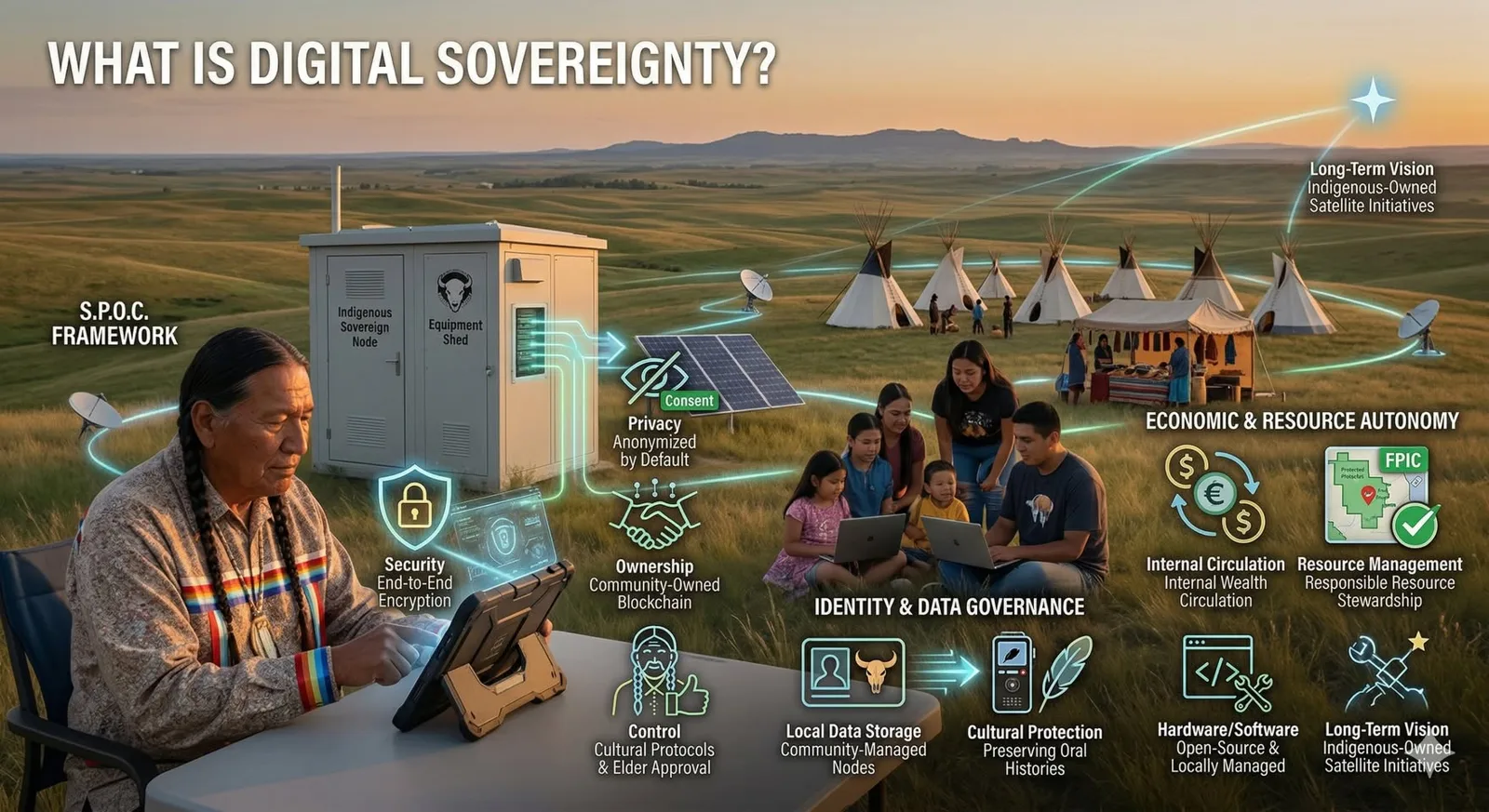
Digital Sovereignty, as defined by Four Worlds, is the ability of communities and community members to maintain complete and absolute control over their data, identity, and digital infrastructure. It is not just about using technology. It's about owning and governing the entire digital ecosystem to empower the community’s self-determination.
This concept is built upon four core pillars, which are designed to support your community's digital independence and resilience:
1. The S.P.O.C. Framework: Four unbreakable ethical principles protect digital sovereignty:
Security: Protecting all data through end-to-end encryption and decentralized monitoring.
Privacy: Ensuring data is only used with explicit community consent and is anonymized by default.
Ownership: Affirming that individuals and communities own their data, which is recorded immutably on a blockchain.
Control: Implementing access rules that follow cultural protocols, such as requiring Elder approval for sacred knowledge.
2. Identity and Data Governance
Sovereign Identity: Every participant holds a Decentralized Identifier (Sovereign ID) and Verifiable Credentials that they, not a government or corporation, fully control.
Local Data Storage: Information is stored on physical "Sovereign Nodes" owned and managed by the community rather than on distant corporate servers.
Cultural Protection technology is used in some Indigenous communities to transcribe oral histories and languages, with traditional leaders controlling sensitive knowledge through 'Consent Engines,' exemplifying the practical application of these principles.
3. Economic and Resource Autonomy
Internal Circulation: The use of community currencies and smart contracts allows wealth to circulate within Indigenous nations without high fees or reliance on external banks.
Resource Management: Digital sovereignty extends to the physical world by using blockchain to track resource permits and enforce environmental standards, ensuring that extraction occurs only with free, prior, and informed consent.
4. Technological Independence
Hardware and Software Sovereignty: Prioritizing open-source hardware and software to prevent proprietary "backdoors" or external interference.
Long-Term Vision: Moving toward full independence from external providers by developing Indigenous-owned satellite constellations and orbital data centers