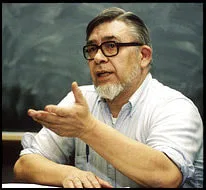
Since his first book, "Custer Died For Your Sins," in 1969, I have studied and reflected on Deksi Vine Jr.'s books and writings, including his correspondence with my father. I also followed closely his tenure as Executive Director of the National Congress of American Indians.
From 1964 to 1967, Deksi increased NCAI's membership of tribes from 19 to 156. During this time, he encouraged me to enter law school at a University in Washington, DC, as a NCAI legal intern.
This was very encouraging and uplifting, but my life was to unfold in a different direction. However, the vision of being a lawyer in Washington, DC, and legally fighting the US Government on behalf of the Good of the People was heartfelt and exciting but brief.
From my perspective, the essence of what has been termed the "Delorian trilogy" is profoundly important until today. This trilogy comprises Deksi's impactful elucidation of tribal sovereignty, his unique conceptualization and defense of the pivotal doctrine of tribal self-determination, and his insightful discussion and analysis of the significance and sacredness of space and place for Indigenous nations.
Deksi's ideas, as acknowledged by diverse tribal nations, interest groups, and academics familiar with his work, are credited with providing the intellectual and substantive ideological framework that sparked the renaissance of Native America in the 1960s and continues to shape it today. From Deksi's view, these concepts constitute the major framework of the federal relationship with Indian tribes.
Deksi asserted that "these concepts form the major framework of the federal relationship with the Indian tribes." This assertion aligns with the reality that the fortunes of First Nations today are intricately linked to their ability to effectively implement and fundamentally relate to the notions of their inherent sovereignty, the fundamental right of self-determination, and the sacred relationship Indigenous communities have with their territory.
Deksi's powerful trilogy of core concepts serves as an Indigenous roadmap. If put into practice, these concepts would address ongoing problems. Deksi's visionary talent, spanning a wide range of fields, can stabilize and clarify the cultural identities of tribal nations, enhance the political and legal standing of tribal nations and other oppressed minority groups, and foster greater ecological respect, benefiting all concerned.
Deksi's recommendations that encompass diverse aspects are still very relevant today, such as formal federal acknowledgment of tribal sovereignty through constitutional amendment, the revival of the treaty-making process, disavowing congressional plenary power, consolidating and restoring tribal lands, affirming the political rights of non-recognized tribal groups, establishing a permanent Court of Indian affairs, supporting the international status of Indian nations, modifying the trust doctrine, forging better ties between urban and reservation-based communities, and increasing the teaching of Indigenous knowledge and wisdom to Native youth, among other crucial considerations.
Deksi used the term "Indian" throughout his life, as he shared with me that all our treaties use the term "Indian." His focus was on the treaties. That is why he opposed any action that undermined Treaty Rights, our inherent sovereignty, and our sacred connection to our homelands.
From my perspective, inherent sovereignty, the fundamental right of self-determination, and the sacred relationship Indigenous communities have with their territory are integral to our identity, culture, and ongoing struggle for autonomy and cultural preservation.
Inherent Sovereignty:
Definition: Inherent sovereignty refers to the inherent and pre-existing right of Native American nations to govern themselves and determine their own destinies. It is rooted in the truth that Indigenous nations possessed self-governing structures long before the arrival of European colonizers.
Significance: Native Americans view inherent sovereignty as a fundamental aspect of our existence, recognizing our governance structures and ways of life have deep historical roots. This concept asserts that the authority to govern comes from our traditions and is not granted by external entities.
The Fundamental Right of Self-Determination:
Definition: The fundamental right of self-determination emphasizes the right of Indigenous peoples to make decisions about our political, economic, social, and cultural futures without external interference. It encompasses determining our political status and pursuing economic, social, and cultural development as we choose.
Significance: Native Americans see the fundamental right of self-determination as essential for maintaining cultural integrity and addressing historical injustices. It involves shaping policies and practices that reflect Indigenous communities' unique needs and aspirations.
The Sacred Relationship Indigenous Communities Have with Their Territory:
Definition: The sacred relationship with territory goes beyond a mere connection to the land; it embodies spiritual, cultural, and historical ties between Indigenous peoples and our ancestral lands. It acknowledges that the land is not merely a resource but a living entity with which Indigenous communities share a profound, spiritual connection.
Significance: For Native Americans, the sacred relationship with territory is central to our cultural identity. The land is considered a teacher, a provider, and a source of spiritual sustenance. This concept emphasizes the responsibility to protect and preserve the environment for future generations, reflecting a holistic understanding of the interconnectedness of all living beings.
These concepts collectively form the foundation of Indigenous worldviews and guide our efforts to reclaim and maintain our sovereignty and cultural heritage. From a Native American perspective, these principles are living truths that shape our ongoing struggles for recognition, justice, and preserving our distinct ways of life.
In weaving the tapestry of Indigenous wisdom, I have added a fourth dimension to the trilogy: spiritual and cultural mycelium. This mycelium, existing in the seen and unseen realms, is a testament to the profound spiritual strength and beauty inherent in Indigenous spiritual perspectives, values, and vision.
Understanding the Mycelium:
This mycelium is not confined by the limitations of time and space; it is omnipresent, everywhere, all at once. It forms the fabric that interconnects every facet of the physical world, enveloping the universe in its sacred embrace.
With this understanding and experience, the mycelium becomes a living expression of the interconnectedness of all things, symbolizing the timeless and boundless nature of spiritual and cultural elements within Indigenous communities and beyond.
The Unseen Network:
This spiritual and cultural mycelium is a network, both seen and unseen, transcending the tangible and reaching the metaphysical. It comprises shared beliefs, values, and cultural practices, intricately binding Indigenous nations in a Sacred Covenant.
This Covenant goes beyond the surface, emphasizing the significance of acknowledging the visible aspects of culture and the invisible threads that weave through the intricate tapestry of Indigenous Teachings.
Enriching Perspectives:
Incorporating the spiritual and cultural mycelium as the foundation of thoughts and actions elevates the understanding of Indigenous perspectives on sovereignty, self-determination, and the sacred relationship with territory.
This Covenant serves as a guiding force, emphasizing a depth of connection that extends beyond the immediate and tangible. It beckons individuals to delve into spirituality and shared cultural consciousness, fostering a profound appreciation for the intricate layers of Indigenous worldviews.
Holistic Framework:
With the addition of the fourth dimension of spiritual and cultural mycelium, a holistic framework emerges, unveiling the complexities and richness of Indigenous worldviews.
This holistic perspective emphasizes the intricate interplay between the seen and the unseen, breathing deeply into the Indigenous identity, unity, vision, and resilience. It is a reminder that true understanding comes from what is visible and embracing the unseen threads that form the essence of Indigenous heritage.
With this addition, the spiritual and cultural mycelium becomes a living force, enriching our lives with its resilience, beauty, and eternal strength that flows through the heart of Indigenous wisdom.
Shunkmanu He Me Yedo! Chanupa Sapa He will Me Yedo!