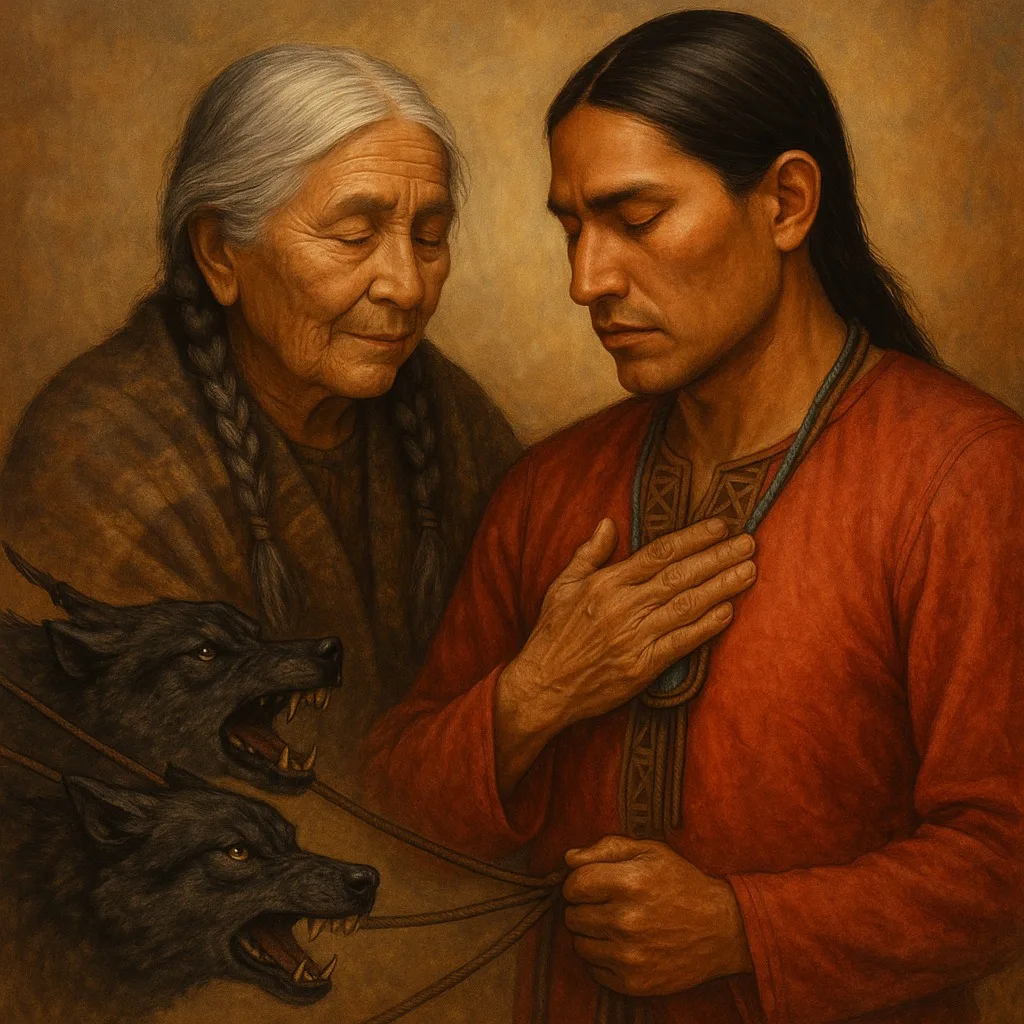
❖ “Cry ‘Havoc!’ and let slip the dogs of war.”
— Mark Antony, Julius Caesar, Act 3, Scene 1, by William Shakespeare
This line, spoken by Mark Antony after the assassination of Julius Caesar, is among the most chilling and potent invocations in all of Shakespeare's work. It captures a moment of profound grief, betrayal, and fury—but also a deliberate unleashing of chaos and destruction.
Let us now explore its full meaning, layered with historical, symbolic, and spiritual insight — especially through an Indigenous lens.
𐂃 Literal and Historical Meaning
In ancient warfare, especially in Roman and medieval contexts, to "cry havoc" was a command given by officers to their soldiers. It meant that all constraints were lifted—no rules, no order, no mercy. Looting, pillaging, and slaughter could begin. It marked the transition from structured battle to total devastation.
The phrase “let slip the dogs of war” furthers this image, evoking the image of war not as a noble endeavor, but as a violent force of nature, like wolves or hounds held back by chains. Once unleashed, they rush forth with a frenzy, heedless of innocence, justice, or law.
Shakespeare’s brilliance lies in turning this command into poetry, giving voice to the raw, furious grief of Mark Antony, who foresees that Caesar’s death will not lead to peace or freedom, but to a blood-soaked reckoning.
❖ Symbolic and Spiritual Understanding
From my spiritual perspective, this phrase can be read not just as a call to physical war, but as a warning against the spiritual disease of revenge and imbalance. War, when rooted in unhealed grief and broken trust, becomes more than just conflict, it becomes a wildfire consuming everything in its path.
The “dogs of war” are not only soldiers or armies, but:
Rage without wisdom.
Grief turned to vengeance.
Power corrupted by ego.
Fear masked as strength.
Spirits are unbalanced and unanchored.
In my thought, when the sacred hoop is broken, when relationships are not honored and spiritual law is forgotten, then waŋna, the time of havoc, begins. This is not merely an external war but an inner war , within the hearts of people, families, nations, and even between human beings and Mother Earth.
Mark Antony, in this moment, is not merely a man calling for revenge. He becomes an archetype of the wounded warrior — the one who, having lost his beloved brother (in this case, Caesar), seeks justice through destruction rather than restoration.
But what does it mean to "cry havoc" today? In our world, it is:
The rhetoric of war has been exhausted before diplomacy can be pursued.
The violence of words that tear instead of mend.
The unleashing of technologies and weapons that no longer recognize borders or the sacredness of life.
The spiritual disconnection that allows us to see others as enemies rather than relatives.
The Cry of War or the Call to Peace?
In the teachings of our ancestors, we are always faced with a choice:
To cry “Havoc!” and continue cycles of war, or
To cry “Mitákuye Owás’iŋ," All My Relations, and seek restoration through truth, healing, and sacred ceremony.
The dogs of war must be acknowledged. They live within all of us, that part of the human spirit that reacts when hurt, betrayed, or afraid. But we are also the keepers of the pipe, the drum, the prayers. We are the ones who can choose to walk the path of the Peacemaker, not the path of devastation.
So when Shakespeare writes, “Cry ‘Havoc!’ and let slip the dogs of war,” he is not only dramatizing a historical turning point — he is giving us a mirror to examine our own hearts and histories.
Will we cry havoc?
Or will we cry healing?
Let us, as Relatives, remember that every war ever fought began first as a spiritual imbalance, a broken promise, an unmet need, a grief too heavy to carry alone. But every peace ever made began with a willingness to listen, to remember, to forgive, and to love again.