
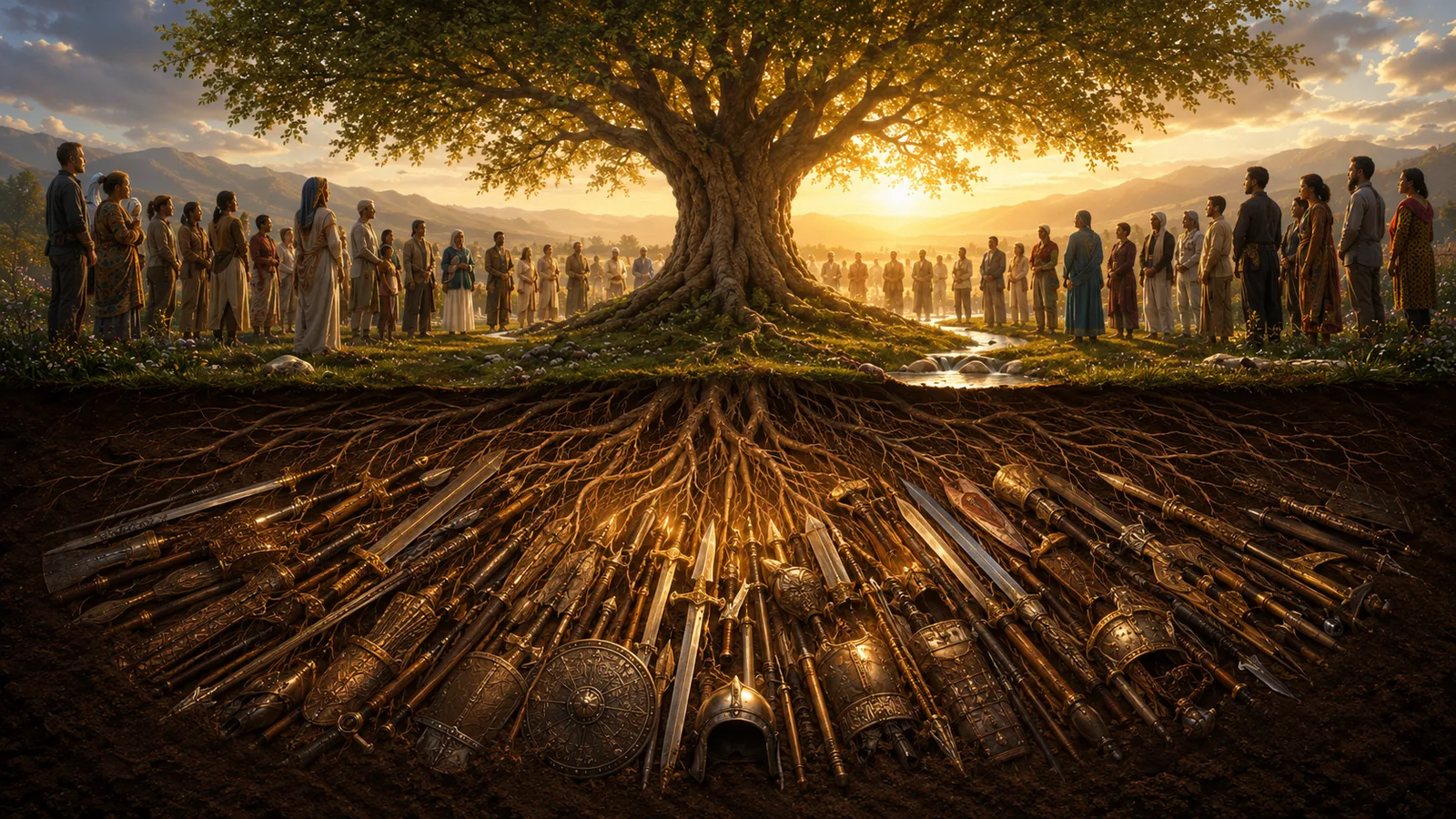
Alma 24 is one of the most spiritually powerful chapters in the Book of Mormon because it teaches that true transformation is never merely a change of belief. It is a change of heart, a change of conduct, a change of memory, and a change in the whole direction of a people.
The Anti-Nephi-Lehies had once lived in ways that harmed others, but when the word of God entered their hearts, they did not simply become sorry for the past. They became a new people.
The heart of this chapter is repentance, but not repentance as shallow regret, fear, or temporary remorse. Alma 24 reveals repentance as a complete turning of the soul. These people understood that Wakan Tanka had shown them mercy, lifted guilt from their hearts, and opened a door to a new life.
Because they knew the seriousness of what they had done before, they refused to treat forgiveness lightly. They understood that if the Creator had cleansed them, then they must not return to the very pattern that had wounded their souls and harmed others.
This is why the burying of their weapons is so spiritually important. They did not merely put their weapons away for a season. They did not hide them where they could easily return and take them up again when fear, anger, or revenge rose in their hearts.
They buried them deep in the earth. That outward act revealed an inward covenant. It was a sacred sign that they were finished with the old life.
Their weapons became more than weapons. They became symbols of everything they were choosing to leave behind: violence, revenge, anger, domination, fear, pride, and the belief that survival must come through harming others.
By burying them, they were saying with their whole lives, “This old way must not rise again through us.” Mother Earth herself became a witness to their covenant.
This has a profound parallel with the sacred teaching of the Peacemaker and the Great Tree of Peace. Out of respect for the sacred protocols of the Iroquois Confederacy, we will not mention his sacred name here.
It is enough to remember the holy work he carried among the Haudenosaunee people: to end cycles of bloodshed, vengeance, grief, division, and fear, and to gather the nations into a new spiritual and political order rooted in peace, unity, and sacred law.
The Peacemaker did not come into a world already at peace. He came into a world torn by conflict, sorrow, retaliation, and distrust. The nations were suffering from old wounds.
The cycles of harm had become so deep that many could no longer imagine another way. This is always the condition into which the great peace teachings come.
They do not arrive because the world is already healed. They arrive because the world is crying out for healing.
On his journey, the Peacemaker brought not only a message, but a living spiritual power. He carried a vision of a new order of relationship among the people.
He taught that the mind must be made clear, the heart must be made peaceful, and the people must learn to sit together in council.
Peace was not to be a temporary pause between wars. Peace was to become a law, a covenant, a way of life, and a structure strong enough to hold the people together across generations.
Hiawatha’s place in this sacred story is especially meaningful because he carried deep grief. He knew suffering personally. He knew loss, sorrow, confusion, and the heaviness that can come when the heart has been broken by violence and tragedy.
The Peacemaker did not simply give Hiawatha an idea. He helped restore his mind, lift his grief, and prepare him to become a carrier of peace.
This is one of the deepest teachings in the story: the wounded one can become a healer when grief is transformed by spiritual power.
This is why the journey of the Peacemaker and Hiawatha speaks so deeply to Alma 24. In both stories, the people do not merely receive words.
They receive a new way to live. In both stories, violence is not answered with more violence. A higher law is revealed. A new covenant is made. Wounded people are invited to become something more than the pain they have inherited.
When the Peacemaker brought the people together beneath the Great Tree of Peace, the weapons of war were buried beneath that Sacred Tree. This was not simply a political agreement. It was a sacred transformation. The instruments of violence were placed under the roots of a living tree.
The old way was not denied, but it was overcome. The weapons were buried so the tree could stand above them, so that peace, council, unity, and law could grow where fear and vengeance had once ruled.
That same spiritual pattern is found in Alma 24. The Anti-Nephi-Lehies did not only speak words of repentance. They changed their relationship with violence. They allowed Mother Earth to receive what they no longer wished to carry. The ground held the old life so a new life could rise.
Under the Tree of Peace, weapons were buried so the nations could sit together in council. In Alma 24, weapons were buried so that the people could stand before God with clean hands and transformed hearts.
In both sacred stories, the earth is not passive. Mother Earth becomes a keeper of the covenant. Mother Earth receives the instruments of death so that the people may walk a path of life.
This teaches us that peace is not real until something is surrendered. Unity is not real until the old weapons, both the weapons in our hands and the weapons in our hearts and minds, are placed beneath the roots of a higher law.
Another deep teaching in Alma 24 is that peace requires courage. The Anti-Nephi-Lehies were not weak. They were not passive because they lacked strength.
They had strength, but they placed that strength under God’s command. They chose faithfulness over self-protection, covenant over fear, and spiritual integrity over retaliation. Their refusal to fight was not empty. It was full of spiritual power.
This is one of the most difficult teachings for the human heart. Many people think courage means striking back.
Alma 24 teaches that there is another kind of courage: the courage to end the cycle, the courage to refuse revenge, the courage to keep one’s covenant even when threatened, misunderstood, or attacked.
This kind of courage does not come from weakness. It comes from a soul that has been healed deeply enough that it no longer wishes to pass its wounds on to others.
This is also what makes the Tree of Peace so powerful. It is not only a tree. It is a spiritual image of what must happen within the human family. The roots go deep. The weapons are placed beneath them.
The tree rises upward. The people gather around it. The council fire is protected. The nations are invited to sit together, listen deeply, and remember that the survival of one people cannot be built upon the destruction of another.
The chapter also teaches that a pure witness can transform others. When the enemies of the Anti-Nephi-Lehies saw that these people would not return violence for violence, many were pierced in their hearts.
Their covenant faithfulness did what argument alone could not do. It opened a doorway for repentance. It revealed a power greater than force. It showed that Great Spirits’ deepest victories are not always won through domination but through sacrifice, humility, love, and unbroken spiritual commitment.
There is also a warning in this chapter. Those who receive spiritual light and then harden themselves against it can become more closed than before. Sacred knowledge brings sacred responsibility.
When a heart has been touched by truth, it must remain humble, tender, and obedient. Otherwise, the same light that could have healed the soul becomes a witness against the soul. Alma 24 reminds us that the more mercy we receive, the more accountable we become for how we live.
For me, the spiritual heart of Alma 24 is this: when the Creator has truly healed us, we must not return to what wounded us, nor to what caused wounds in others.
The buried weapons are not only ancient swords. They are also anger, resentment, pride, addiction, cruelty, jealousy, harsh words, bitterness, domination, and every pattern that keeps us from walking in peace.
Every person and every community must ask: What must we bury deep in the earth so our hearts can remain clean before God? What old weapons are we still carrying? What resentments do we still sharpen? What fears do we still protect? What habits do we keep near us in case we decide to return to the old life?
Alma 24 teaches that peace is not simply something we pray for. Peace is something we choose, protect, embody, and covenant to live, even when it costs us something.
The Peacemaker’s Tree of Peace and the buried weapons of the Anti-Nephi-Lehies both testify to the same sacred truth: a new people can only be born when the old instruments of harm are surrendered to a higher law.
This understanding does not belong to only one people or one scripture. In different languages, symbols, ceremonies, and sacred memories, this same truth stretches all around Mother Earth.
Again and again, the great spiritual traditions teach that the human family must lay down the instruments of harm, cleanse the heart, restore right relationship, and return to the sacred order of life. Everywhere on Mother Earth, the deepest teachings call us away from domination and back toward humility, justice, compassion, reverence, and peace.
Some traditions speak of swords becoming plowshares. Some speak of forgiveness, mercy, and reconciliation. Some speak of restoring balance, healing the circle, cleansing the heart, or walking the sacred path. Some speak through trees, rivers, mountains, councils, covenants, prayers, or ceremonies.
The words may differ, but the spiritual pattern is recognizable: the old weapons must be surrendered, the heart must be transformed, and the people must return to right relationship with the Creator, with one another, and with Mother Earth.
This chapter is ultimately about becoming new. It is about mercy powerful enough to cleanse the past, covenant strong enough to guide the present, and love deep enough to change the future. It teaches that the Creator not only forgives individuals but can also transform whole peoples.
But that transformation must become visible. It must take root in conduct, in relationships, in community life, and in the sacred choices we make when fear tells us to return to the old ways.
The weapons must be buried. The roots of peace must grow above them. The people must gather around the living tree. And together, they must walk forward as living witnesses that another way is possible.
The Path of the Book
Chapter One has already laid the foundation. We have begun with Alma 24 and the sacred act of burying the weapons deep in the earth. We have seen that this was not only an ancient story of repentance, but a living instruction for humanity today. The Anti-Nephi-Lehies did not merely put their weapons away. They buried the old life itself: violence, revenge, domination, fear, and the belief that survival must come through harming others.
We have also placed this beside the sacred teaching of the Peacemaker and the Great Tree of Peace.
This chapter will bring together Joseph in the Bible, Yusuf in the Qur’an, and Joseph of Egypt in the Book of Mormon. Joseph teaches forgiveness without denying the wound. In the Qur’an, Yusuf teaches patience, purity, trust, and mercy through trial. In the Book of Mormon, Joseph becomes a prophet of covenant memory, scattered branches, records coming together, and peace established through remembrance.
Joseph’s question is one of the deepest questions of this book: when those who wounded us stand before us in need, what will we do with our power? Will we sharpen the old weapon, or will we become servants of life? Peace. Beneath that living tree, the weapons of war were buried so that the nations could sit together in council. This gives us the great image that will guide the whole book: Our Mother Earth as witness, the roots of peace growing over the instruments of destruction, and a people becoming new because they have surrendered the old weapons to a higher law.
From here, the book widens. We now begin to follow this same sacred pattern through the great spiritual traditions of humanity. Each chapter will ask a simple but profound question: What weapon must be buried here? What old pattern must be surrendered? What teaching has been given to help humanity cross from violence into covenant, from revenge into mercy, from separation into unity, and from fear into the new world now struggling to be born?
Part 2-Joseph, Forgiveness, and the Spiritual Power of our Creator
The story of Joseph is one of the great spiritual stories of humanity. It is not only a story belonging to one scripture or one people. It lives in the Bible, in the Qur’an, in the Book of Mormon’s prophetic memory, and in the sacred unfolding of the Bahá’í Revelation. It is a story of betrayal, suffering, exile, patience, purity, revelation, divine protection, forgiveness, and the final triumph of God’s purpose.
This is why the story of Joseph is so important. It shows how the Creator works through the deepest wounds of human life, transforming them into instruments of mercy, wisdom, and reconciliation. Joseph is betrayed by his own brothers, cast away, sold, falsely accused, imprisoned, forgotten, and tested again and again. Yet through every trial, the spiritual power of the Creator continues to move. What human beings intended for harm, God turns toward healing, protection, and the saving of many lives.
In this sense, Joseph’s story is a story of humanity itself. Humanity has betrayed its own brothers and sisters. Humanity has cast away the innocent. Humanity has imprisoned truth, rejected the messengers, and wounded the very ones sent to guide it. Yet the Creator does not abandon the human family. Again and again, through suffering, revelation, forgiveness, and divine love, God opens a path for reconciliation.
This is also why the story of Joseph stands so close to the foundation of the Bahá’í Revelation. The Báb’s first revealed work, often known as His commentary on the Súrih of Joseph, was not accidental. The Báb unfolded the story of Joseph as a doorway into a new Revelation. Through that sacred story, He announced a new spiritual dawn, a new voice of divine guidance, and a new movement of the Creator’s power in the world.
Bahá’u’lláh also deepens the meaning of Joseph. In the Bahá’í Revelation, Joseph becomes more than a historical figure. Joseph becomes a spiritual sign: the hidden beauty of God, the one rejected and then revealed, the beloved who suffers yet remains pure, the light that is concealed for a time and then made manifest for the healing of the world.
This is why Joseph belongs beside the story of Alma 24 and the Tree of Peace. All three stories reveal the same sacred pattern. The weapons must be buried. The cycle of harm must be broken. The wounded heart must not become a weapon. The betrayed one must not become the betrayer. The one who has suffered must rise into a greater law.
Joseph had every human reason to avenge himself upon his brothers. He had power over them. He could have punished them. He could have returned their betrayal with judgment. But instead, Joseph revealed the higher law of the Creator: forgiveness, mercy, and reconciliation. He saw that God’s purpose was greater than the harm done to him. He did not deny the wound, but he did not allow the wound to rule him.
This is the same spiritual power we see in Alma 24. The Anti-Nephi-Lehies buried the weapons of outward violence. Joseph buried the weapon of revenge within his own heart. The Peacemaker helped the nations bury the weapons of war beneath the Tree of Peace. In all these sacred stories, the old pattern is not continued. It is transformed.
The story of Joseph teaches that forgiveness is not weakness. Forgiveness is one of the greatest powers of the Creator working through the human soul. It does not excuse wrongdoing. It does not erase justice. It does not pretend that betrayal did not happen. But it refuses to let hatred become the final word. It opens the door for a future that violence could never create.
This is why Joseph is so central. His story teaches that the Creator can take what is broken and make it whole. God can take exile and turn it into preparation. God can take imprisonment and turn it into wisdom. God can take betrayal and turn it into reconciliation. God can take sorrow and turn it into a blessing for many.
Joseph’s life shows that humanity’s spiritual destiny is not to remain trapped in cycles of revenge, accusation, and division. The destiny of humanity is reunion. The destiny of humanity is forgiveness. The destiny of humanity is to recognize one another again as relatives, as brothers and sisters, as one human family under the loving care of the Creator.
So the buried weapons, the Tree of Peace, and the story of Joseph all speak with one voice. They tell us that peace begins when the old instruments of harm are surrendered. They tell us that forgiveness is stronger than revenge. They tell us that the Creator’s power can move through suffering and bring forth a new world. They tell us that no wound, no betrayal, no exile, and no darkness is greater than the mercy and transforming love of God.
This is why Joseph must be remembered. His story is not simply ancient history. It is a living map for humanity. It shows us how the Creator leads the human family from betrayal to forgiveness, from separation to reunion, from suffering to wisdom, and from hidden sorrow to revealed glory.
Chapter Three: Abraham and the Covenant Beyond Tribe
From Joseph, the book will naturally move to Abraham, the father of the covenant. Abraham is called to leave the old world behind and walk by faith into a promise meant to bless all families of Mother Earth. His story speaks to Judaism, Christianity, Islam, the Bahá’í Faith, and to the larger human family.
The weapon to be buried here is the weapon of tribal separation, religious arrogance, and the belief that the covenant belongs to one people for the exclusion of others. Abraham’s covenant was never meant to become a wall of superiority. It was meant to become a blessing flowing outward.
This chapter will ask how the children of Abraham can move beyond rivalry into responsibility. It will invite Jews, Christians, Muslims, Bahá’ís, and all people of faith to remember that the Covenant is not fulfilled by domination. Covenant is fulfilled when the human family is blessed, protected, reconciled, and brought into right relationship with the Creator and with one another.
Chapter Four: Zoroaster and the Choice Between Truth and the Lie
Zoroaster brings us to the great moral struggle between truth and falsehood, light and darkness, righteousness and destruction. Here, the weapon to be buried is the lie. The lie is one of the oldest weapons of war. Before violence appears in the hand, falsehood often prepares the way in the mind and heart.
This chapter will explore Asha, the path of truth, order, and righteousness. It will show how the world’s wars are fed by deception, propaganda, greed, spiritual confusion, and the refusal to live in truth. Zoroaster’s teaching calls humanity to choose: will we serve truth, life, and light, or will we continue to feed the forces that destroy trust, community, and Mother Earth?
This chapter becomes especially powerful in our time, when lies can travel faster than wisdom and when false stories can dehumanize whole peoples. To bury the weapons of war, humanity must also bury the lie.
Chapter Five: Moses, Liberation, and the Law of Justice
Moses brings the sacred teaching of liberation. He leads a people out of bondage and receives a law meant to shape a community around justice, memory, responsibility, and faithfulness. The weapon to be buried here is oppression: Pharaoh’s weapon, the empire’s weapon, the weapon of domination over the vulnerable.
This chapter will show that peace is not real without justice. People cannot be told simply to be peaceful while they remain enslaved, exploited, displaced, or silenced. Moses teaches that the Creator hears the cry of the oppressed. Liberation is not merely political; it is sacred.
This chapter will connect Exodus to the struggles of Indigenous Peoples, enslaved peoples, colonized peoples, refugees, and all those who have cried out under systems of bondage. The weapons must be buried, but so must the systems that forge them.
Chapter Six: Christ and the Courage of Non-Retaliation
The Christ brings us to the radical courage of love. Blessed are the peacemakers. Love your enemies. Forgive. Put away the sword. Overcome evil with good. The weapon to be buried here is retaliation.
This chapter will not present non-retaliation as a weakness. It will show it as one of the highest forms of spiritual power. Christ reveals that the cycle of violence cannot be healed by repeating it. Someone must be spiritually strong enough to stop passing the wound forward.
The Cross becomes a place where the weapons of empire, accusation, religious cruelty, betrayal, and fear are exposed. Yet the response is forgiveness, not revenge. This chapter will closely align with Alma 24. Both reveal that true peace requires the courage to refuse the old weapon, even when suffering is real.
Chapter Seven: Muhammad and the Mercy of Surrender
The chapter on Muhammad, peace be upon him, will explore surrender to the One God, mercy, justice, community, prayer, charity, and accountability. The weapon to be buried here is arrogance: the arrogance of tribe, the arrogance of wealth, the arrogance of ignorance, the arrogance that refuses to bow before God.
Islam calls human beings to surrender, but true surrender is not passive. It is the disciplined turning of the whole life toward God. This chapter will explore mercy, forgiveness, social justice, care for people experiencing poverty, and the transformation of divided tribes into a community bound by faith and responsibility.
Here, the question becomes: if we truly surrender to God, what weapons of hatred, injustice, and pride can we still justify carrying?
Chapter Eight: The Sikh Gurus and the Sword Transformed into Service
The Sikh tradition brings a powerful and necessary balance. It teaches devotion, equality, courage, service, and defense of the oppressed. The weapon to be buried here is not courage itself, but ego, revenge, domination, and the misuse of power.
The Sikh path shows that spiritual people are not called to abandon the vulnerable. They are called to protect life without becoming servants of hatred. The sword, in its highest symbolic meaning, is not for conquest. It is for justice, dignity, discipline, and the protection of those who cannot protect themselves.
This chapter will explore Naam, seva, langar, equality, and the Gurus’ spiritual courage. It will ask how power can be purified so that it serves life rather than ruling over it.
Chapter Nine: The Buddha and the Extinguishing of the Inner Fires
The Buddha brings the journey inward. The weapons of war begin in the heart: craving, hatred, ignorance, fear, attachment, and illusion. The weapon to be buried here is the inner fire that keeps suffering alive.
This chapter will explore how violence is born from ungoverned desire, wounded perception, and the false belief in separateness. The Buddha’s path teaches discipline, mindfulness, compassion, and liberation from the patterns that bind the mind.
This chapter deepens the whole book by showing that peace cannot be built only through outer agreements. The inner weapons must also be laid down. Hatred must be extinguished. Craving must be understood. Ignorance must be illuminated. The heart must become a place where violence no longer finds a home.
Chapter Ten: Hindu Dharma, Ahimsa, and the Divine Life in All Beings
The Hindu traditions bring vast teachings on dharma, karma, devotion, ahimsa, sacred duty, and the Divine presence within all beings. The weapon to be buried here is forgetfulness: forgetfulness of the sacred, forgetfulness of duty, forgetfulness of the Divine life that moves through all creation.
This chapter will explore the tension between duty and nonviolence, action and surrender, discipline and compassion. It will reflect on ahimsa as a moral force and on dharma as the alignment of life with the sacred order.
This chapter will also bring us into the right relationship with animals, rivers, forests, ancestors, and the whole living world. If the Divine dwells in all beings, then domination of life is a spiritual failure. The weapons buried beneath the earth must include the weapons we have used against Mother Earth herself.
Chapter Eleven: Bahá’u’lláh and the Oneness of Humanity
Bahá’u’lláh brings the book into the present age with unmistakable power. His central teaching is the oneness of humanity. The weapon to be buried here is the weapon of division: racial prejudice, religious hatred, nationalism, sectarianism, gender injustice, and the idea that one people can prosper apart from the whole.
This chapter will show that humanity has reached the hour when unity is no longer optional. It is the condition for survival. Bahá’u’lláh calls the peoples of the earth to see themselves as one human family, one body, one soul, one unfolding civilization under God.
This chapter will connect deeply with the purpose of the whole book. The buried weapons, the Tree of Peace, Joseph’s forgiveness, Abraham’s covenant, Christ’s love, Muhammad’s surrender, the Buddha’s compassion, Sikh service, Hindu reverence, Zoroastrian truth, and Indigenous prophecy all converge here: humanity must become one, or it will continue to suffer from the weapons of its own division.
Chapter Twelve: Indigenous Prophecies and the Reunion of the Sacred Circle
This chapter will gather Indigenous prophecies and teachings with humility and respect: the Tree of Peace, the Seven Fires, the White Buffalo Calf teachings, the Condor and the Eagle, the sacred hoop, the return to balance, and the responsibilities to Mother Earth.
The weapon to be buried here is colonial separation: separation from land, language, ceremony, ancestors, the animal nations, the waters, and the sacred circle of life. Indigenous teachings remind the world that peace is not only peace among human beings. Peace must include the earth, the waters, the plants, the animals, the ancestors, and the generations still coming.
This chapter will show that Indigenous Peoples have not merely carried cultural memories. They have carried instructions for this time. The world cannot be healed while Mother Earth is treated as an object. The weapons must be buried in her soil, and humanity must remember that she is not a battlefield. She is our sacred relative.
Chapter Thirteen: The Hidden Weapons of the Heart
After walking through the sacred traditions, this chapter will turn inward and name the hidden weapons that live inside individuals, families, communities, religions, governments, and movements.
These weapons include resentment, jealousy, pride, addiction, cruelty, racism, greed, domination, religious superiority, fear, harsh words, false accusation, betrayal, and the desire to punish when power finally comes into our hands.
This chapter will bring together the teachings of the whole book into a single inner examination. It will ask, “What weapon am I still carrying?” What wound have I turned into identity? What pain am I tempted to pass on? What old story do I still keep nearby in case I decide to return to the old life?
Chapter Fourteen: Mother Earth as Witness and Keeper of Covenant
This chapter will return to the Earth itself. In Alma 24, the earth receives the weapons. Under the Tree of Peace, the earth holds the instruments of war beneath the roots. Across Indigenous traditions, Mother Earth is not passive. She is a witness, a relative, a teacher, and a keeper of the covenant.
The weapon to be buried here is exploitation. Humanity has not only made war against itself. It has waged war against the living systems that sustain life. Forests, waters, animals, soils, and climates have all suffered from the same spirit of domination that produces war among nations.
This chapter will show that peacebuilding and ecological healing are inseparable. To bury the weapons of war is also to end the war against Mother Earth.
Chapter Fifteen: The Turning Point of History
This chapter will bring the reader to the present moment. Humanity now stands at a threshold. The sacred teachings have been given. The prophecies have spoken. The warnings are before us. The technologies of destruction have grown powerful, but so have the possibilities for unity, communication, healing, and global spiritual awakening.
The weapon to be buried here is despair. Many people believe the world cannot change. Many believe war is inevitable. Many believe humanity is too divided, too wounded, too late. But the sacred stories say otherwise. People can become new. Families can be healed. Nations can sit in council. Records can come together. Prophecies can awaken. The old weapons can be buried.
This chapter will call the reader to recognize that we are not merely studying ancient stories. We are standing inside their fulfillment.
Chapter Sixteen: Becoming a New People
The final chapter will return to the central image: the weapons buried beneath the roots of peace and the people gathered around the tree. This is where all the traditions come together, not by losing their distinctiveness, but by offering their medicine to the healing of the whole human family.
The book will close with a call to become a new people. Not only new believers. Not only new thinkers. A new people. A people who bury revenge. A people who bury hatred.