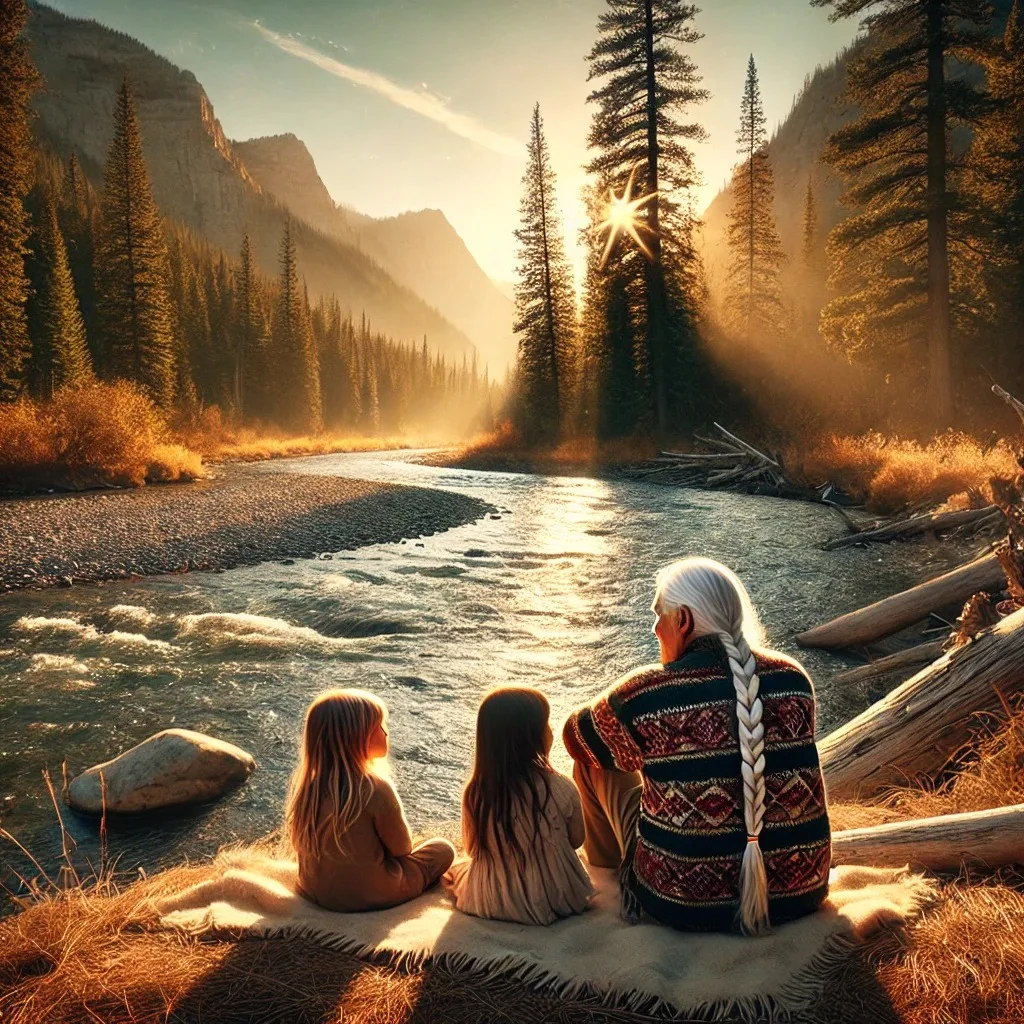
Čhaŋnúpa Sápa Shares the Story of Šúŋkmanu with Grandchildren, Ella Michelle and Natáyu
Beneath the towering pines, where the crisp mountain air carried the scent of sage and cedar, Čhaŋnúpa Sápa sat with his beloved grandchildren, Ella Michelle and Natáyu, beside a gently flowing wakpá (river). Now low in the sky, the sun cast golden ribbons of light through the trees, making the water shimmer like a trail of stars.
The three sat upon a soft blanket of pine needles, their backs warmed by the sunlit stones. The soothing sound of the wakpá echoed through the valley, its song mingling with the distant call of an íŋkpa dúta (red-winged blackbird) and the rustling whispers of the cottonwoods.
Čhaŋnúpa Sápa, his long, silver-streaked hair catching the light, held his čhaŋnúpa (sacred pipe) with care, placing it gently beside him. His weathered hands, strong yet gentle, rested on his knees as he gazed into the eager eyes of his grandchildren.
"Čháŋte Wašté Wičhákiničiyapi Hokšíla na Wičhíŋčala, My beloved grandchildren, his voice was steady, like the heartbeat of Mother Earth herself. Tonight, I will tell you the story of Šúŋkmanu, the boy who learned the language of the Šúŋkawakȟaŋ (horses).”
Ella Michelle leaned forward, wrapping her arms around her knees, while Natáyu traced patterns in the soft earth with a small twig. They knew that when Grandfather spoke, his words were like a flowing river—deep, endless, and full of meaning.
Above them, the sky burned in hues of šíčamná (purple) and phéžuta šá (medicine red), as if the Great Mystery had painted the heavens just for this moment. The wind's breath carried the scent of wildflowers and the fresh scent of the wakpá, wrapping them in its embrace.
Čhaŋnúpa Sápa took a slow breath, his eyes reflecting the stories of generations before him. The children, quiet as deer in the deep forest, listened, their young hearts open.
Then, as the first evening stars awaken, Grandfather began his story.
And the river listened with them.
Long ago, in the lands where the Pté Oyáte (Buffalo Nation) roamed, and the rivers ran clear, there was a young boy named Šúŋkmanu—which means “Horse Thief.”
But he was no ordinary thief. In the old ways, a true Šúŋkmanu did not steal out of greed but took the strongest Šúŋkawakȟaŋ (horses) from the enemy to protect his people, a leader who stood fully accountable before Wakȟáŋ Tȟáŋka (the Great Mystery) for every action.
Hokšíla Kiŋ Ečháku Šúŋkawakȟaŋ Kiŋ
(The Boy Who Listened to the Horses)
Šúŋkmanu was small for his age, but his čhaŋté (heart) was as vast as the sky. He dreamed of running with the wild Šúŋkawakȟaŋ, feeling the wind whip through his hair as their hooves thundered across the prairie.
But there was one problem—he was afraid. He had seen great Wičháša Wačhípi (warriors) ride without fear, leaping onto the backs of stallions as effortlessly as a Wanbli (eagle) taking flight. But he had never even touched a wild Šúŋkawakȟaŋ.
One evening, as the sky turned the color of a fading fire, an elder named Tȟatȟáŋka Wíyaka (Grandfather Buffalo Robe) saw the boy sitting alone, watching the herd from a distance.
“Tókhel iyéčhiŋyaŋ šni, čhiŋšká?” (What troubles you, grandson?) the old man asked, his voice as gentle as the whisper of wind through the tall Wahčázi (grass).
“Waná wičháša wačhípi héčha čhíŋ,” (I want to be like the warriors, Grandfather,) the boy said. “Mawáni kte šúŋkawakȟaŋ kiŋ ečháku kte. Niyé šni!” (But the horses… they are too strong, too wild! How can I ever ride one?)
Grandfather Buffalo Robe smiled. “Šúŋkawakȟaŋ kiŋ wačházi šni. Koda kiŋ.” (The horse is not something to be conquered. It is a relative.) “Tókhel mawáni kte šúŋkawakȟaŋ kiŋ, heháŋ wóuŋspe wéčhakiyé.” (If you wish to ride, you must listen first.)
Šúŋkmanu furrowed his brow. Listen to a horse? What could a Šúŋkawakȟaŋ possibly say?
That night, he crept close to the herd. He did not try to catch one or reach out his hand. He simply sat, quiet as the stones, and nawažó (listened).
For many nights, he did this. He learned their language—not with words, but with movement, the flick of an Ite (ear), the swish of a Siŋté (tail), the deep huff of their Iŋyaŋpa (breath).
He watched how the Tatáŋka Tȟáŋka (herd leader) protected the others, how the young foals stayed close to their Iná (mothers), and how the strongest Šúŋkawakȟaŋ did not bully the weak but guided them.
Then, one night, a great Šúŋkawakȟaŋ Sápa (black stallion) stepped forward, his eyes like two dark moons. He lowered his head and snorted.
Šúŋkmanu did not move.
The stallion pawed the Maka (Earth).
Still, the boy remained, his Čhaŋté (heart) open.
Then, something amazing happened—the great horse came closer, and Nážiŋ (stood still), then nudged him, just once, before turning away.
Šúŋkmanu’s heart soared. The horse had spoken. It had said, “Niš aŋpétu kiŋ owášte wašté!” (I see you, and you are good.)
From that moment on, the boy was no longer afraid. He had learned the secret—riding a Šúŋkawakȟaŋ was not about strength but Waóhola (respect).
The next time he approached the herd, the stallion did not run. Instead, it stood and waited.
That was the first horse Šúŋkmanu ever rode.
In time, he became a great Itȟáŋčha (leader), not just of Šúŋkawakȟaŋ, but of his Oyáte (people). For he had learned the way of true Wakȟáŋ (sacred strength)—not to take by force, but to nawažó (listen), to Wóuŋspe wéčhakiyé (understand), and to Waóhola (honor).
Wóuŋspe kiŋ
(The Lesson of the Story)
And so, my little ones, remember:;
The strongest Itȟáŋčha is not the one who shouts the loudest but the one who nawažó kiŋ kičhíyA (listens the deepest).
The bravest Čhaŋté is not the one without fear but who walks forward despite it.
And if you wish to walk with the spirit of the Šúŋkawakȟaŋ, do not try to own it—earn its Waóhola, and it will walk beside you forever.
Mitákuye Oyás’iŋ. (We are all related.)
"Míčhiŋ Čhaŋnúpa Sápa na wačhíŋič’upi k’eyá Wakháŋ Tháŋka tókhečha oyákihiŋ na oúŋ kte!"
Breakdown of the Translation:
Míčhiŋ → "My name is"
Čhaŋnúpa Sápa → "Black Pipe" ( my name)
na → "and"
wačhíŋič’upi k’eyá → "I stand fully responsible" (a deep way of saying accountability before the Creator)
Wakháŋ Tháŋka → "Great Spirit" (Creator, the Sacred, the Great Mystery)
tókhečha oyákihiŋ → "for all my words"
na oúŋ kte! → "and actions!" (literally "and what I live/do!")