
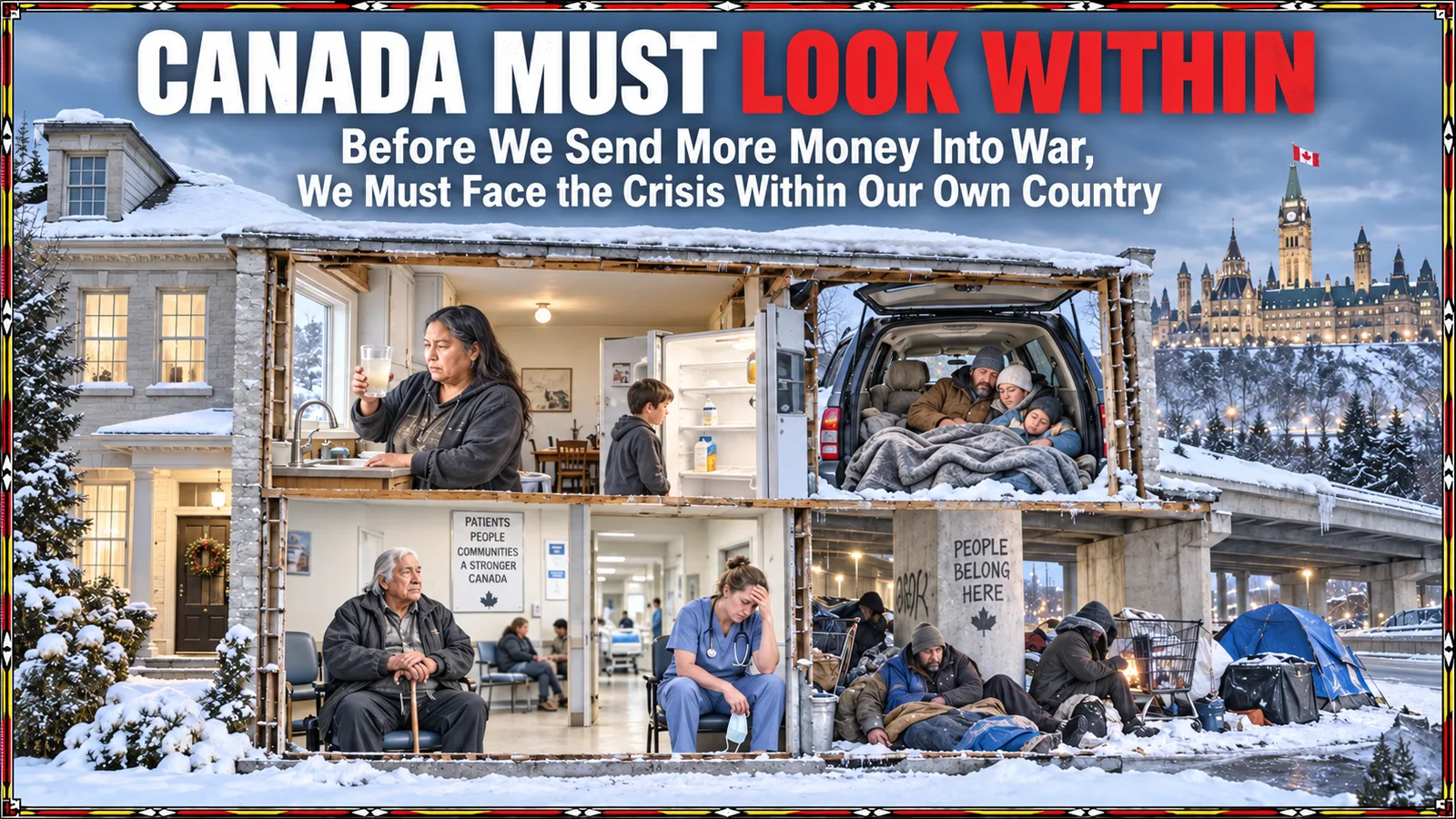
As someone who is both Canadian and American, and as an Indigenous person whose relatives have lived upon Turtle Island long before either country existed, I believe the time has come for Canada to look deeply and honestly within. This is not a call for Canada to abandon the human family or turn our backs on people suffering from war, famine, displacement, occupation, poverty, or natural disaster. Compassion must never stop at a national border. But compassion must also include the people sleeping on Canadian streets, the children going to school hungry, the elders waiting for medical care, the families unable to afford housing, the young people being destroyed by toxic drugs, and the First Nations communities still living without dependable drinking water, adequate housing, and essential infrastructure. Before Canada sends more public money into weapons and warfare, Canada must look within.
This position does not take Ukraine’s side against Russia or Russia’s side against Ukraine. It does not attempt to decide which historical explanation, political narrative, or security argument is correct. Layers of history, fear, broken agreements, competing interests, external interventions, and unresolved grievances cannot be honestly reduced to a slogan. The peoples and governments directly involved must ultimately face and resolve those circumstances. Canada is not responsible for deciding through weapons what those nations have been unable to resolve through dialogue.
Our responsibility is to oppose the killing of human beings on every side, protect civilians wherever possible, provide humanitarian assistance without discrimination, and support every credible pathway toward negotiation and peace. A grieving Russian mother and a grieving Ukrainian mother shed the same tears. A dead child has no nationality that makes one death more acceptable than another. A frightened elder, a wounded soldier, and a displaced family possess the same human dignity, regardless of which language they speak or on which side of a border they were born. There are no winners when mothers bury their children.
The people caught in war are not abstractions. They are human beings. They are relatives within one human family, and their lives must never become pieces on a geopolitical chessboard. Canada should not deepen any conflict by identifying one people as entirely righteous and another people as entirely evil.
Governments make decisions, armies carry out orders, political leaders advance competing interests, corporations profit from weapons, and ordinary people bear the consequences. The people themselves are not the enemy. The enemy is the hatred, fear, greed, and dehumanization that make war possible.
Since February 2022, Canada has committed more than $25.5 billion in multifaceted support to Ukraine, including more than $8.5 billion in military assistance. The total includes economic support, loans, humanitarian assistance, and other programs, so it would be inaccurate to describe every dollar as money for weapons. Nevertheless, billions of Canadian public dollars have been committed directly to military purposes.
Canada has both the right and responsibility to decide how it uses public resources, and Canadians have the right to ask whether these expenditures reduce suffering, bring negotiations closer, or extend a conflict without a clearly defined pathway to peace. That is not support for Russia, and it is not opposition to Ukraine. It is support for human life. (Government of Canada)
To question military spending is not to endorse the actions of an opposing side. To call for negotiations is not to surrender one’s conscience. Demanding peace is not ignoring injustice. Peace requires courage because it compels every side to face truths it may not want to hear. It requires recognizing others’ fears and suffering without abandoning one’s own dignity. It requires negotiation not because the parties agree, but precisely because they do not. If people already agreed, negotiation would not be necessary.
Supplying weapons may enable one side or another to continue fighting, but weapons cannot reconcile peoples, restore trust, heal trauma, rebuild families, or establish lasting peace. Eventually, every war ends through some combination of exhaustion, collapse, defeat, or negotiation.
The moral question is whether humanity waits until countless more people have died before beginning the conversation that was always necessary. Canada should make clear that its highest purpose is not helping one side kill more effectively than another. Canada’s highest purpose should be helping all sides stop killing.
This means supporting genuine diplomacy, impartial mediation, humanitarian corridors, prisoner exchanges, ceasefire monitoring, civilian protection, and negotiations in which everyone’s concerns can be heard. Canada should assist children, families, elders, and displaced people because they are human beings, not because they belong to the politically favored side of a conflict.
Humanitarian assistance that feeds children, provides medicine, shelters displaced families, restores water systems, removes landmines, and rebuilds civilian communities is fundamentally different from sending weapons. One preserves life. The other is designed to take it.
Canada must ask how much of its international spending goes to ending warfare and how much sustains the ability to continue it. For every dollar committed to military assistance, Canadians should be told what peaceful outcome that expenditure is intended to produce, what diplomatic work accompanies it, what negotiations are being pursued, what protections exist for civilians, and what conditions would end the military commitment.
No government should receive an open cheque for war, whether that government is considered an ally, an adversary, or something in between. Human life must not be made conditional upon political alignment.
Canada’s Earlier Identity as a Peace-building Nation. At one point, Canada became internationally known not primarily for taking sides in armed conflicts, but for helping create space between the sides. During the 1956 Suez Crisis, Canadian diplomat Lester B. Pearson proposed creating a United Nations emergency force to separate the combatants and help prevent a wider war.
Pearson received the 1957 Nobel Peace Prize for this work. That achievement helped establish Canada’s identity as a nation of peacekeeping, mediation, and practical diplomacy. (Nobel Prize)
Between 1948 and 1988, Canada supplied approximately 10 percent of all United Nations peacekeeping personnel. More than 125,000 Canadians have served in peace operations, and approximately 130 lost their lives in that service.
Canadian peacekeepers were respected because they entered dangerous places to stand between opposing forces, monitor agreements, protect civilians, and create enough stability for political solutions to emerge. (Canadian War Museum) Canada’s relationship with the Vietnam War was more complicated than our national memory sometimes suggests. Canada did not send its Armed Forces into Vietnam as a combatant. It officially presented itself as a neutral peacemaker, participated in international supervisory commissions, and later welcomed many American war resisters. Estimates vary, but tens of thousands of draft-age Americans came to Canada during that era.
However, Canada was not completely neutral. Canadian companies sold military equipment, raw materials, and other supplies that supported the United States war effort. It would therefore be historically inaccurate to portray Canada as entirely outside the conflict. (The Canadian Encyclopedia)
Nevertheless, an important national principle emerged during that period: Canada did not automatically have to join every war its allies undertook. Canada could maintain its alliances while retaining an independent judgment. It could offer refuge to people resisting war. It could speak about negotiation and peace without treating every disagreement with a powerful ally as disloyalty.
That independent peacebuilding identity has weakened considerably. In 1993, Canada had approximately 3,300 uniformed personnel serving in United Nations missions. As of April 2026, Canada was contributing only 59 uniformed personnel to six United Nations peace operations, ranking sixty-ninth among contributing nations. Canada still speaks proudly of its peacekeeping heritage, but the numbers demonstrate that peacekeeping has become far more prominent in Canada’s national memory than in its present international deployment. (United Nations Peacekeeping)
It would not be accurate to say that Canada is no longer respected or appreciated around Mother Earth. Canada ranked eighth in the 2026 Global Soft Power Index, with continuing strengths in political stability, lifestyle, education and international familiarity. Other international reputation studies have also placed Canada near the top. But reputation is not the same as moral authority. A country can remain widely admired while drifting away from the qualities that first created that admiration. (Brand Finance)
Canada’s strongest international identity was never simply being wealthy, Western, or militarily aligned. It was that Canada appeared capable of listening, mediating, peacekeeping, and building bridges where greater powers could not. Canada has not lost all international respect, but it risks losing the distinct peacebuilding identity that once made its contribution unique.
Canada should not attempt to imitate the military posture of much larger powers. Canada’s greatest contribution could once again be its ability to convene adversaries, support impartial mediation, verify ceasefires, protect civilians and transform conflict before it becomes endless war. Canada should become known again not for choosing which people to arm, but for helping peoples stop killing one another.
While We Finance War, Canadians Are Going Hungry
At the same time, Canada faces a profound crisis within its own borders. In 2024, approximately 10 million people in the ten provinces lived in food-insecure households. That represented roughly one-quarter of the population surveyed. Among them were approximately 2.5 million children, nearly one-third of all children in the ten provinces. About 1.9 million of those children lived in moderately or severely food-insecure households. These national survey figures exclude people living on First Nations reserves, some remote northern populations, and people without homes, meaning the real burden is likely even greater. (Statistics Canada;PROOF)
Food Banks Canada recorded 2,165,776 food-bank visits in a single month in 2025—almost double the monthly level recorded six years earlier. Approximately 711,770 of those visits involved children, and 19 percent of people using food banks were employed. How can Canada find billions of dollars for warfare while children within Canada do not know whether there will be enough food for supper?
How can we speak about human security abroad while families at home must choose between rent, medicine, heat, transportation, and groceries? How can a country that produces and exports food around Mother Earth accept that millions of people living within its borders cannot consistently afford to eat? This is not a food shortage. It is a failure of distribution, affordability, and national priorities. (Food Banks Canada)
Housing Has Become a National Emergency
Canada is also experiencing a severe housing crisis. Tens of thousands of people are counted as homeless on a single night. At the same time, many more remain hidden, sleeping in vehicles, moving between relatives’ homes, living in overcrowded rooms or remaining in dangerous relationships because they have nowhere else to go. The nationally coordinated 2025 enumeration identified approximately 65,000 people experiencing homelessness in participating communities, including about 36,700 staying in shelters. This was not a complete national count because it did not capture every community or everyone experiencing hidden homelessness. (Housing, Infrastructure and Communities Canada)
In the 2022 Canadian Housing Survey, 22.1 percent of renters were in core housing need, compared with 6.1 percent of homeowners. They lived in housing that was unaffordable, inadequate, or unsuitable and could not afford an acceptable alternative in their communities. Housing is not merely a market commodity or an investment asset. A home is where children become secure, families gather, elders are protected, and human dignity takes root. (Canada Mortgage and Housing Corporation)
Before Canada purchases another shipment of weapons, Parliament should have to explain why that expenditure takes priority over housing a family, maintaining a women’s shelter, supporting an elder, or helping a veteran recover from trauma. That does not mean every dollar spent internationally could immediately become a Canadian home. Public budgets are more complicated than that. But complexity must never be used to avoid the fundamental moral question: What do our expenditures reveal about what, and whom, we truly value?
Universal Healthcare Without Universal Access
Canada takes pride in universal healthcare, and rightly so. Publicly funded hospital and physician services protect families from many catastrophic medical bills. But universal insurance does not guarantee timely access. In 2024, about 5.7 million Canadian adults lacked access to a regular healthcare provider.
Emergency departments are overcrowded, healthcare workers are exhausted, and many people wait months for specialist appointments, diagnostic procedures, and non-emergency surgery. (Canadian Institute for Health Information)
People in rural, northern, and remote communities face even greater difficulties. Indigenous patients may have to travel hundreds or thousands of kilometers for care available near the homes of people in major cities. Prescription medication, dental treatment, vision care, psychotherapy, rehabilitation and long-term care are not all universally covered in the same way as physician and hospital services.
A health card is not enough if no doctor is available. A publicly stated right remains incomplete when people cannot reach the service. Before Canada finances machinery that wounds human beings elsewhere, it must ensure its own healthcare system has the people and resources needed to heal human beings here.
Addiction, Toxic Drugs and the Loss of Life
Between January 2016 and December 2025, Canada recorded more than 56,000 apparent opioid-toxicity deaths. Approximately 5,630 deaths occurred in 2025 alone, and 96 percent were classified as accidental. These were not disposable people. They were sons and daughters, mothers and fathers, grandparents, friends and relatives. Many carried trauma, loneliness, homelessness, mental illness, or despair. (Public Health Agency of Canada)
Canada cannot arrest its way out of this crisis. Nor can Canada merely manage addiction without creating pathways toward recovery. Harm reduction can keep someone alive today, but people also need treatment, safe housing, trauma healing, cultural belonging, purposeful work, family support, and loving relationships. The goal cannot be simply to prevent death. The goal must be to restore life.
Reconciliation: Promise, Progress and Unfinished Reality
Canada speaks continually about reconciliation. We now have land acknowledgments, Orange Shirt Day, the National Day for Truth and Reconciliation, public apologies, commemorative events, and government departments using partnership language. Some of these actions matter. Survivors fought for decades to have the truth recognized, and public remembrance can educate generations that were never taught what happened.
Indigenous languages have received legal recognition. The federal government adopted legislation intended to implement the United Nations Declaration on the Rights of Indigenous Peoples. Many long-term drinking-water advisories have been lifted.
Indigenous governments, organizations and communities are leading important work in education, conservation, economic development, language restoration, health and governance. These are real steps, and they should not be erased. But recognition is not transformation.
The Truth and Reconciliation Commission released 94 Calls to Action in 2015. As of September 1, 2026, the independent Indigenous Watchdog classified only 14 as complete, with 41 in progress, 24 stalled, and 15 not started. In other words, 41 percent were either stalled or not started more than eleven years after the Calls to Action were released. (Indigenous Watchdog)
The federal government uses a broader measure, reporting that more than 85 percent of the 76 Calls for which it is wholly or jointly responsible are complete or well underway. The difference matters. “Well underway” is not the same as completed, and government activity is not necessarily the same as a changed condition in a community.
A law can be passed while people continue to suffer. A program can be announced while funding remains inaccessible. A consultation can be held while the final authority remains unchanged. Reconciliation must be measured where people live—not only where governments report.
As of September 10, 2026, 38 long-term drinking-water advisories remained active on public systems in 36 First Nations communities, affecting approximately 5,590 homes and 335 community buildings. These federal figures exclude British Columbia, where First Nations water advisories are tracked separately.
Canada has lifted many advisories, and that progress deserves recognition. But advisories continue to arise because water systems need more than construction money. Communities require trained operators, permanent operational funding, maintenance, replacement parts, source-water protection, and infrastructure designed for future generations. (Indigenous Services Canada)
The Assembly of First Nations estimates that closing the overall First Nations infrastructure gap, including housing, water, schools, healthcare facilities, roads, and connectivity, will require approximately $376.1 billion over ten years.The First Nations housing requirement alone includes approximately 150,000 new homes and repairs to 85,000 existing homes, with an estimated cost exceeding $135 billion. These figures reveal the distance between reconciliation as a national promise and equality as a lived reality. (Assembly of First Nations;AFN submission to the Senate)
Indigenous adults represent approximately 5 percent of Canada’s adult population, yet accounted for about 33 percent of admissions to federal custody in 2022–2023. Indigenous women accounted for approximately 49 percent of female admissions to federal custody.
Indigenous youth represented about 40 percent of admissions to provincial and territorial youth correctional services, despite representing only about 8 percent of Canada’s youth population. (Department of Justice Canada)
Indigenous children continue to be dramatically overrepresented in state care. Indigenous women, girls and Two-Spirit relatives continue to face disproportionate violence, disappearance, exploitation and death. The National Inquiry into Missing and Murdered Indigenous Women and Girls issued 231 Calls for Justice, yet families and survivors have repeatedly warned that implementation remains dangerously slow.
Under these conditions, we cannot honestly say that reconciliation has been achieved. In several critical areas—including incarceration, housing pressure, toxic-drug deaths, and the continued separation of children from their families—the situation has remained severe or become worse. There has been movement toward reconciliation, but reconciliation has not yet happened.
A day on a calendar, by itself, is not reconciliation. A land acknowledgment, by itself, is not reconciliation. An apology without changed conditions is not reconciliation. Research conducted upon Indigenous Peoples without Indigenous authority is not reconciliation, and consultation after the important decisions have already been made is not reconciliation.
Reconciliation becomes real when treaties are honored, children are safe, families remain together, women can travel without fear, communities have clean water and adequate homes, Indigenous languages flourish, and Nations exercise meaningful authority over their lands, knowledge, and futures.
Braiding Knowledges Canada: Reconciliation Through Research
This is why I see such profound importance in Braiding Knowledges Canada. I do not mean that it is the only place where reconciliation is happening. Indigenous Nations, Elders, youth, researchers, educators, community organizations, businesses, and public institutions across Canada are doing courageous and transformative work. Their work must be seen, honored, connected, and strengthened. Canada needs to know not only where reconciliation has failed, but also where reconciliation is becoming real.
Braiding Knowledges Canada can help provide a national home for that work—a place where genuine examples of reconciliation are identified, supported, connected, and made visible. Its purpose is Reconciliation Through Research.
For generations, researchers studied Indigenous Peoples. Researchers entered communities, collected stories, knowledge, samples, and data, built careers and institutions from what they took, and often left communities no stronger than before. Braiding Knowledges Canada calls for research conducted with Peoples and places, through relationships founded upon consent, reciprocity, shared governance and Indigenous authority.
Indigenous knowledge and Western science are not placed in competition, and one is not absorbed into the other. Each strand retains its integrity. The braid becomes strong precisely because its strands remain distinct while entering into a respectful relationship.
This is not blending everything into sameness. It is not placing an Indigenous quotation at the beginning of an otherwise unchanged Western project. It is not inviting an Elder after the research questions, funding and methods have already been decided. True braiding begins when authority, purpose, methods, interpretation, benefits and responsibility are shared from the beginning.
Western scientific traditions bring powerful capacities for measurement, classification, technological analysis and testing. Indigenous knowledge systems bring languages, laws, histories, sciences and relationships developed through thousands of years of living with particular lands and waters.
English and French scientific lexicons are noun-dominant. They can turn land into property, water into a resource, forests into timber, and knowledge into data. Indigenous languages across Canada are verb-dominant and relational. They teach us to understand life through movement, process, relationship, reciprocity, responsibility, and the consequences of our actions across generations. They do not merely describe a world filled with separate objects. They carry understandings of a living universe in which creation is continually unfolding, and every being exists through relationship.
Neither way of knowing must destroy the other. The future belongs to our ability to braid analytic precision with relational wisdom. When these knowledge systems meet with dignity and integrity, the whole can become far greater than the sum of its parts. Like a strong alloy, something new can emerge without diminishing either source.
Braiding Knowledges Canada asks a decisive question of every project: Does this work leave the people, lands, waters, and future generations stronger than they were before? That is how reconciliation should be measured. It should be visible in clearer water, healthier watersheds, restored buffalo, stronger forests, renewed languages, safer communities, healthier children, transformed institutions and Indigenous Nations exercising their knowledge authority. It should be visible in research that becomes action, policy, restoration, community health and good governance—not merely another report placed on a shelf.
Through our Four Worlds understanding, reconciliation must touch the spiritual, emotional, mental, and physical dimensions of life. Spiritually, it restores identity, values, and sacred responsibility. Emotionally, it rebuilds trust, belonging, and relationships. Mentally, it transforms research, education, language, and policy. Physically, it must result in land, water, housing, funding, infrastructure and implementation.
If reconciliation exists only in the mental world of policies, reports and speeches but never reaches the physical conditions of people’s lives, it remains incomplete. Reconciliation must have a body. People must be able to see it, feel it, and live within it.
Making Reconciliation Visible Across Canada
Canada needs a national movement to identify and illuminate every place where reconciliation is genuinely happening. We should highlight First Nations restoring their languages through children and Elders, Indigenous guardians protecting lands and waters, and researchers sharing authority with Indigenous knowledge holders. We should recognize schools teaching the truth about residential schools alongside the living cultures, knowledge and achievements of the First Peoples.
We should highlight municipalities building lasting relationships with the Nations whose territories they occupy, businesses honoring free, prior and informed consent and sharing long-term benefits fairly, and communities bringing children home, restoring cultural identity, reducing violence and healing addiction.
We should recognize universities that treat Indigenous knowledge not merely as cultural material to be examined, but as a living intellectual, scientific, spiritual and legal authority.
Let us illuminate every watershed restored, every language renewed, every child reunited with family, every treaty obligation fulfilled and every institution transformed. Canada must see what reconciliation looks like when it moves beyond words.’
These living examples could become a national map of reconciliation in action. Communities could share not only what they promised, but what actually changed: who held authority, what resources were committed, how consent was obtained, what relationships were restored, and how the land, water, and people became healthier.
This must not become another government reporting exercise that reduces sacred relationships to checkboxes. Measurement must serve relationship, not replace it. The purpose is to help Canadians recognize that reconciliation is possible because people are already living it. What we illuminate, we encourage. What we connect, we strengthen. What we honor, we help to multiply.
Where Canada’s Resources Must Flow
Every military expenditure represents public money, human labor, intelligence, and productive capacity that could be directed toward life. The same scientific ability used to create increasingly sophisticated weapons could develop clean energy, medical treatments, resilient housing, and technologies that restore Mother Earth.
The same public money used to purchase weapons could train healthcare workers, build treatment centers, house families, restore watersheds, and ensure clean water in every First Nation. A government budget is more than a collection of numbers. It declares what a country considers important.
If Canada wants to contribute beyond its borders, let it contribute to healing. Let Canada become known again for bringing adversaries together, protecting children on every side, rebuilding communities, and preventing the next war.
Let Canada send food rather than ammunition, medicine rather than missiles, mediators rather than weapons, and builders rather than instruments of destruction. Let Canada invest in the peace that must eventually come rather than the warfare that delays it. Neutrality toward governments does not require neutrality toward human life.
We can stand firmly for civilians without endorsing any government. We can oppose attacks upon children regardless of who carries them out. We can condemn cruelty without turning an entire people into an enemy. Our allegiance must be to life, peace, truth and the oneness of the human family.
Canada must care for suffering people abroad while accepting that its first direct responsibility is to the people whose public resources it is spending and to the Indigenous Nations whose lands make Canada’s prosperity possible.
Before sending more money into war, let us look into the eyes of the hungry Canadian child, the elder waiting for care, the family sleeping in a vehicle, and the First Nations mother who must boil water before giving it to her children. Let us look at the young person caught in addiction, the Indigenous woman who does not feel safe, and the veteran carrying wounds that cannot be seen. Then let us ask whether Canada has truly done everything within its power to care for them.
This is not isolationism. It is moral responsibility. It is not indifference to people suffering elsewhere. It is a refusal to believe that sending weapons is the only way to care. It is not support for one side against another. It is the recognition that every side is part of the human family and every human life is sacred.
Canada must stop allowing outside conflicts to divide Canadians into opposing camps of hatred. We do not have to choose which people we are permitted to love. We can love them all. Our side must be the side of peace.
Canada’s first responsibility is to put its own house in order and then share from the strength of what it has learned. Development begins from within. Peace begins from within. Reconciliation begins from within. National healing begins from within. Before Canada tells others how to resolve their conflicts, Canada must face its own broken treaties, homelessness, hunger, addiction, inequality, and injustice. Before Canada finances more warfare, Canada must invest in healing.
Before Canada claims to be a voice for human rights, Canada must fulfill its promises to the people within its own borders. Before Canada speaks of reconciliation, it must show where relationships, institutions and material conditions have actually changed.
Wherever real reconciliation is happening, Canada must illuminate it, honor it, connect it and help it grow. Canada must look within—not with shame, hatred or partisan blame, but with honesty, courage and love. Only by healing our own house do we gain something genuine to share with the human family. The time has come. Canada must look within.