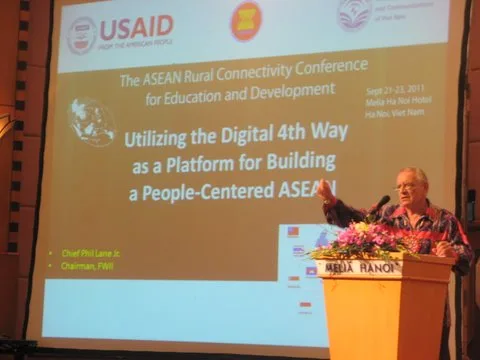
Speaking at the Association of Southeast Asia Nations (ASEAN) in Hanoi, Vietnam, in 2012, at the ASEAN Rural Connectivity Conference for Education and Development, on "Utalizing the Digital Fourth 4th Way as a Platform for Building a People-Centered ASEAN."
Through dedicated hard work by my Daughter Deloria and her husband Franco, who was stationed in Bangkok, and our local team led by the local Deep Social Network (DSN) TEAM team by Tom Litchfield, we were able to work with Indigenous young people from Cambodia, Indonesia, the Philippines, and Thailand. SE Asia has the largest concentration of Indigenous peoples globally, with 150 Million.
Our DSN Team was backed up by sister Bernice See from the Philippines, Brother Jon Ramer, and myself.
Two of the many Highlights of the DSN project:
Before the first DSN training, there had been doubts about whether or not this innovative and cutting-edge digital initiative would be able to be sustainable in rural Indigenous communities. There was a concern that Indigenous young people would need more interest or the proper tools, such as basic computer skills and access to computers and the Internet, to make the DSN Initiative successful.
At the first training in March 2008, fourteen young people from the Hmong, Karen, Lahu, and Akha Ethnic Minority/Indigenous communities in Northern Thailand arrived on motorcycles after a 250-kilometer commute in the rain. Seven of these fourteen young people had laptops, thirteen had email addresses, more than half already belonged to a social network, and one young man had already created a video, which he learned how to post on YouTube with our assistance.
Through the DSN Project, more than 40 DSNs with Indigenous young people across Cambodia, Indonesia, the Philippines, and Thailand. One was with young people who loved living with thier families and worked in Phnom Penh, Cambodia's massive garbage dump. During the DSN Training, Deloria and Franco stayed with them at the garbage dump.
Another was at Mae Sot, Thailand, on the border with Myanmar(Burma). Indigenous young people would come across the river from the "Dark Zones" to learn about digital technology and DSNs, including digital security. They would return to thier communities to share what they had learned with other young people in their communities.
.
This was dangerous as thier communities were engaged in intense guerilla warfare with Myanmar Government. You could be raped, tortured, killed, and imprisoned in the dark zone, especially for empowering your Indigenous Communities.
.