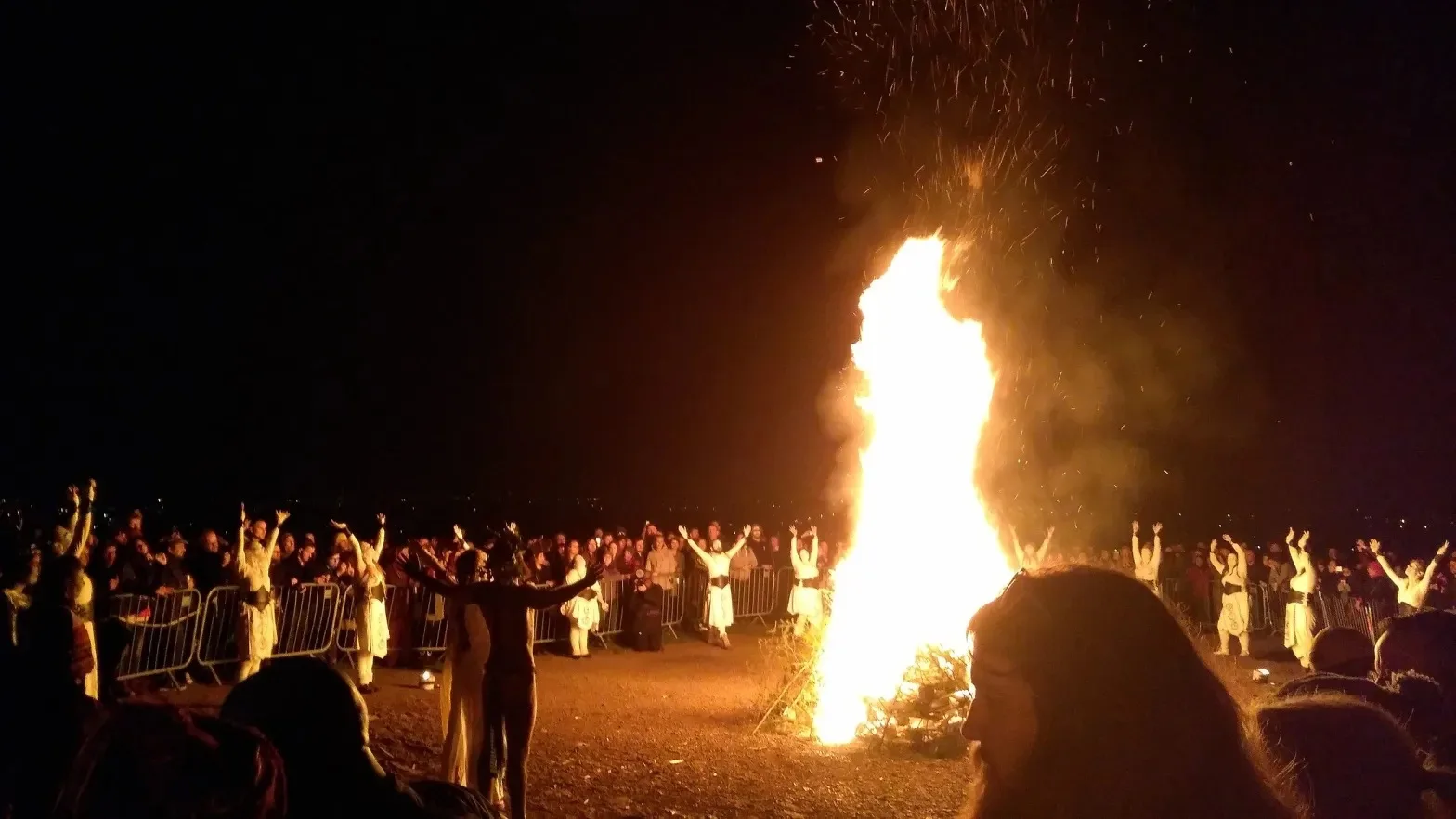
Happy Beltane! Beltane, known in Irish as Bealtaine, stands as one of the most ancient and sacred seasonal ceremonies of the Gaelic world, arising from a time when human life was understood as inseparable from the rhythms of Mother Earth and the unseen forces that breathe life into it.
Rooted in pre-Christian Ireland and carried forward through memory, story, and practice, Beltane marked not merely a date on a calendar, but a profound turning point in the living cycle of the year: the threshold into summer, when the energies of growth, fertility, and abundance awaken fully across the land.
Celebrated on May 1st, midway between the spring equinox and the summer solstice, it formed one of the four great Gaelic fire festivals, alongside Samhain, Imbolc, and Lughnasadh, each holding a sacred place in the unfolding story of the seasons.
The earliest written reference appears in Sanas Cormaic, a 10th-century source that recalls how the people understood these ceremonies as acts of relationship with the seen and unseen worlds. At its spiritual heart, Beltane reflects a timeless understanding: that life is continually renewed through balance, between light and dark, mother earth and sky, the human family and the spirit world, and that this balance must be consciously honored if harmony is to endure.
Central to this sacred time were the fires, living symbols of transformation, protection, and shared life force. Across Ireland, great bonfires were lit, often on high, revered places such as the Hill of Uisneach, long regarded as a spiritual center where the energies of the land converge.
These were not ordinary fires. These fires were ceremonial flames, kindled with intention and care, carrying prayers for the well-being of the people, the animals, and the earth itself. In one of the most powerful rituals, two fires would be raised, and cattle, the lifeblood of pastoral communities, were driven between them, the rising smoke believed to purify, protect, and strengthen them before their journey to summer pastures.
The people, too, would pass through the smoke or leap across the embers, not as spectacle but as a gesture of trust in renewal, seeking health, blessing, and spiritual alignment. From these communal fires, household hearths were rekindled, each flame carrying the essence of the whole, expressing a deep truth: that the well-being of each home flows from the unity of the community, and that all life shares one sacred fire.
Yet Beltane was not only about protection, but also a celebration of creation itself, a recognition that our Mother Earth, like the human spirit, is alive with generative power. As blossoms opened and the land softened into warmth, the people honored the sacred union that sustains life.
Homes were adorned with flowers, doorways and animals were decorated with greenery, and the beauty of the natural world became both offering and reminder. In this season, human relationships were also brought into alignment with the land's rhythms.
Traditions such as handfasting, ceremonial unions of partnership, reflected the deep awareness that love, commitment, and fertility were not separate from nature, but expressions of the same creative force. The blossoming trees, the lengthening light, and the gentle return of warmth signaled a time when the boundary between worlds grew thin, when blessings could pass more freely between the visible and the invisible, and when the human family could more easily remember its place within the greater web of life.
With the coming of Christianity, many of the outward forms of Beltane were discouraged or reshaped, yet its spirit was never extinguished. It continued to live quietly within May Day customs, rural practices, songs, and the people's memory.
In recent years, there has been renewed recognition of its meaning, and gatherings once again bring communities together to light fires, honor the land, and remember ancestral ways. Contemporary celebrations such as the Beltane Fire Festival echo these ancient rhythms, reawakening not only tradition but the deeper understanding that gave it life.
In this way, Beltane remains far more than a historical observance; it is a living teaching that speaks across generations and cultures. It reminds us that we are not separate from the cycles of our Mother Earth but are participants within them, responsible for maintaining balance in our relationships, with one another, with the natural world, and with the unseen dimensions of existence.
When we tend the fire, both the one we gather around and the one that lives within us, we participate in renewal. When we act with awareness of our interconnectedness, we strengthen the whole. And when we walk in harmony with the living world, we enter into a path of shared flourishing, where the well-being of the individual and the community, like the flames of Beltane, rise together as one.