
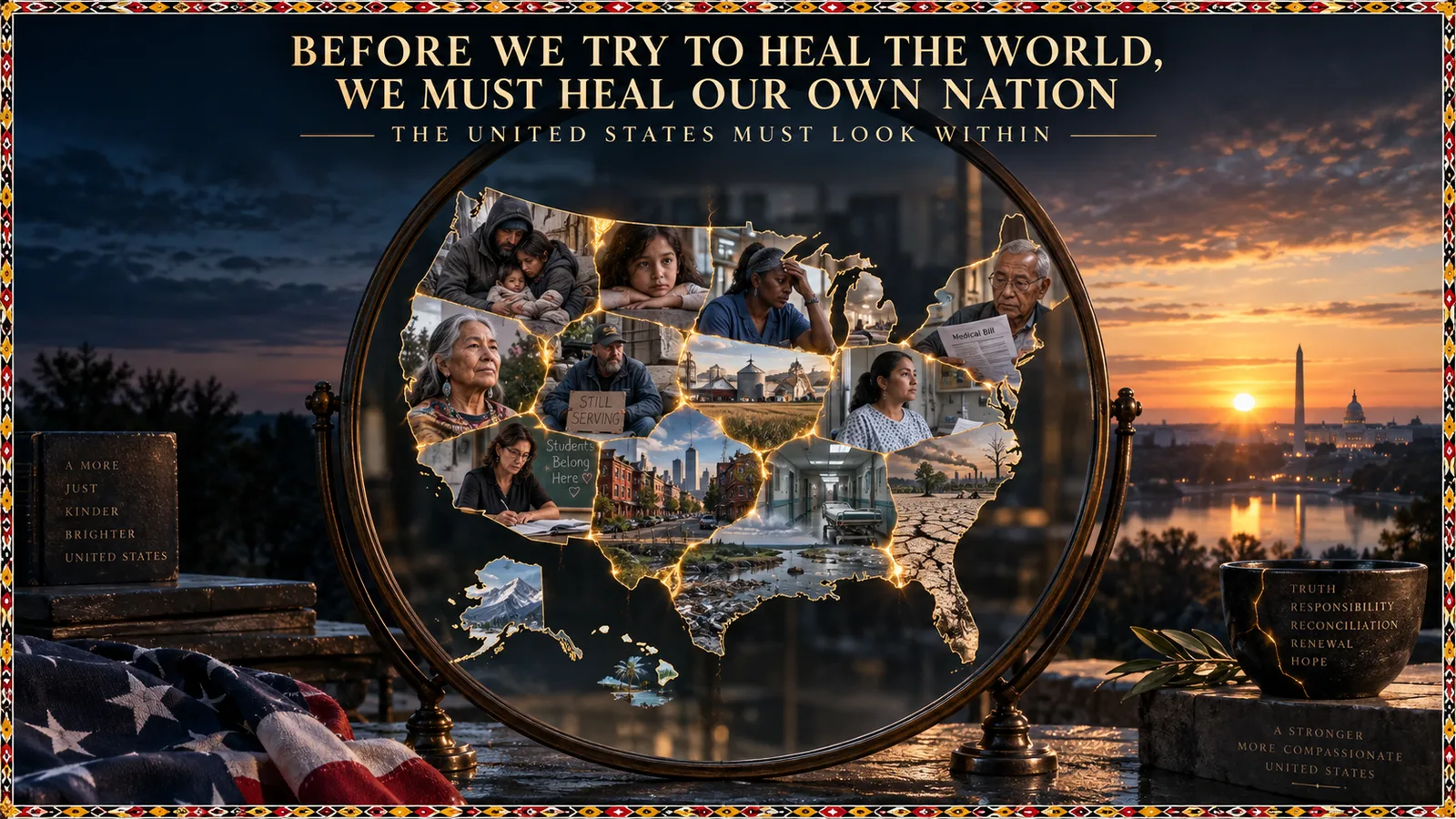
There comes a moment in the life of every human being, and in the life of every nation, when we must stop pointing outward and begin looking within. For the United States, that moment has arrived.
This is not a partisan statement. It is not an attack upon one president, one political party, one race, one religion, or one region. It is a loving but urgent call to our whole family, of the United States. We cannot continue measuring our greatness only by the size of our economy, the power of our military, the height of our buildings, or the reach of our influence.
The true measure of a nation is how it treats its children, its elders, its women, its veterans, its workers, its prisoners, its poor, and the First Peoples upon whose lands it was built.
Before we tell other nations how to govern, develop, protect human rights, or care for their people, we must have the humility and courage to ask: How well are we caring for our own? The answer must begin with truth.
In January 2024, more than 771,000 people were experiencing homelessness in the United States on a single night. About 274,000 of them were living without shelter, on streets, in vehicles, beneath bridges,ges or in other places never intended to be homes. With today's growing economic challenges, more of our human relatives are certainly experiencing poverty in 2026.
Among them were thousands of veterans who had worn our country’s uniform. The latest official count identified more than 32,000 veterans experiencing homelessness, including over 13,000 living without shelter.
These are not merely statistics. Each number is a human being with a name, a family, a history, and a sacred purpose. (HUD;Department of Veterans Affairs) In the wealthiest nations ever created, millions of families remain only one emergency away from crisis. The Federal Reserve found that just 63 percent of American adults could meet an unexpected $400 expense using cash, savings,s or a credit card they could pay off immediately.
The remaining 37 percent would need to borrow, sell something, go into debt, bt or leave the expense unpaid. Thirteen percent said they could not meet it by any means. (Federal Reserve) These figures reveal something deeper than a shortage of money. They reveal a shortage of security, stability, and peace of mind.
Millions of people go to sleep wondering what will happen if their child becomes sick, their vehicle breaks down, their rent increases, or their employer reduces their hours. A nation cannot call itself healthy when so many of its people live one accident, one illness, or one missed paycheck away from disaster.
Healthcare reveals another profound wound. People of the United States collectively carry at least $220 billion in medical debt. Approximately 14 million adults owe more than $1,000, while around 3 million owe more than $10,000.
People postpone examinations, ration medication,n and avoid seeking care because they fear the cost. A national study estimated that approximately 1.3 million adults rationed insulin because they could not afford to use it as prescribed. (KFF)
No parent should have to choose between buying medicine and buying food. No elder should have to divide pills to make a prescription last longer. No family should lose its home because a loved one developed cancer, diabetes, or heart disease.
Healthcare must begin with the recognition that every human life is sacred, not with calculating how much that life can afford to pay.
We must also face what is happening to women. Investigations have documented women dying after miscarriage care was delayed under restrictive and confusing abortion laws. Doctors and hospitals have sometimes hesitated because they feared criminal penalties, even when a pregnancy was no longer viable, and a woman’s life was in danger.
Whatever one’s personal beliefs about abortion may be, there should be no disagreement that a woman suffering a miscarriage must receive immediate and compassionate medical care. A frightened physician, a delayed procedure and an ambiguous law must never be allowed to become a death sentence.
We must look deeply at our children. American students routinely practice lockdown and active-shooter drills alongside their lessons in mathematics, science and language. Children learn where to hide, how to remain silent and what to do if someone enters their school carrying a weapon.
Whatever our political convictions concerning firearms, we must be able to agree that children should not have to rehearse for their own murder in the place where they go to learn.
Our teachers carry an equally heavy burden. Approximately one in six full-time public-school teachers works a second job during the school year. These are the people entrusted with awakening the minds and gifts of the next generation, yet many must work evenings, weekends, or summers merely to sustain their own families. (Pew Research Center)
At the same time, the federal minimum wage has remained at $7.25 an hour since July 2009. More than seventeen years have passed without an increase, even as housing, food, transportation, childcare, and medical costs have risen.
Some states and cities have established higher wages, but millions of workers remain trapped in an economy where full-time labor does not necessarily provide a stable life. (U.S. Department of Labor)
Work should provide dignity. A person who works full-time should be able to obtain safe housing, nutritious food, adequate healthcare,e and a secure life for their family. When honest labor cannot provide the foundations of survival, something within the economic system has fallen out of balance.
We must also examine our justice system. Nearly 1.8 million people are confined in American prisons and local jails. Many people held in local jails have not been convicted of the charges against them. Some remain detained because they cannot afford bail. This means that poverty can determine whether one person waits for trial at home while another waits behind bars.
Accountability is necessary. Communities must be protected from violence. But justice cannot be measured only by the number of people we punish. Justice must also heal victims, restore families, prevent future harm, and create pathways for human beings to accept responsibility and transform their lives. A system that knows only how to cage people, but not how to restore them, remains incomplete.
As an Indigenous person, I cannot speak about America’s need for healing without speaking about the Original Peoples of Turtle Island. The United States made solemn treaties with Tribal Nations. These were not acts of charity. They were agreements between sovereign peoples. Lands and resources were taken in exchange for enduring promises involving peace, education, healthcare, and the protection of Tribal rights.
Yet Native communities continue to experience severe disparities in healthcare, housing, infrastructure, education, and economic opportunity. The Indian Health Service acknowledges that American Indian and Alaska Native Peoples continue to experience lower life expectancy and higher rates of diabetes, suicide, injury, liver disease, and other preventable causes of death. (Indian Health Service)
These conditions did not arise because Indigenous Peoples somehow failed to develop. They are connected to land dispossession, broken treaties, forced removals, massacres, boarding schools, the suppression of spiritual traditions, attacks upon Indigenous languages,s and the long separation of children from their families. The wounds are still alive because the consequences are still alive.
Healing requires more than an apology. It requires honoring treaties, protecting Tribal sovereignty, adequately supporting Indigenous healthcare and education, restoring lands and waters where possible, protecting sacred places, and ensuring that Native Peoples lead the decisions affecting their own lives. Nothing about us without us.
We must also face the wounds carried by African American families, the continuing consequences of slavery, racial terror, segregation, discriminatory housing policies and unequal access to wealth. We must face the hardships endured by immigrant families, poor rural communities, neglected urban neighborhoods and working people of every race whose labor keeps the country alive while their own lives remain precarious.
The suffering of one community must never be used to erase another’s suffering. Pain must not become a competition. The tears of a Native mother do not diminish the tears of a Black mother. The struggle of a rural white family does not invalidate the struggle of an immigrant family. Every person’s suffering deserves to be heard, and every community’s gifts are needed to heal the whole.
We must confront the epidemics of addiction, suicide, loneliness, and despair. We have treated too many wounded people as criminals when they needed healing. We have allowed corporations to profit from substances and practices that destroy human health, families, and communities.
We have built systems that track purchases, maximize profits, and predict consumer behavior. Yet, too often we fail to identify a lonely elder, a suicidal child, an addicted parent, or a veteran crying out silently for help.
**What we lack is not intelligence. What we lack is the collective will to place intelligence in the service of life. **We must examine where our money flows. Budgets are moral documents. Investments reveal what a nation truly values. Before We Finance War and Grandeur, We Must Care for Our Own People
Nowhere is this moral test clearer than in what the United States spends preparing for war, supporting war,r and replacing what war destroys. According to the Stockholm International Peace Research Institute, the United States spent approximately $997 billion on its military in 2024 alone—more than one-third of all military spending on Mother Earth. That is nearly $2.7 billion every day, more than $113 million every hour, day and night. (Stockholm International Peace Research Institute)
Those numbers are so enormous that they can lose their human meaning. We must bring them back to the ground. Every billion dollars represents homes that could be built, clinics that could be opened, teachers who could be supported, veterans who could be housed, drinking-water systems that could be repaired, Tribal treaty obligations that could be honored, and lands and waters that could be restored. The question is not simply how much money we possess. The question is what we are choosing to protect.
From fiscal years 2022 through 2024, Congress appropriated approximately $174.2 billion through five supplemental acts connected to the war in Ukraine and the broader United States response. Not all of that money went directly to Ukraine; substantial portions funded the replacement of American weapons, United States military operations in Europe, and other related activities.
That distinction matters. But the larger moral question remains: How can such enormous sums be mobilized with urgency for a war overseas while people sleeping beneath bridges, Native communities without adequate housing, and families unable to afford medicine are repeatedly told that helping them is too expensive? (Special Inspector General for Operation Atlantic Resolve)
This is not a statement against the Ukrainian people, the Russian people, or any other people caught in war. Both are our relatives. The death of a Russian child and the death of a Ukrainian child are both tragedies. Nor is this an attempt to determine here who carries what share of blame for the conflict.
The histories and circumstances that produced that war must be faced honestly by the parties themselves and resolved through diplomacy, negotiation, and the difficult work of reconciliation. Our responsibility is to say clearly that continuously feeding war is not the same as building peace.
America has a legitimate responsibility to protect its people, and those who serve in uniform deserve proper equipment, healthcare, housing and lifelong support. But national security cannot mean writing an almost unlimited cheque for weapons while leaving millions of people economically insecure.
A nation is not truly secure when its arsenals are full. Still, its families are hungry, its children are frightened, its veterans are homeless, its bridges and water systems are failing, and its people cannot afford lifesaving care.
We must also question our appetite for grandeur. Before building enormous monuments, lavish government additions, extravagant ceremonial spaces or other gaudy structures meant to project power and prestige, we must ask whether they are truly needed and what values they proclaim.
A major addition to the White House may be described as privately financed rather than paid for through an ordinary congressional appropriation, and that financial distinction should be stated honestly. Yet private financing does not erase the moral symbolism. When hundreds of millions of dollars can be raised to enlarge a place of power, while shelters, schools, healing centers, and community facilities struggle to raise a fraction of that amount, the contrast tells us what wealth is invited to serve.
This principle must apply regardless of which president occupies the White House, and regardless of which political party controls Congress. It is not about attacking a particular personality. It is about rejecting a national culture that confuses size with greatness, display with strength and opulence with achievement.
The greatness of a public building cannot be separated from the conditions outside its doors. Marble, gold, glass and towering halls cannot conceal children sleeping in cars or elders choosing between food and medicine.
Before we finance another war, we must exhaust every path to peace. Before we manufacture another generation of weapons, we must ask whether our diplomacy, mediation, conflict prevention and peacebuilding have received even a small fraction of the same imagination and resources.
Before replacing every weapon sent into a foreign battlefield, we must count what has not been replaced at home: aging schools, unsafe water lines, inadequate hospitals, burned forests, broken roads and the trust of communities neglected for generations.
War spending must never become an automatic river of public money flowing without moral examination, clear limits, transparent accounting and a genuine strategy for peace. Every proposed expenditure should have to answer four questions: Is it truly necessary to defend life? Have we pursued all realistic peaceful alternatives? Who profits from it? And what urgent responsibility to our own people will remain unmet because this choice was made?
The deepest choice is not between caring for America and caring for the world. We must do both. But genuine help should preserve life, strengthen diplomacy, provide humanitarian relief, and create the conditions for a just peace.
Sending weapons without an achievable path toward peace can prolong the suffering it claims to answer. A mature nation does not abandon the human family, but it also does not confuse military expenditure with moral leadership.
Imagine if even a meaningful portion of what is now devoted to war and prestige were placed into a national covenant of healing: permanent supportive housing; community-led addiction recovery; rural and Tribal healthcare; clean water; mental-health services; renewable energy; regenerative agriculture; youth opportunity; veterans’ care; violence prevention; and the restoration of Mother Earth. These would not be acts of charity. They would be investments in the real foundations of national security.
We do not need larger symbols of power while the foundation beneath our people is eroding. We need a larger capacity to care. We need the courage to transform swords into tools of restoration and wealth into well-being. Before America spends another fortune proving how powerful it is, America must look within and prove how deeply it can love, heal, and serve its own people.
If there is always money for punishment but never enough for prevention, something is wrong. If there is money to respond after a community collapses but not enough to help that community remain strong, something is wrong. If there is money to build another jail but not to maintain a school, support a family, restore a watershed or open a healing center, something is deeply out of balance.
The question is not whether America possesses enough resources. The question is whether America possesses enough moral courage to direct those resources toward healing.
America has extraordinary gifts. It has courageous people, fertile lands, great universities, brilliant scientists, devoted teachers, compassionate healthcare workers, inventive young people, abundant resources,s and communities capable of tremendous generosity.
The purpose of naming our wounds is not to deny these gifts. It is to call them forward. But healing cannot be imposed from above. Distant institutions cannot deliver it to passive communities.
**Development begins from within. **Sustainable change grows through relationships, trust, participation, cultural identity,y and a shared vision. The people most directly affected by a problem must help define that problem and lead the creation of its solution. The top must place its resources into service, while the grassroots bring their lived knowledge, relationships, and spiritual strength. Neither can succeed alone.
Government, business, Tribal Nations, faith communities, schools, universities, veterans, youth, elders, and neighborhood organizations must become partners in a common covenant of renewal.
We must move beyond the politics of humiliation. A nation cannot heal while its people are trained to hate one another.
We can disagree without denying one another’s humanity. We can hold leaders accountable without turning millions of our relatives into enemies. We can speak the truth strongly without poisoning the truth with contempt.
Looking within does not mean withdrawing from the human family. It means becoming a more trustworthy member of it.
A nation that reduces homelessness, provides accessible healthcare, protects its children, honors its workers, restores its communities,s and fulfills its promises to Indigenous Peoples will possess something far more powerful than political influence. It will possess moral credibility.
Then the United States will not need to lecture the world. Its living example will speak. This is the same principle we teach in community development: we must become the change we are asking others to make.
A person cannot give away peace that they have never cultivated within. A nation cannot teach justice while tolerating injustice in its own house. A society cannot guide others toward healing while refusing to touch its own wounds.
The time has come for a great national turning, not to the political left or political right, but inward toward conscience, and forward toward our common humanity.
We must ask whether our children are safe, whether our elders are respected, whether our women are protected, whether our veterans are sheltered, and whether our workers can live with dignity.’
We must ask whether our prisoners are treated as human beings capable of accountability and transformation, whether the treaties are honored, whether the First Peoples are heard, and whether our lands and waters are being protected for the generations yet unborn.
Above all, we must ask: Is our enormous wealth serving life. Or merely accumulating power? These are not questions of national weakness. They are questions of national maturity.
A mature nation does not hide from its wounds. It faces them. It listens to those who have suffered. It accepts responsibility. It repairs what can be repaired, transforms what must be transformed, and walks forward with humility.
The United States does not need to pretend it is perfect to be worthy of love. But because we love our relatives, our communities, and the generations yet unborn, we must refuse to accept preventable suffering as normal.
Let us house those without homes. Let us feed hungry children. Let us support families before they collapse. Let us make lifesaving medicine accessible. Let us care for veterans who carried the burdens of war. Let us honor teachers and protect students. Let us restore communities injured by addiction and incarceration. Let us fulfill the treaties. Let us heal the historic wounds that continue to divide us.
Let us protect Mother Earth, whose living systems sustain every human economy and every human life.
Then, when we stand among the Nations of Mother Earth, we will not stand as a self-appointed master instructing everyone else how to live. We will stand as one member of our human family, a nation that has looked honestly within, accepted responsibility for its wounds and begun the sacred work of transformation.
Before we tell the world how to heal, let us heal our own house. Before we ask others to change, let us embody the change. Before we attempt to lead humanity, let us learn again how to serve it. The time has come. The healing must begin within.