
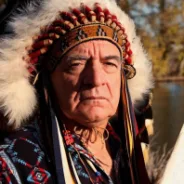
Hereditary Chief Phil Lane Jr. is an enrolled member of the Ihanktonwan Dakota and Chickasaw Nations and an internationally recognized Indigenous leader in human, community, and economic development.
Born in 1944 at the Haskell Institute, an Indian Residential School in Lawrence, Kansas, he has dedicated 58 years of service to the upliftment of Indigenous Peoples and the healing, unity, and well-being of the Human Family. His work has reached communities across the Americas, Micronesia, Southeast Asia, China, India, Hawaii, Africa, and beyond.
Chief Lane carries a profound hereditary and spiritual lineage. On his Dakota side, his inheritance flows through Hinhawa Shasha / Hinhan Wicasa, also remembered as Owl Man, who was the Itasha, the chief and leader of the Holy Man’s Society of the White Swan Dakotas. This sacred inheritance was not merely political leadership. This was spiritual responsibility, rooted in prayer, ceremony, protection of the people, and service to the sacred life of the Nation.
Through this lineage, leadership was understood not as personal status but as a sacred trust carried with humility, accountability, and service to the people, the ancestors, future generations, and Wakan Tanka, the Great Mystery.
This Dakota lineage continued through Chief Lane’s great-grandfather, Tipi Sápa, Black Lodge, Philip Joseph Deloria, also known as Reverend Philip Joseph Deloria, who served the Indigenous peoples of the Plains for more than 40 years. Tipi Sápa’s life carried forward the family’s spiritual, ceremonial, educational, and leadership responsibilities during a time of immense hardship, displacement, cultural pressure, and transformation.
He helped guide the people through changing times while preserving the deeper responsibilities of faith, identity, sacred remembrance, and service. In recognition of his lifetime of service, in 1936, his statue was enshrined on the High Altar of the National Cathedral in Washington, DC.
Chief Lane was raised by his father with the Sacred Teachings of the White Buffalo Calf Woman. He also joined his parents every Sunday at the Episcopal Church, where he was confirmed, and served as an altar boy during his high school days.
The name Philip itself carries a special family memory. Emerging from Philip Joseph Deloria, the name has been carried forward through successive generations: through Chief Lane’s father, through Chief Lane himself, and now through his son, Tiger Philip III. In this way, the name is more than a personal or family name. It is a living thread of memory, identity, responsibility, and spiritual inheritance, linking generations in a continuing stream of service.
Chief Lane also honors the central role of his father, Mato Gi, Brown Bear, Phil Sr/, who was a deeply respected Elder in the many circles he walked, including the American Indian Science and Engineering Society and other Indigenous leadership, education, and spiritual circles.
His father carried this lineage with dignity, humility, and strength, and then passed its responsibility on to Chief Lane. This inheritance was not given as something to be possessed or claimed for oneself, but as something to be carried in service, prayer, and accountability.
On his Chickasaw side, Chief Lane also descends from a distinguished line of leadership, diplomacy, and communication. His great-great-grandfather, on his mother’s side, was the elected head of the Chickasaw Senate, as well as a translator for the Chickasaw Nation, working across Indigenous languages and other languages, including English, French, and Spanish.
This Chickasaw inheritance reflects another powerful stream in Chief Lane’s life: the ability to stand between peoples, languages, governments, and worlds, helping them understand one another through wisdom, diplomacy, and clear communication.
Together, these Dakota and Chickasaw lineages form a living foundation of responsibility, service, and spiritual leadership. For Chief Lane, ancestry is not simply a record of the past. Ancestry is a sacred trust carried forward for the healing of the people, the protection of sacred teachings, the strengthening of Indigenous Nations, and the restoration of right relationship among all members of the Human Family.
Chief Lane’s academic background is equally important to understanding the foundation from which he writes and speaks. His education included studies in political science, economics, education, psychology, Native American Studies, public affairs, curriculum, and instruction.
He studied at the University of Washington, Harvard Business School, Olympic College, Whitman College, California State University San Diego, Eastern Washington State College, the University of Washington Graduate School of Public Affairs, where he received an MED in Public Administration, and the National University Graduate School of Education, where he completed a Master’s Degree in Curriculum and Instruction.
His special training also included proposal development and fundraising at the University of Chicago, creative administration, International Arts Administration, through a Fellowship to the Harvard Business School, and additional training in education, counseling, and holistic learning.
As an educator and scholar, Chief Lane served for 16 years as an Associate Professor in the Faculty of Education at the University of Lethbridge in Alberta, Canada, where he specialized in holistic education, curriculum development, Jungian Psychology, the Anisa Model, and Indigenous human and community development. Remarkably, he received tenure after only one year, an extraordinary academic recognition that speaks to the depth, originality, and importance of his contribution to Indigenous education, holistic learning, and community transformation.
In 1982, Chief Lane co-founded the Four Worlds International Institute with Indigenous Elders and Spiritual Leaders. Under his guidance, Four Worlds became an internationally recognized leader in Indigenous human, community, and economic development, with a unique focus on the inseparable relationship between culture, spirituality, education, healing, and practical action.
Four Worlds’ major initiatives include the Fourth Way, Deep Social Networks, environmental protection and restoration, Bioregional Sanctuaries, Compassion Games International, and the ongoing work of reuniting the Condor, Hummingbird, Quetzal, and Eagle through a principle-centered path of unity, and an Indigenous and Ally-Led Movement for World Peace, beginning in the Americas.
This World Peace Movement was catalyzed and ignited, before the Sacred Pramids of Palenque, through the 8th Fire and the Sacred Fire of St. Bridget. This Sacred Fire was ignited at the Union of the Condor, Hummingbird, Quetzal, and Soltice Ceremony, March 21, 2024, at the 2nd Gathering of the Union of the Condor, Hummingbird, Quetzal, and Eagle.
Chief Lane’s life work has been guided by the understanding that true transformation begins within the human heart and then moves outward into families, communities, Nations, institutions, and Mother Earth herself.
He has worked for more than five decades to build bridges among Indigenous Peoples, faith communities, governments, educational institutions, and global movements dedicated to peace, justice, healing, and sustainable development.
His leadership has been recognized through many honors, including the Windstar Award, the Year 2000 Award for Freedom and Human Rights, the Ally Award from the Center for Healing Racism, and the 2023 Stellar Award for Service to Humanity.
As an author, educator, spiritual leader, and movement builder, Chief Lane speaks from a rare convergence of hereditary lineage, academic achievement, applied experience, lifelong spiritual study, and direct prayerful engagement with the sacred places of the Human Family.
Throughout his life, he has not only studied the world’s spiritual traditions from a distance. He has also walked, visited, prayed, and reflected at sacred sites associated with many faith traditions, seeking the deeper unity that lies beneath outward differences.
His spiritual journey has included praying at Christian, Jewish, and Muslim holy sites throughout the Holy Land since 1979, from the sacred waters and lands near the Dead Sea and Jordan, across the wider spiritual landscape of the region, including sacred mosques and places of deep reverence for the Abrahamic traditions.
In February 1982, Chief Lane also began a profound spiritual journey into the ancient traditions of India, beginning with more than a month of travel through many of India’s holy places, sacred sites, spiritual communities, and living centers of devotion.
From that time forward, he continued to learn from Indian spiritual teachers, whose guidance greatly deepened his spiritual understanding. Through these teachings, he deepened his study of the Mahabharata, the Ramayana, and other sacred texts that illuminate the eternal struggle between truth and falsehood, duty and selfishness, spiritual courage and human weakness, and the possibility of divine guidance in times of great crisis.
A special place in this journey was held by Siddha Yoga, whose teachings, practices, and spiritual discipline became an important part of his inner development, beginning in 1985.
Alongside these studies, Chief Lane has also drawn inspiration from Supreme Master Ching Hai, her teachings of compassion, her commitment to vegan living, and her global efforts through Supreme Master Television to promote kindness toward animals, peace among peoples, and a more loving relationship with all life.