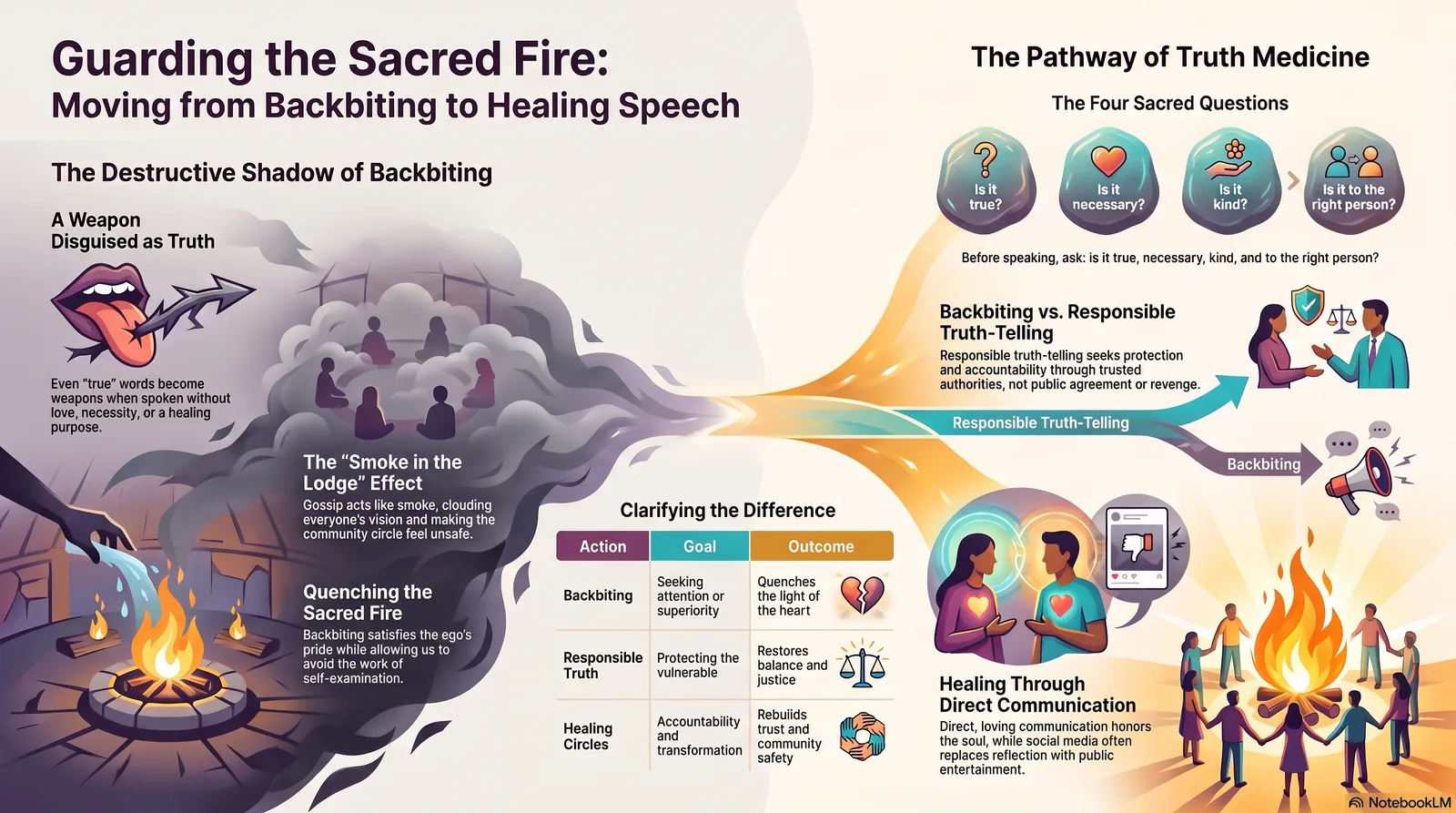
Understanding Backbiting, Restoring Trust, and Creating Sacred Pathways for Truth and Healing
Backbiting is far more than the careless repetition of another person’s faults. It is a spiritual injury. It harms the person who is spoken about, it burdens the person who listens, and it darkens the heart of the one who speaks. This is why the Sacred Teachings warn us very strongly that backbiting quenches the light of the heart and extinguishes the life of the soul.
The human heart was created to reflect love, truth, compassion, forgiveness, and the light of our Beloved Creator. It is like a sacred fire entrusted to our care. Every truthful word, every act of kindness, every sincere prayer, and every effort to forgive add fuel to that sacred fire. But backbiting covers the sacred fire with ashes. It weakens our capacity to see clearly, to love purely, and to recognize the sacred worth of another human being.
When we speak about the faults of others in their absence, we may believe we are merely describing what is true. Yet truth spoken without love, without necessity, and without a healing purpose becomes a weapon. Even when the fault is real, repeating it to others deepens division, damages a reputation, poisons relationships, and creates wounds that are difficult to heal.
Backbiting often disguises itself as concern. We may say that we are only trying to understand a situation, protect the community, or seek advice. But we must honestly examine our intention. Are we speaking because we truly seek healing, justice, or protection? Or are we satisfying anger, resentment, jealousy, pride, curiosity, or the desire to feel superior?
The soul grows through humility. Backbiting does the opposite. It directs our attention outward toward the imperfections of others while allowing us to avoid the difficult work of examining ourselves. It gives the ego temporary satisfaction by lowering another person in our estimation. Yet every time we do this, we move farther from the sacred discipline of self-knowledge.
It is easy to see the dust upon another person’s garment. It is much harder to recognize the shadows within our own heart. But spiritual maturity begins when we turn inward and ask: Why has this fault disturbed me so deeply? What lesson is being placed before me? Is there something within myself that needs healing, correction, forgiveness, or greater understanding?
Whenever we notice the shortcomings of another person, we are being offered an opportunity. We can choose judgment, or we can choose prayer. We can repeat the fault, or we can guard the dignity of the person. We can magnify the darkness, or we can search for the light that still lives within them.
Every human being is unfinished. Each of us is walking through experiences, wounds, struggles, and lessons that others may not fully understand. We see only a small part of another person’s journey. We may witness one moment of anger but not the years of sorrow behind it. We may see weakness but not the daily struggle to overcome it. We may hear an unwise word but not know the pain from which it arose.
This does not mean that harmful behavior should be ignored. Silence is not always righteousness. There are times when the truth must be spoken to protect a child, an elder, a family, a community, or someone vulnerable. There are times when misconduct must be reported to those who carry the proper responsibility. Justice, accountability, and community protection are sacred duties.
But such matters should be addressed with wisdom, confidentiality, fairness, and a sincere desire to stop harm. Speaking to the appropriate person for protection or healing is fundamentally different from spreading another person’s faults among those who have no responsibility to resolve the matter.
The difference lies in our motive, our manner, and our purpose. Are our words opening a pathway toward truth and healing, or are they merely spreading pain? Are we protecting the community, or are we feeding conflict? Are we speaking to those who can help, or are we gathering listeners who will confirm our anger?
Backbiting is destructive because words carry spiritual power. Once spoken, they travel from heart to heart. They influence how people see one another. They can turn friendship into suspicion, cooperation into division, and trust into fear. One unguarded statement can pass through an entire family or community, gathering exaggeration as it travels.
In this way, backbiting is like smoke entering a lodge. At first, it may seem small, but soon it clouds everyone’s vision and makes it difficult to breathe. People begin to wonder who is speaking about them, whom they can trust, and whether their own weaknesses will be exposed without mercy. The sacred circle becomes unsafe.
A healthy community is not one in which everyone is perfect. Such a community does not exist. A healthy community is one in which people know that their dignity will be protected while they learn, heal, and grow. It is a place where correction is offered with love, where truth is spoken directly and respectfully, and where forgiveness remains possible.
When backbiting becomes common, the spiritual life of a community begins to weaken. Consultation becomes guarded. People stop speaking honestly because they fear their words will be repeated. Relationships become superficial. Small misunderstandings become lasting divisions. The collective light begins to fade.
This is why guarding the tongue is a sacred responsibility. The tongue can bless or wound, unite or divide, heal or destroy. A few words may restore hope to a discouraged person, while a few careless words may burden them for many years.
The discipline of right speech does not mean that we never discuss difficult matters. It means that we learn to speak the truth in a way that serves life. Before speaking, we can ask, “Is it true?” Is it necessary? Is it kind? Is it being spoken to the right person? Will it contribute to healing, justice, protection, or understanding?
If the answer is no, silence may be the wiser path.
Silence, however, is not emptiness. Sacred silence is active. It is the choice to protect another person’s dignity. It is the refusal to feed anger. It is the space in which the heart can become calm enough to pray, reflect, and seek a better response.
When we resist backbiting, we strengthen our soul. We become more trustworthy. Others learn that their weaknesses are safe from public exposure in our presence. They know that we will not use their mistakes to elevate ourselves or to gain others’ approval.
Trust is one of the most precious spiritual qualities within a family or community. It takes years to build and only moments to damage. A person who guards others’ faults while responding responsibly to genuine harm becomes a source of safety. Their presence calms the circle.
We must also be careful about listening to backbiting. The person who listens without objection may unintentionally allow harmful words to continue. A fire requires fuel, and backbiting requires an audience. Without listeners, it cannot spread.
We can gently redirect the conversation. We can speak of the person’s good qualities. We can ask whether the concern has been brought directly to them. We can suggest prayer, consultation, mediation, or another healing approach. We do not need to shame the speaker, for that may become another form of judgment. We can close the door to backbiting with dignity and kindness.
There may also be times when we ourselves must repair the damage we have caused. If we have spoken unfairly, we should acknowledge it. We may need to correct the false impression we created, ask forgiveness, and make a sincere commitment not to repeat the offense.
Repentance is not humiliation. It is the restoration of spiritual life. It is the moment when the heart turns again toward the light. The Creator does not ask us to remain forever bound to our mistakes. We are asked to learn, make amends, and walk in a better way.
One of the strongest protections against backbiting is to train ourselves to see the good in others. Every person carries gifts. Every soul reflects some quality of the Creator. Even those who challenge us may possess courage, generosity, patience, intelligence, devotion, or some other virtue that deserves recognition.
When we deliberately search for what is praiseworthy, our vision changes. We become less interested in exposing faults and more capable of encouraging growth. This does not make us naive. It makes us spiritually disciplined. We learn to see the whole person rather than reducing them to their worst moment.
We should especially guard against speaking carelessly within families. Family members know one another’s weaknesses more intimately than anyone else. Because of this closeness, they have a greater responsibility to protect one another. The home should not become a place where old failures are repeatedly brought forward or where private struggles are shared without permission.
Our children learn how to speak about others by listening to us. If they hear adults mocking, condemning, or exposing people, they will come to believe this is normal. But if they hear us speak with compassion, restraint, and fairness, they will learn that every person deserves dignity.
The same principle applies to leadership. Leaders carry a special responsibility because their words influence many people. A leader who speaks carelessly about others can divide an entire community. A leader who refuses gossip, honors confidentiality, and speaks directly with courage and compassion can protect the unity of the people.
True leadership does not build itself by diminishing another person. It does not gather influence by spreading suspicion. It calls forth the best in people, addresses wrongdoing fairly, and keeps the circle focused on the greater purpose.
Backbiting also drains the spiritual energy needed for service. When our minds become occupied with the failures of others, we lose time and strength that could have been used to pray, teach, heal, build, encourage, and serve. We become so preoccupied with what others are doing wrong that we neglect the good work placed before us.
The sacred path calls us back to our own responsibilities. What can I heal today? Whom can I encourage? What act of service can I offer? What weakness within myself can I begin to overcome? These questions restore life to the soul.
Our ancestors understood that every word enters the great circle of relationship. Words do not disappear simply because they cannot be seen. They leave impressions in the hearts of others and in the community’s spiritual atmosphere. Therefore, speech should be offered with the same reverence as prayer.
Before we release words into the world, we should ask whether they carry medicine or poison. Medicine may sometimes be strong, and truth may sometimes be difficult, but true medicine is given to restore balance. Poison is given to harm, weaken, humiliate, or divide.
When we speak directly to a person with love and honesty, we honor their soul. We allow them to explain, reflect, correct, or heal. When we speak about them to others while avoiding them, we deny them that opportunity and often deepen the wound.
Direct and loving communication requires courage. Gossip requires very little. It is easier to speak around a person than to sit with them in a sacred way and say, “Something has happened between us, and I want us to understand and heal it.”
Healing begins when truth and love walk together. Truth without love becomes harshness. Love without truth may become avoidance. But when truth is carried by humility, courage, patience, and respect, it can restore relationships and strengthen the whole community.
The teaching that backbiting quenches the light of the heart should not lead us into despair or self-condemnation. It is a call to vigilance, purification, and renewed spiritual life. Each day gives us another opportunity to speak differently.
We can begin by pausing before we repeat a story. We can ask whether we have permission to share it. We can refuse to pass along rumors. We can stop conversations that demean others. We can replace criticism with prayer and suspicion with honest consultation.
We can also become more merciful toward ourselves. Sometimes people speak harshly about others because they are carrying pain within themselves. The answer is not only greater control of the tongue but also deeper healing of the heart. When the heart is peaceful, the tongue becomes gentler.
Prayer is one of the strongest medicines for backbiting. It is difficult to continue condemning someone when we sincerely pray for their well-being. Prayer softens anger, restores perspective, and reminds us that the person we are judging is also a child of the Creator.
We may pray: “Great Spirit, help me to see this person through Your eyes. Help me to recognize their suffering, their gifts, and their possibility. Protect my tongue from harmful speech. Purify my heart from pride, anger, and resentment. Show me how to walk in truth without hatred and in justice without cruelty.”
Forgiveness is another sacred medicine. Forgiveness does not mean pretending that harm did not occur. It does not remove accountability. It means refusing to let bitterness govern our hearts. It frees us from carrying the offense into every conversation and every relationship.
When we forgive, we stop feeding the story that keeps the wound alive. We may still remember. We may still establish boundaries. We may still seek justice. But we no longer allow hatred to extinguish the light within us.
The life of the soul is sustained by love. Love is not weakness. It is the power to hold truth without vengeance, to correct without humiliation, and to protect without hatred. It is the power to see a person’s wrong action without denying their sacred humanity.
When we choose this path, the light of the heart begins to shine again. The soul becomes spacious. Our words become cleaner. Our relationships become safer. The community breathes more freely.
The sacred discipline before us is simple to state but demanding to live: speak only those words that are truthful, necessary, responsible, and guided by love. Protect the dignity of others. Properly address harm. Examine ourselves before condemning another. Refuse to make another person’s weakness the subject of entertainment or superiority.
In this way, we become guardians of the sacred fire. We help preserve the light within our own hearts and within the hearts of others. We strengthen the spiritual life of our families, communities, Nations, faiths, and the entire Human Family.
Backbiting quenches the light of the heart because it separates us from love. It extinguishes the soul’s life by turning us away from humility, compassion, truthfulness, and unity. But every guarded word, every act of forgiveness, every sincere apology, and every effort to see the good in another rekindle that sacred flame.
The light can be restored. The soul can be renewed. The circle can be healed.
This begins with each one of us.
At the same time, we must be very clear that the teaching against backbiting does not mean that injustice should be ignored, concealed, excused, or allowed to continue. Most certainly, justice must be established. Those who have been harmed must be heard, protected, and treated with dignity. Those responsible for harmful conduct must be held accountable through clear, fair, and trustworthy avenues of justice.
Every family, community, Nation, organization, and spiritual gathering should establish well-understood processes for safely bringing forward serious concerns. These may include respected elders, trained facilitators, community healing circles, restorative justice circles, mediation processes, safeguarding bodies, ethical review councils, or lawful systems of justice. The pathway must be known before a crisis arises, so that people are not left wondering where they can turn when they have been wounded or when the well-being of others is at risk.
Whenever possible, justice should create an opportunity for truth, accountability, healing, restitution, and the restoration of right relationship. A community healing circle can allow each person to speak their truth medicine in a protected and respectful setting. The person who has experienced harm must not be silenced or pressured to forgive prematurely. The person accused must also be given a fair opportunity to hear the concern, respond honestly, and accept responsibility where responsibility is due.
Truth medicine is sacred, but medicine must be carried in the proper vessel. It must be offered with integrity, discernment, and a sincere desire to protect life and restore balance. Truth is not made more powerful by humiliation, exaggeration, public shaming, or the destruction of another person’s dignity. Truth becomes healing medicine when it is joined with courage, fairness, confidentiality, compassion, and justice.
Social media is rarely the proper place to investigate or resolve serious personal and community conflicts. Social media encourages immediate reaction rather than careful reflection. It can remove words from their context, spread unverified accusations, expose private pain to strangers, and turn a difficult human situation into public entertainment. Once allegations, judgments, and personal information have been widely circulated, the harm may continue even after the facts have been clarified.
A social media platform is not a healing circle. It is not a court of law. It is not a council of elders. It is not a confidential process in which everyone can be heard with patience, fairness, and respect. It does not ordinarily provide the sacred space necessary for listening, investigation, accountability, reconciliation, or the protection of all who are involved.
This does not mean that people should never speak publicly about injustice. There are circumstances in which public testimony becomes necessary, particularly when established authorities refuse to act, when powerful institutions conceal abuse, when vulnerable people remain in danger, or when every responsible avenue of redress has been closed. Public truth-telling has often been necessary to awaken society and bring hidden injustice into the light.
However, even public truth-telling should be carried out with discipline. Its purpose should be to stop harm, protect others, seek justice, and bring about necessary change—not to provoke a crowd, destroy a person through rumor, or satisfy anger. Before making a matter public, every reasonable effort should be made to verify the facts, protect vulnerable people, respect privacy, and distinguish firsthand knowledge from assumption or hearsay.
We must therefore learn the difference between backbiting and responsible truth-telling. Backbiting speaks about another person’s faults to those who have no responsibility or ability to address them. Responsible truth-telling raises concerns for the people who are entrusted and qualified to respond. Backbiting often seeks agreement, attention, revenge, or superiority. Responsible truth-telling seeks protection, accountability, justice, healing, and the restoration of balance.
We must also recognize that healing justice is not the same as avoiding consequences. Sometimes accountability requires firm boundaries, removal from leadership, restitution, professional intervention, or lawful action. Where violence, abuse, exploitation, or danger is involved, the immediate priority must be the safety of those at risk. A healing approach must never become a way of placing an institution’s comfort or reputation above the protection of the harmed person.
Restorative justice is meaningful only when it is voluntary, properly facilitated, and safe. It cannot be forced upon someone who has been harmed. Reconciliation cannot be demanded before truth has been acknowledged and accountability has begun. Forgiveness is a spiritual gift, not an administrative requirement, and no person should be pressured to offer it to preserve the outward appearance of unity.
True unity is not created by suppressing difficult truths. True unity is built upon justice. It requires the courage to address wrongdoing without hatred and the wisdom to protect human dignity without hiding harm. Justice and compassion are not opposites. At their highest level, they walk together.
A healthy community must therefore cultivate both a culture of careful speech and a trustworthy system of accountability. People should know that gossip and public humiliation will not be encouraged, but they should also know that genuine concerns will be taken seriously. They should not have to choose between remaining silent and exposing their pain before the entire world.
This is especially important for children, young people, elders, persons with disabilities, and all who may be vulnerable because of their social position or dependence upon others. Their voices must be protected, and they must be given safe, accessible ways to report harm. Those receiving such reports must be trained to listen without blame, retaliation, or premature judgment.
Community healing circles can be powerful when grounded in sacred protocol. The circle reminds us that no one stands above the truth and no one stands outside the Human Family. Each person speaks in turn. Each person listens. The purpose is not to win an argument but to understand what happened, who it affected, what responsibilities must be accepted, what protection is needed, and what actions can begin to restore balance.
The circle also teaches that truth has many dimensions. Each person may carry part of the story. This does not mean that every claim is automatically equal or that clear evidence should be disregarded. It means that patient listening and careful investigation are necessary before reaching conclusions. Truth medicine requires both an open heart and a discerning mind.
Within such a process, the person who has caused harm may be called to acknowledge the impact of their actions, make amends, change their conduct, surrender authority where necessary, and, over time, demonstrate that the transformation is real. Words alone are not always sufficient. Accountability must become visible through changed behavior.
The wider community also has responsibilities. Harm seldom grows in isolation. Sometimes harmful behavior is enabled by silence, fear, favoritism, weak policies, an imbalance of power, or the desire to protect a respected leader or institution. A healing justice process must therefore ask not only “What did this person do?” but also, “What conditions allowed this harm to occur, and what must we change so that it does not happen again?”
In this way, justice becomes more than punishment. It becomes a process of truth, protection, correction, education, restitution, and transformation. It restores the community’s moral foundation. It teaches everyone that dignity is sacred, power carries responsibility, and no person is beyond accountability.
We must create avenues where every person’s truth medicine can be offered without turning that truth into a weapon. There must be a safe place for the wounded person to speak, a fair process to examine the facts, a clear pathway to accountability, and, whenever possible, an opportunity for healing.
The goal is not to hide wrongdoing. The goal is to address wrongdoing in the right way.
The goal is not to silence truth. The goal is to provide truth with a sacred, responsible, and effective pathway.
The goal is not to protect reputations at the expense of people. The goal is to protect the dignity, safety, and spiritual well-being of the whole community while ensuring that justice is truly done.
When truth medicine is carried through clear and honorable avenues, it can cleanse the wound rather than deepen it. It can protect the vulnerable, awaken conscience, restore trust, and guide the community toward a more just and compassionate way of living. In this sacred balance, truth, justice, accountability, compassion, and healing become relatives walking together around the same circle.