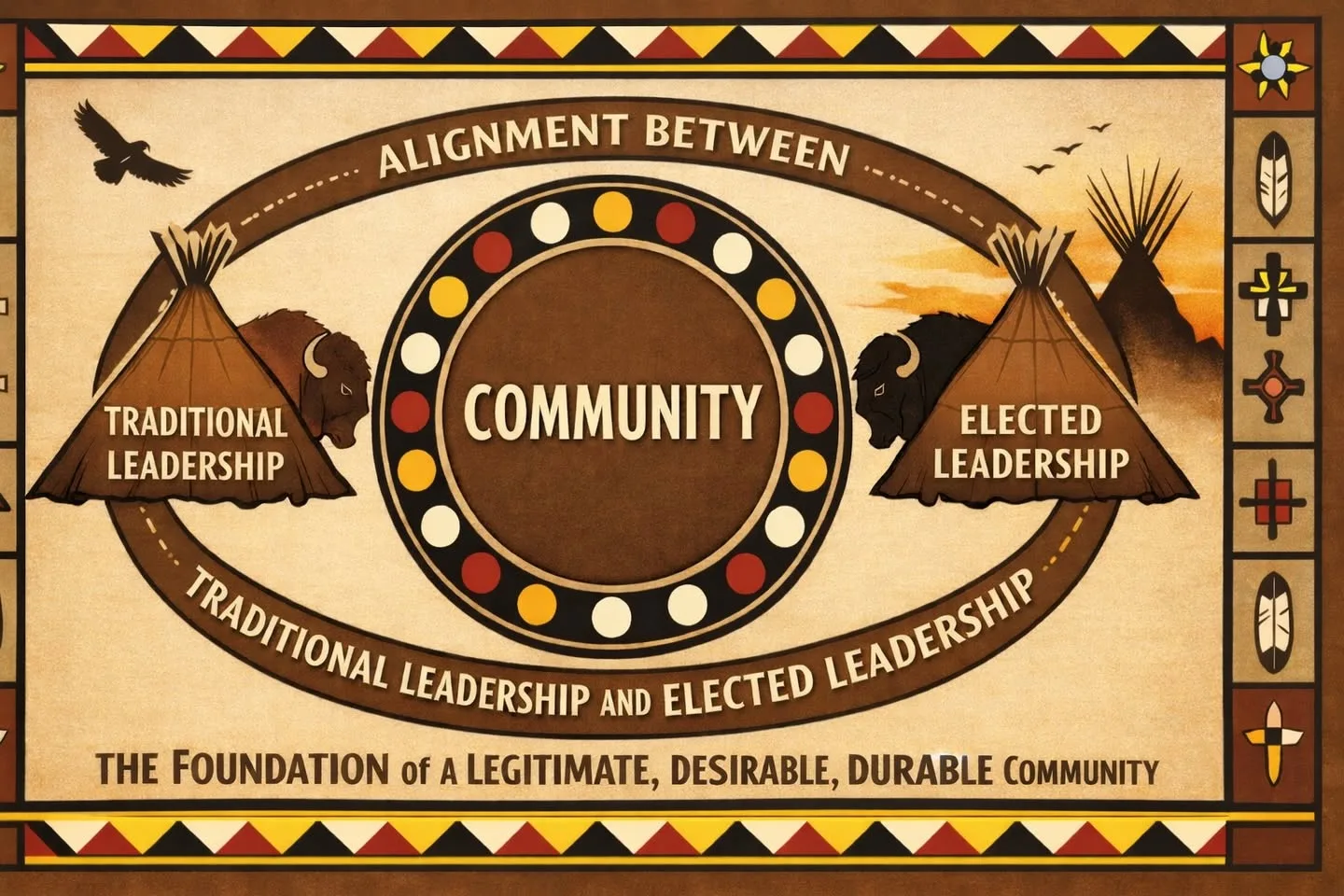
Alignment Between Elected and Traditional Leadership The Foundation of Legitimate, Durable Community Renewal
Alignment between elected leadership and traditional leadership is not a courtesy, a symbolic gesture, or a consultation checkbox. It is the core governance condition that determines whether development efforts heal or harm, endure or collapse, and empower or fragment communities.
In Indigenous contexts, these two forms of leadership arise from distinct sources of legitimacy, carry distinct responsibilities, and operate on different time horizons—yet both are essential. When they are aligned, communities move forward with strength and coherence. When they are not, even well-funded initiatives fracture trust and fail.
1. Two Sources of Authority, Both Legitimate, Different in Nature
Elected Leadership
Elected leadership derives its authority from constitutions, statutes, and elections. It carries administrative responsibility, budgetary and regulatory power, and formal relationships with federal and state governments.
Elected leaders are accountable for programs, compliance, and reporting; for infrastructure and service delivery; and for negotiation with external systems. Their work operates primarily on short-to-medium timelines shaped by election cycles, funding windows, and policy mandates.
Traditional Leadership
Traditional leadership derives authority from ancestral law, spiritual responsibility, cultural knowledge, and relational trust earned over generations. This authority is not conferred by office, but by recognition, conduct, and continuity.
Traditional leaders are accountable for cultural continuity, moral direction, the protection of identity and values, and intergenerational well-being. Their work operates on long timelines, often thinking in generations rather than years.
Neither authority is superior. They are different expressions of leadership, each incomplete without the other.
2. What Alignment Actually Means (and What It Does Not)
Alignment means a shared understanding of purpose and direction, grounded in mutual respect for distinct roles. It requires ongoing communication, not one-time consultation, and clear boundaries of authority. Decisions are made in ways that honor both systems of legitimacy.
Alignment does not mean that traditional leaders become administrators, nor does it mean that elected leaders surrender legal authority. It does not require forced consensus or unanimity. Traditional leaders are not symbolic endorsements, and elected offices do not become spiritual authorities.
Alignment is not sameness. It is coherence without collapse of difference.
3. Why Alignment Is Essential for Healing and Systems Repair
Much of the historic harm experienced in Indigenous communities did not arise only from poverty. It arose from governance fracture—when external systems recognized only elected authority, when traditional leadership was marginalized or bypassed, and when decisions were made that violated cultural law.
Programs imposed without moral legitimacy produced distrust, resistance, quiet non-participation, and program failure despite funding. Alignment repairs this fracture by restoring moral legitimacy to governance itself.
When elected and traditional leadership move together, people trust the direction. Youth feel protected rather than manipulated. Elders feel heard rather than sidelined. External partners know where consent truly resides.
4. What Alignment Looks Like in Practice
A. Shared Framing Before Shared Decisions
Before policies, budgets, or programs are finalized, traditional leaders help frame why an initiative matters, while elected leaders help frame how it can be implemented. Purpose precedes process.
B. Parallel Roles, Not Blended Roles
Elected leadership leads external negotiations, contracts, and compliance. Traditional leadership safeguards values, protocols, and cultural integrity. Each leads where their authority is strongest.
C. Standing Spaces for Ongoing Dialogue
Alignment requires continuity, not episodic meetings. It is sustained through regular councils, circles, or advisory bodies—spaces where disagreement is allowed, and decisions are refined through relationship rather than rushed.
D. Cultural Veto Without Administrative Paralysis
Traditional leadership must be able to say, “This violates who we are.” Elected leadership must have the ability to say, “This is how we navigate the system responsibly.”
Alignment finds solutions without silencing either voice.
5. Alignment Within the Top-Down / Bottom-Up Framework
From the bottom up, Elders, knowledge keepers, families, and youth define meaning. Cultural law sets moral boundaries. Healing and identity remain central.
From the top down, policy, capital, and infrastructure are aligned. External systems are negotiated responsibly. Resources flow without extraction.
Alignment is the bridge between these two movements. Without alignment, bottom-up wisdom has no pathway, and top-down resources cause harm. With alignment, wisdom shapes systems, and systems protect wisdom.
6. What This Looks Like in Standing Rock and Other First Nations and Tribal Communities
In the Standing Rock context, traditional leadership provides cultural continuity across Wakpala, Little Eagle, Bullhead, and Cannon Ball. Elected leadership ensures legal standing, policy alignment, and protection from external misuse. Initiatives proceed only when both are in a relationship.
This creates stability across election cycles, protection against leadership turnover, and community confidence that the work is not transient. Youth benefit in particular, because they are not asked to choose between tradition and opportunity, and they see leadership coherence modeled in real time.
7. Why External Partners Must Respect This Alignment
For NGOs, foundations, federal agencies, and private partners, recognition of elected leadership alone is insufficient. Engagement with traditional leadership alone is incomplete. Proper consent lives where both align.
Partners who understand this move faster, not slower. They face less resistance, build trust that outlasts funding, and participate in real systems repair. Those who bypass alignment may gain speed initially—but lose everything later.
Synthesis
Alignment between elected and traditional leadership is not an internal matter. It is the governing architecture that makes healing, development, and regeneration legitimate.
When elected leadership provides structure without soul, systems fail. When traditional leadership provides soul without structure, systems stall. When both move together, communities heal, youth rise, and the future becomes trustworthy again.
This alignment is not a procedural step. It is the living center of the work.
When elected leadership provides structure without soul, systems fail. When traditional leadership provides soul without structure, systems stall. When both move together, communities heal, youth rise, and the future becomes trustworthy again.
This alignment is not a procedural step. t is the living center of the work.
My background on these issues includes serving as Director of the Native American School of Government at the University of Washington Graduate School of Public Affairs from 1978 through 1980. During this same two-year period, I was also completing my Master of Public Administration (MPA) degree.
At that time, the Graduate School of Public Affairs had not yet been renamed; it is now known as the Evans School of Public Policy and Governance. While a graduate student, I simultaneously carried full responsibility for leading the Native American School of Government, shaping its vision, guiding its programs, supporting Native leaders and students, and carrying out the administrative, academic, and relational work required to build Indigenous capacity in governance and public service.
This dual role as both a student and a director reflected a period of intense responsibility and service, grounded in a commitment to strengthen Native American self-determination, leadership, and institutional presence within public administration and governance.