
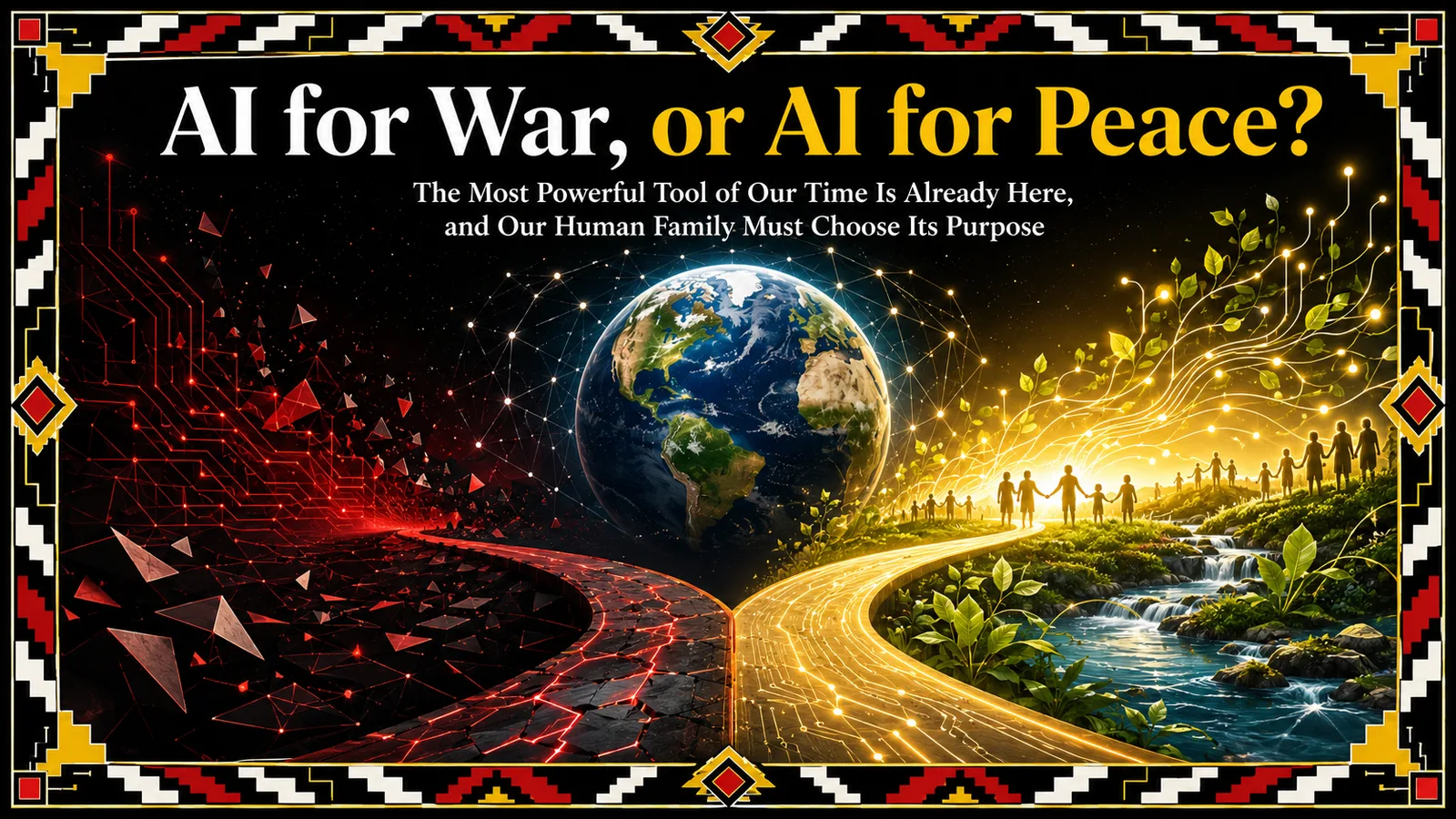
Artificial intelligence is not something waiting somewhere in the future. It is already woven deeply into the daily life of our Human Family. It helps determine what information people see, which roads they travel, how goods move, how electricity is distributed, how businesses operate, how governments deliver services, and increasingly how public spaces are managed. In many instances, people are interacting with AI without knowing it.
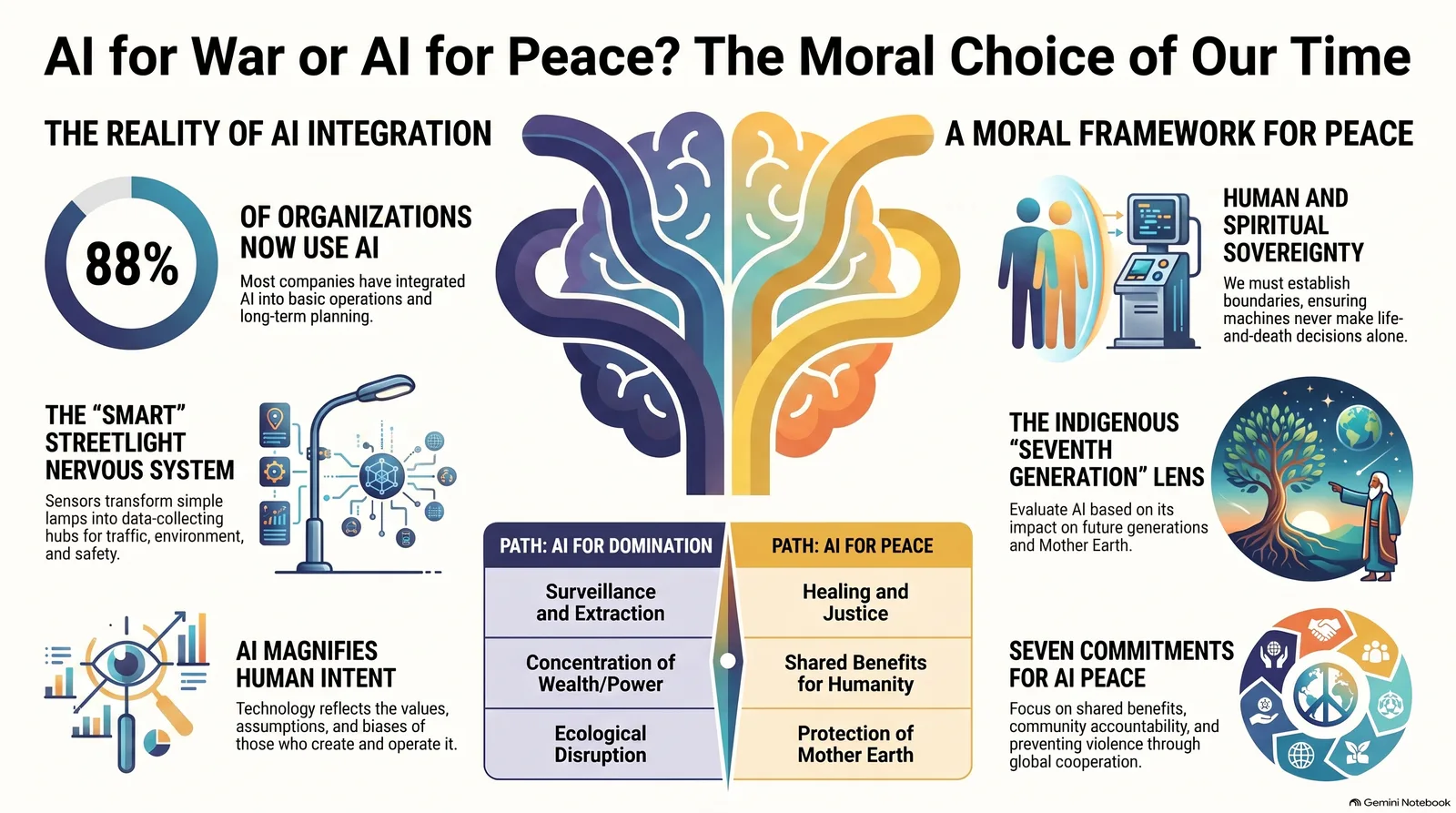
One of the clearest examples is the ordinary streetlight. We usually think of a streetlight as a simple pole with a lamp that turns on at night and off in the morning. But cities are increasingly turning streetlights into interconnected digital infrastructure. Modern poles may contain light sensors, motion detectors, traffic counters, environmental monitors, microphones, cameras, wireless communication equipment, electric-vehicle chargers, and computerized controllers. When these devices are connected to software that learns from data, predicts conditions, recognizes patterns, or recommends actions, the streetlight becomes part of an AI-supported urban nervous system.
How AI Is Being Used in Streetlights and Traffic Systems
AI-supported street lighting can adjust illumination according to the presence of pedestrians, cyclists, and vehicles. Instead of operating at full brightness throughout the night, lights can remain dim when a road is empty and brighten when movement is detected. More advanced systems analyze historical traffic patterns, weather, time of day, road conditions, and special events to predict when and where additional lighting will be needed.
AI helps cities maintain thousands of streetlights. A connected light can report that it is failing, consuming abnormal amounts of electricity, or nearing the end of its useful life. Predictive systems can identify patterns that suggest future equipment failure, allowing repairs to be scheduled before an entire section of roadway becomes dark. This reduces energy consumption and maintenance costs while improving public safety.
Streetlight poles can also support traffic management. Sensors and computer-vision systems may count vehicles, bicycles, and pedestrians without necessarily identifying individual people. That information can help a city understand where congestion is developing, whether a pedestrian crossing needs more time, where bicycle infrastructure is being used, and how streets should be redesigned.
Toronto, for example, has described its movement toward “smart” traffic signals that automatically adjust their timing according to actual traffic demand and changing traffic patterns. The city recognizes that digital infrastructure can improve services, but also raises serious questions about privacy, security, equity, inclusion, and public accountability.City of Toronto
Montréal has developed large collections of annotated traffic-camera images for machine-learning research. The images classify roads, sidewalks, vehicles, buses, cyclists, pedestrians, vegetation, construction objects, and other elements of the urban environment. The city reports that its cameras are positioned to avoid capturing faces and license plates, illustrating both the potential of AI and the necessity of privacy safeguards.City of Montréal Open Data
Across Canada, intelligent LED street-lighting systems are already being marketed and deployed with wireless controllers, traffic-monitoring equipment, environmental sensors, and centralized management software. Internationally, even more advanced systems are operating. Along more than 200 kilometers of highway in Greece, for example, AI-supported lighting adjusts brightness according to predicted traffic and weather conditions.AI-powered adaptive street lighting case study
It is important, however, to distinguish between three different technologies. A light operated by a timer is automated, but it is not necessarily AI. A light that responds directly to a motion detector is “smart,” but it may still be following a simple rule. A system becomes more clearly AI-supported when it learns from large amounts of data, recognizes complex patterns, predicts future conditions, or continuously changes its decisions based on experience. Cities and companies sometimes use the term “AI” too loosely, so citizens must ask what the system is actually doing.
The Streetlight Is Only One Small Example
The same pattern is unfolding throughout society. AI is already being used in:
Navigation systems that estimate traffic and calculate routes.
Public transit systems that predict arrival times and passenger demand.
Electrical grids that balance supply, demand, storage, and renewable energy.
Water systems that detect leaks and forecast consumption.
Agriculture to monitor soil, crops, weather, pests, irrigation, and harvests.
Hospitals to examine medical images, organize records, support diagnosis, and predict patient needs.
Banking to detect fraud, assess risk, and authorize transactions.
Retail to forecast demand, manage inventories, recommend products, and set prices.
Manufacturing to operate robots, inspect products, and predict machinery failures.
Shipping and logistics to schedule deliveries and manage global supply chains.
Emergency management to study wildfire, flood, drought, and severe-weather risks.
Communications to filter spam, translate languages, transcribe speech, and recommend information.
Education to provide tutoring, accessibility support, translation, and administrative assistance.
Government to process information, deliver services, identify patterns, and allocate resources.
Science to analyze enormous bodies of data that no human research team could examine alone.
The scale of adoption is no longer small. Stanford University’s 2026 AI Index reports that 88 percent of surveyed organizations use AI in at least one business function, while 70 percent use generative AI in at least one area. Industry produced more than 90 percent of the notable frontier AI models released in 2025. Companies are no longer merely experimenting with AI. Many are integrating it into their basic operations and long-term planning.Stanford 2026 AI Index andAI adoption data
Governments are moving in the same direction. Canada has established an AI Strategy for the Federal Public Service for 2025–2027, calling on federal organizations to adopt AI responsibly while developing governance, training, transparency, and strong data foundations.Government of Canada AI Strategy: Canada’s broader national strategy now seeks to raise business adoption of AI from approximately 12 percent to 60 percent by 2034.Canada’s National AI Strategy
We have therefore crossed an important threshold. The question is no longer whether AI will become part of society. It already is. The question is: What values, purposes, and relationships will direct it?
One of the greatest challenges before us is the enormous amount of energy and water required to power and cool AI data centres, along with the pollution, resource extraction, and ecological disruption that can follow. These impacts cannot be solved by one company, one country, or one political system acting alone, because AI is already embedded throughout our interconnected world.
Canada, the United States, China, Europe, and nations everywhere are developing and using these technologies, and this expansion will continue. Our Human Family must therefore come together to determine what serves life and what causes harm, establishing shared responsibilities that protect Mother Earth and the generations yet to come.
Until we reach that level of global consultation and cooperation, we must consciously take the side of AI for peace, using its power to reduce conflict, conserve energy and water, prevent pollution, restore the natural world, and strengthen the well-being of all humanity.
AI Does Not Possess a Moral Vision
AI does not love or hate. It does not pray, grieve, forgive, or feel responsibility toward the generations yet to come. It does not recognize Mother Earth as sacred unless human beings build ecological responsibility into its objectives and limitations. It does not naturally choose peace over war, cooperation over domination, or healing over profit.
AI systems do carry the purposes and assumptions of the people and institutions that create, train, purchase, and operate them. The data selected, the objectives established, the behaviors rewarded, and the decisions permitted all reflect human choices. AI is therefore not morally independent, and it is not completely neutral. It can amplify the values already embedded within a society.
If a society is organized around competition, surveillance, domination, extraction, and war, AI can make those forces faster and more powerful. If society is guided by compassion, justice, consultation, ecological balance, and the well-being of the whole human family, AI can help strengthen those purposes as well.
That is why the choice between AI for war and AI for peace is not primarily a technological choice. It is a moral and spiritual choice.
Can We Address AI Without Using AI?
We cannot responsibly address the power of AI by pretending that it does not exist or by standing entirely outside it. Nor should we surrender ourselves to it. We must enter into a conscious relationship with this technology, learning what it can do, establishing boundaries around what it must never be permitted to do, and using its capabilities to strengthen peace, healing, justice, and the protection of Mother Earth.
At the same time, AI cannot govern itself. We need human laws, international agreements, independent oversight, education, community participation, ethical leadership, ceremony, spiritual reflection, and genuine consultation. These do not come from machines. They arise from the conscience of our Human Family.
We can use AI to help study the consequences of war, identify pathways toward de-escalation, translate dialogue across languages, expose misinformation, support humanitarian relief, protect threatened ecosystems, anticipate food shortages, strengthen disaster preparation, and connect peacemakers across borders. It can help us understand enormously complex relationships, but it cannot decide what is sacred. It can present possibilities, but it cannot carry our moral responsibility.
The proper relationship is therefore neither rejection nor surrender. It is human and spiritual sovereignty over technology.
An Indigenous Framework for AI
From an Indigenous perspective, every powerful gift carries responsibility. We do not ask only, “What can this tool do?” We must also ask:
Who will benefit from it?
Who may be harmed or excluded?
Who owns the data and knowledge it uses?
Were the people affected consulted?
Does it respect Indigenous sovereignty and cultural knowledge?
Does it strengthen relationships or weaken them?
Does it protect Mother Earth?
Will it benefit the Seventh Generation?
Can its decisions be understood, questioned, corrected, and stopped?
Does it serve life, or does it merely serve power?
These questions should guide the development of AI at every level: the individual, the family, the community, the nation, and our entire Human Family. Indigenous Peoples must not simply be invited to approve systems after they have been built. They must participate from the beginning as knowledge holders, decision-makers, designers, guardians, and equal partners.
Cities must also ensure that smart streetlights and similar systems do not quietly become instruments of constant surveillance. A technology installed for traffic safety can later be expanded for other purposes. Clear public consent, limits on data collection, short retention periods, independent audits, cybersecurity protections, and firm prohibitions against discriminatory use must be established before deployment—not after harm has occurred.
Turning Artificial Intelligence Toward Peace
AI for Peace should not be merely a slogan or a single computer program. It should become a worldwide movement and a living moral framework. Governments, technology companies, universities, Indigenous Nations, faith and spiritual communities, peace organizations, young people, Elders, scientists, and citizens must sit together in a new kind of global council.
Such a movement could establish commitments like these:
No life-and-death decision should be surrendered entirely to a machine.
AI systems must remain accountable to identifiable human beings and institutions.
Communities must have the right to know when AI affects them and to challenge its decisions.
Indigenous knowledge and cultural data must not be taken, commercialized, or used without free, prior, and informed consent.
AI should be directed toward preventing violence, protecting Mother Earth, addressing poverty, improving health, strengthening education, and supporting peaceful consultation.
The benefits of AI must be shared fairly rather than concentrated in a few corporations, military institutions, and wealthy nations.
Every major AI project should be evaluated according to its impact upon children, vulnerable peoples, other living beings, and generations yet unborn.
The Real Work Is the Transformation of our Human Family
We must remember that technology magnifies what is already within us. If fear, greed, hatred, and the desire for domination govern the human heart, AI will give those forces greater reach. If compassion, courage, humility, justice, and reverence for life guide us, AI can extend our capacity to serve.
Therefore, the deepest work is not simply to make artificial intelligence safer. It is to help the human family become wiser. We must heal the wounds that cause nations and peoples to fear one another. We must replace domination with consultation, exploitation with reciprocity, and the illusion of separation with the understanding that all life is interconnected.
We cannot turn AI toward peace without also turning ourselves toward peace.
The streetlight offers us a simple but powerful teaching. The same technology that observes a darkened road can be used to illuminate the path ahead. But technology cannot choose the direction in which humanity walks. That responsibility remains with us.
AI is already here. It is already in our cities, governments, businesses, homes, and daily relationships. We cannot meet this reality through fear, denial, or passive acceptance. We must meet it consciously, collectively, prayerfully, and courageously.
The choice before us is not AI or no AI. The choice is AI for domination or AI for liberation; AI for exploitation or AI for regeneration; AI for war or AI for peace.
And that choice must be made now—not by machines, but by our Human Family.
If you have a better way to address this issue, please email me at philanejr@gmail. com. We are always open to new and better solutions.