
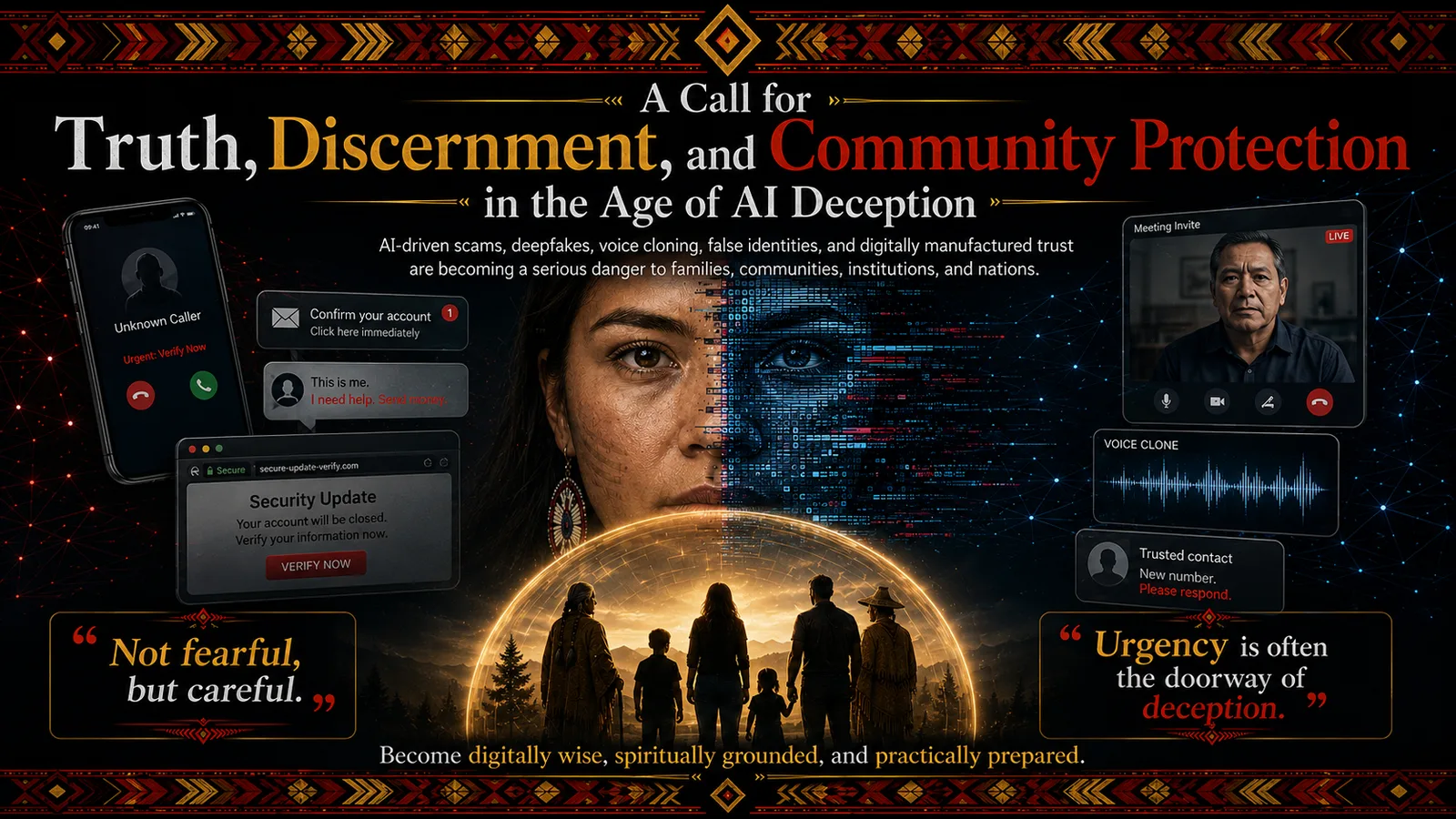
The rising epidemic of AI-driven scams, deepfakes, voice cloning, fake websites, false identities, and digitally manufactured trust is a serious warning to all peoples, communities, families, institutions, and nations. We are entering a time when voices, faces, images, documents, videos, social media profiles, emails, websites, and even trusted relationships can be copied, manipulated, and weaponized for deception.
A person may appear to be a family member. A voice may sound like a relative in distress. A video call may appear to include trusted leaders, colleagues, or officials. A website may look official. A message may appear urgent, personal, and convincing. But beneath these appearances there may be a carefully designed deception. This means we must become very careful: not fearful, but careful; not suspicious of everyone, but wise, grounded, awake, and prepared.
Recent reporting on the Gallup and Stop Scams Alliance study, United States of Scams: The Financial and Emotional Fallout, estimates that 6% of U.S. adults, roughly 15 million people, were scammed out of money in 2025, with total losses estimated at $68 billion. The same study reports that 12% of successful scams involved AI or deepfakes, while warning that this number may understate the real scale because many victims cannot recognize when artificial intelligence has been used.
This is not only about stolen money. It is an attack on human trust. It is a matter of families being frightened, elders being targeted, workers being pressured, leaders being impersonated, and communities being confused. It is a matter of emotional harm, shame, isolation, anxiety, grief, and the loss of confidence that people need to live together in a good way.
Gallup reports that nearly three-quarters of scam victims experienced a negative effect on their mental health or well-being, showing that scams are not simply financial crimes. They are also wounds to the heart, the family, and the spirit of community trust. For this reason, our response must never be blame or shame. Our response must be compassion, education, protection, and healing.
We must understand clearly what is happening. These new scams are not only about technology. They are about manufacturing false trust. The machine may create the face, voice, image, or message, but the real target is the human heart and mind. The scammer wants the victim to feel urgency, fear, loyalty, shame, secrecy, love, duty, or obedience. The deeper attack is not only on our bank accounts. It is on our ability to know what is true.
One of the clearest warnings came through the 2024 Arup case. A finance worker in Hong Kong was reportedly deceived into transferring about $25 million after joining a video call where the people appearing to be company leaders were not real, but AI-generated deepfakes. Arup later confirmed that fake voices and images were used, while saying its internal systems were not compromised and its financial stability was not affected.
This example teaches us something very important. The danger is no longer only a suspicious email with poor spelling. The danger can now appear as a familiar face, a familiar voice, a professional meeting, a trusted title, or a realistic video call. In this new digital world, seeing is no longer enough to believe. Hearing is no longer always believing. Even a familiar face on a screen may not be enough.
Therefore, we must develop a new culture of sacred discernment. Sacred discernment means we slow down before we act. It means we do not let fear, urgency, secrecy, or pressure control our decisions. It means we ask questions. It means we consult with trusted people. It means we verify through more than one channel. It means we protect our elders, our youth, our families, our organizations, our spiritual communities, our councils, and our resources.
From this point forward, every family, organization, council, business, school, and community network needs simple protection protocols. Any request involving money, passwords, private documents, personal information, banking details, gift cards, wire transfers, cryptocurrency, emergency help, legal threats, government claims, or confidential action must be independently confirmed before anyone responds.
If a relative calls saying they are in trouble, call them back through a trusted number already saved in your phone. If a leader or colleague sends an urgent request for money, confirm it through a separate communication channel. If a bank, government office, delivery company, technology company, or charity asks for information, do not use the link they sent. Go directly through a known official pathway. If a message says, “Do not tell anyone,” that is a warning sign. If a message creates panic, shame, or pressure, slow down immediately.
We must teach our people a simple principle: Urgency is often the doorway of deception. Real truth can withstand verification. Real relatives can wait for confirmation. Real institutions can follow proper procedures. Real leaders will not be offended when we protect the community by checking carefully. Anyone who pressures us not to verify is already showing us that something may be wrong.
We also need to remove shame from this conversation. Many intelligent, loving, educated, and spiritually sincere people have been deceived. Scammers are becoming highly skilled at studying human behavior, using technology, exploiting trust, and creating emotional pressure. When someone is harmed, we must not blame them. We must surround them with compassion, help them report what happened, help them protect their accounts, and help them recover their confidence.
This is especially important for elders. Many elders have spent their lives trusting the sound of a human voice, the image of a human face, and the sincerity of direct communication. They must not be mocked or dismissed for being vulnerable in a world that has changed so quickly. They must be honored, protected, and supported with patience.
This is also important for youth. Our young people live much of their lives in digital spaces. They need to understand that not every image, message, profile, opportunity, friendship, investment, emergency, or romantic expression online is real. They need tools, not fear. They need discernment, not paranoia. They need adults who can guide them without shaming them.
Communities should begin holding digital safety circles where people can learn together. These circles can teach how scams work, how deepfakes are used, how voice cloning operates, how fake websites collect information, how emotional manipulation works, and how to verify before responding. The purpose is not to make people afraid of technology. The purpose is to make people wise.
We must also recognize that artificial intelligence itself is not the enemy. Like fire, it can warm the lodge or burn it down. Like language, it can tell the truth or spread lies. Like any powerful tool, it reflects the spirit, ethics, and intention of those who use it. The danger is not intelligence itself. The danger is intelligence without conscience, power without responsibility, technology without moral foundation, and communication without truthfulness.
That is why the answer cannot be technology alone. Detection tools may help, but they will never be enough on their own. The deeper protection must be relational, moral, spiritual, and procedural. We need strong relationships. We need trusted channels. We need community education. We need agreed-upon verification steps. We need humility. We need patience. We need truthfulness. We need consultation. We need the courage to pause before acting.
In this age of artificial intelligence, our greatest protection will be truth, discernment, unity, and wise procedure. We must teach one another not to be rushed, not to be shamed, not to be isolated, and not to act under panic. We must teach one another not to trust only what we see, not to trust only what we hear, and not to send money or information without independent confirmation.
We must also teach one another not to remain silent if harm has occurred. Ask. Verify. Consult. Report. Protect one another. These simple words can become a shield for families, elders, youth, organizations, and communities.
This danger won’t decrease. It is going to increase. The tools of deception are becoming cheaper, faster, more convincing, and more widely available. But we are not helpless. We can become wiser. We can become more united. We can build stronger safeguards. We can teach our families. We can protect our elders. We can prepare our youth. We can strengthen our councils, organizations, and communities.
The path forward is not fear. The path forward is awakened responsibility. Let this be a call to all our relatives: become digitally wise, spiritually grounded, emotionally steady, and practically prepared. Let us investigate truth for ourselves. Let us confirm carefully. Let us protect one another. Let us build a culture where deception has less room to grow because our relationships are strong, our procedures are clear, and our hearts are rooted in truth.
In this time of artificial voices and manufactured images, let us become more deeply human. In this time of false appearances, let us walk in truth. In this time of digital deception, let us strengthen the sacred trust between us.